
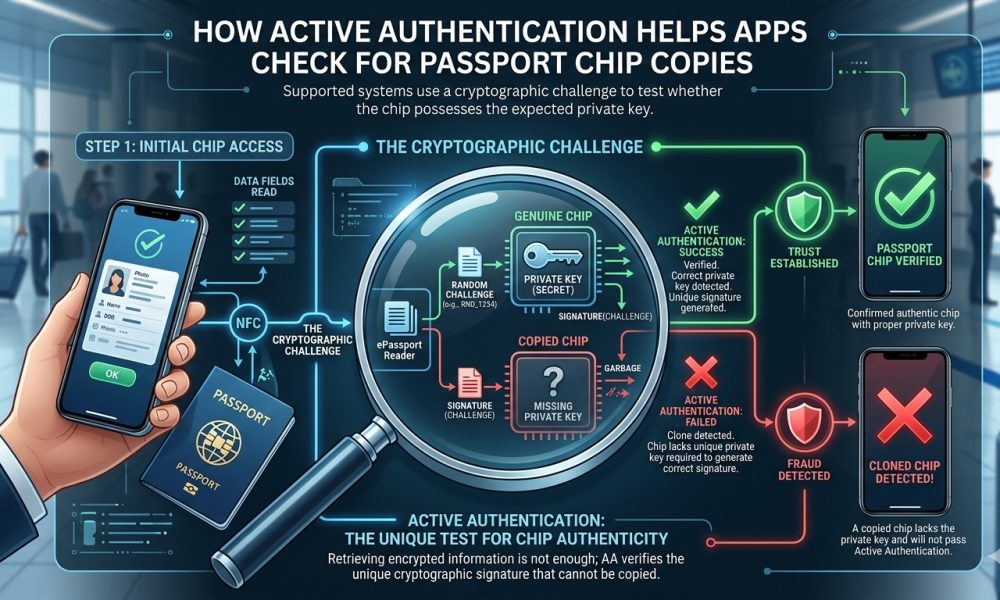
Supported systems use a cryptographic challenge to test whether the chip possesses the expected private key.
WASHINGTON, DC, October 5, 2026, A passport reader can retrieve electronically signed information from a contactless chip without necessarily proving that the physical chip is the original one personalized with the passport, which is why electronic travel-document standards include additional cryptographic mechanisms designed specifically to address the possibility of copied chip data.
Active Authentication provides one such mechanism by requiring a supported electronic passport chip to respond correctly to a fresh cryptographic challenge using a private key that should remain securely stored inside that particular chip, allowing a capable inspection system to test something that ordinary data retrieval and Passive Authentication cannot establish independently.
Passive Authentication and Active Authentication Answer Different Questions
Passive Authentication primarily lets an inspection system determine whether electronically stored passport information remains consistent with the data protected by the issuing authority’s digital signature. At the same time, Active Authentication addresses the additional question of whether the genuine contactless chip associated with the physical travel document is supplying that authenticated information.
This distinction matters because an attacker who can copy readable electronic information from one passport chip to another compatible device could reproduce signed data without possessing the private cryptographic secret embedded in the original chip, meaning a valid signature alone does not necessarily show that the electronic information resides on its original hardware.
The international security architecture described in ICAO Doc 9303 therefore treats Active Authentication as a challenge-response mechanism that lets an inspection system test whether the contactless integrated circuit possesses the private key corresponding to an authenticated public key stored within the passport’s protected electronic data.
The Private Key Is What Makes the Test Different
An electronic passport supporting Active Authentication contains a dedicated cryptographic key pair: a public key that can be made available to the inspection system and a corresponding private key intended to remain securely protected within the passport chip, rather than becoming readable like ordinary passport data.
The public portion of that Active Authentication key is stored within Data Group 15. At the same time, the passport’s Document Security Object protects a cryptographic representation of that data group, allowing Passive Authentication to verify that the public key belongs to the electronically signed information created during the issuing process.
The corresponding private key remains inside secure chip memory. It should not be exportable during ordinary reading, which forms the basis of an anti-copying test because reproducing visible data, photographs, document numbers, certificates, and other readable information does not automatically reproduce the protected private key needed to answer the challenge correctly.
The Reader Sends a Fresh Cryptographic Challenge
When Active Authentication begins, the inspection system generates a fresh unpredictable value. It sends that challenge to the passport chip, which must then perform the required cryptographic operation using its protected private key before returning a response that the inspection system can verify using the authenticated public key.
Because the challenge changes from one Authentication session to another, simply recording a previous successful exchange should not provide a copied chip with everything necessary to answer a new challenge, since the expected response depends upon cryptographic operations performed with the private key retained inside the genuine chip.
ICAO specifies that the inspection system generates a nonce, transmits that challenge through the appropriate Authentication command, and verifies the resulting cryptographic response, directly testing whether the chip participating in the session can demonstrate possession of the private key corresponding to the authenticated public key.
Why Copying the Stored Data Is Not Enough
A straightforward electronic copy can reproduce information that is readable from a passport chip, including biographical data, a facial Image, certificates, signed security objects, and other accessible structures, but copying those files does not necessarily provide access to cryptographic secrets protected within secure hardware.
This limitation is exactly what makes Active Authentication valuable, because a copied chip may be able to present electronic information that looks identical to information retrieved from the original passport while still failing when asked to perform a cryptographic operation that requires possession of the protected original private key.
Germany’s Federal Office for Information Security describes the related anti-cloning principle used by chip-authentication systems, explaining that chip-specific private keys remain protected. In contrast, readers use cryptographic protocols to determine whether the chip actually possesses the expected secret rather than merely presenting copied information.
Passive Authentication Normally Comes First
Active Authentication depends on trust established elsewhere in the electronic passport architecture, because an inspection system needs confidence that the public key it uses to verify the challenge response has not been substituted by someone attempting to create a fraudulent chip with an entirely new key pair.
Passive Authentication provides that Protection by authenticating the hash associated with Data Group 15 through the issuer-signed Document Security Object, meaning the inspection system can establish that the Active Authentication public key corresponds with information protected through the legitimate passport-signing process before relying upon that public key during the challenge-response test.
This relationship shows why electronic passport security operates through interconnected layers rather than independent green checkmarks: Passive Authentication establishes the integrity and signed origin of protected electronic information. At the same time, Active Authentication provides evidence that the authenticated information came from the genuine chip possessing the associated secret key.
A Successful Test Provides Strong Anti-Copying Evidence
When the authenticated public key is trustworthy, and the chip correctly answers a fresh challenge using the corresponding protected private key, the inspection system gains strong cryptographic evidence that it is communicating with the chip associated with the electronically signed passport information rather than a simple duplicate containing only copied readable data.
ICAO describes a successful Active Authentication challenge-response procedure as demonstrating that the Document Security Object belongs with the physical document and that the contactless integrated circuit is genuine, provided the preceding Authentication steps and comparisons required by the protocol have also been completed correctly.
That result is substantially different from merely opening a passport chip with an NFC-enabled smartphone, because ordinary chip access proves only that a device responded and supplied information. At the same time, Active Authentication requires the electronic component to demonstrate possession of a cryptographic secret that should not be obtainable through normal reading.
Not Every Passport or Reader Uses Active Authentication
Users should not assume every electronic passport supports Active Authentication or that every smartphone Application performs it, because electronic travel documents have evolved through several generations of security protocols, and issuing countries can implement different combinations of standardized mechanisms depending on document generation, national policy, and technical design.
ICAO’s current framework also defines Chip Authentication, which uses a different cryptographic approach and can provide both chip Authentication and strong session keys, reflecting the continuing development of electronic passport security beyond the earlier Active Authentication mechanism used by many generations of travel documents.
The absence of an Active Authentication result should therefore be interpreted according to the passport’s supported security capabilities rather than automatically treated as evidence of a problem, since some documents may rely upon alternative mechanisms. At the same time, some consumer applications may not support the relevant protocol.
A Green Active Authentication Result Has a Specific Meaning
When an Application clearly reports successful Active Authentication, the result should generally be understood as evidence that the electronic chip successfully demonstrated possession of the private key corresponding with the authenticated Active Authentication public key, rather than as an all-purpose declaration that every component of the passport has passed every possible Authenticity test.
The result does not independently establish that the passport remains valid in the issuing government’s current records, that the document has not been reported lost or stolen, that the person presenting it is the lawful holder, or that every physical security characteristic of the booklet is genuine.
Those questions require other verification layers, including physical document examination, comparison of visible and electronic personalization, biometric holder matching, trusted certificate validation, and access to appropriate governmental or law-enforcement databases when those systems are lawfully available to the organization conducting the examination.
Failed Active Authentication Also Requires Interpretation
A failed challenge-response procedure can strongly indicate a need for further investigation when the passport and reader should support the protocol. Still, technical failures involving NFC communication, Application implementation, unsupported cryptographic algorithms, damaged chips, incomplete preceding Authentication, or software compatibility can also affect how an Application reports the result.
Professional examination should consequently identify exactly which cryptographic stage failed and determine whether the failure can be reproduced under appropriate conditions before concluding that a passport chip has been copied, substituted, damaged, or otherwise compromised.
The same disciplined approach applies to successful results, because Authentication technology is most useful when examiners understand precisely what each protocol establishes, rather than interpreting every green indicator as a universal guarantee covering physical Authenticity, governmental validity, biometric identity, and electronic integrity simultaneously.
Modern Passport Security Depends on Layered Verification
As Amicus International Consulting has explained in its examination of passport security, modern travel documents rely on multiple overlapping protections, including specialized materials, secure printing, optical features, electronic signatures, biometric information, cryptographic Authentication, and database checks designed to detect different forms of manipulation or misuse.
Passive Authentication can establish whether protected electronic information remains consistent with an issuer’s signed data. At the same time, Active Authentication can add evidence that the information comes from the expected physical chip, illustrating how separate cryptographic mechanisms strengthen one another when an inspection system applies them correctly.
For investigators, compliance professionals, identity-verification specialists, financial institutions, border authorities, and consumers using technically capable passport applications, understanding this difference prevents the successful reading of copied electronic information from being mistaken for proof that the device supplying that information is necessarily the original passport chip.
Active Authentication ultimately addresses a precise but important security question by asking the passport chip to prove possession of a protected private key, giving supported inspection systems a cryptographic method for distinguishing genuine chip possession from the comparatively simpler act of copying readable electronic passport information.




