
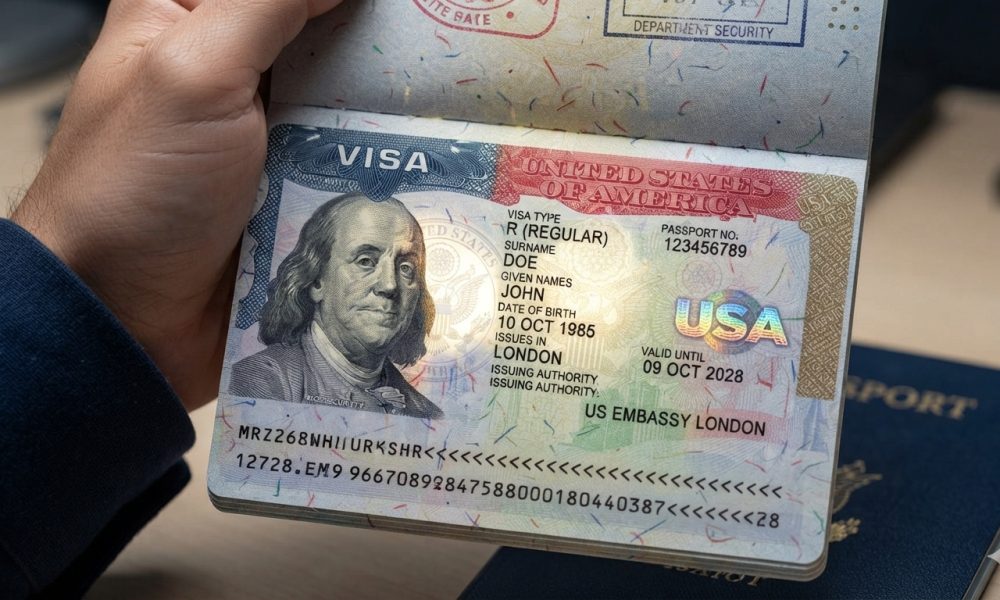
Watermarks, embedded fibers, and specialized printing help protect visa pages against substitution, reproduction, and other forms of document manipulation.
Washington, DC, October 3, 2026 — Although the identity page usually receives the most attention during passport inspection, the paper used throughout the rest of the booklet can contain sophisticated security features that help authorities determine whether pages have been substituted, reproduced, removed, or otherwise manipulated.
Modern passport security therefore extends well beyond the photograph, machine-readable zone, and electronic chip, because governments deliberately construct visa pages with specialized paper, embedded materials, controlled printing techniques, and coordinated designs that give inspectors additional opportunities to recognize suspicious inconsistencies.
These protections matter because passport booklets may remain valid for many years, receive immigration stamps and visas from numerous jurisdictions, and undergo substantial physical handling while still needing to preserve evidence that their original construction remains intact.
Security Paper Is Different From Ordinary Commercial Paper
Passport paper is manufactured under controlled conditions using specifications designed for secure government documents, meaning its composition, appearance, and embedded characteristics can differ considerably from the ordinary paper commonly used by offices, commercial printers, and consumer printing equipment.
Rather than relying exclusively on visible artwork printed after manufacturing, security paper can incorporate protective elements during production, creating characteristics that become part of the sheet itself and are therefore much harder to reproduce convincingly through scanning or Photocopying.
These embedded properties allow inspectors to examine not only what has been printed onto a passport page but also whether the underlying paper behaves and appears consistently with materials expected from the issuing country and the specific document generation process.
A counterfeit page might reproduce visible artwork reasonably well while still displaying incorrect thickness, texture, fluorescence, opacity, or embedded features, giving trained inspectors important indicators that the page may not originate from the legitimate passport production process.
For this reason, physical passport examination remains relevant even as electronic Authentication becomes increasingly sophisticated, because a digital chip can provide important information about stored passport data without independently establishing that every physical page inside the booklet remains original.
Watermarks Become Part of the Paper During Manufacturing
Traditional watermarks remain an important security feature because they are generally produced during paper manufacturing. At the same time, the paper itself is being manufactured rather than being printed onto a finished sheet using conventional ink or toner.
Variations in paper thickness create lighter and darker areas that become visible when the page is viewed against transmitted light, allowing detailed images, symbols, letters, or repeating patterns to appear within the material itself.
A genuine watermark can therefore display tonal depth, gradual transitions and structural characteristics that may be difficult to reproduce accurately using ordinary printing, especially when a counterfeit attempt relies upon surface graphics intended merely to imitate the appearance of a true embedded feature.
Inspectors examining a suspected document can compare thewatermark’ss position, dimensions, orientation, and tonal characteristics with known examples, while also checking whether similar features appear consistently throughout other pages of the same passport booklet.
The International Civil Aviation Organization’s travel document program maintains the broader international standards governing machine-readable travel documents, providing a technical framework for secure, interoperable passports used across international borders.
Embedded Fibers Create Randomized Security Characteristics
Security paper can also contain visible or fluorescent fibers introduced during manufacturing, creating small colored or ultraviolet-reactive elements distributed throughout individual pages before the passport booklet is assembled and personalized.
Because these fibers embed in the paper rather than print on its surface, their appearance under ordinary or ultraviolet illumination can help distinguish authentic passport stock from commercial paper used in attempted page substitution.
Some fibers may remain visible under normal lighting. In contrast, others respond primarily to ultraviolet illumination, enabling inspectors to evaluate characteristics that travelers might never notice during ordinary handling of their documents.
The random distribution of embedded fibers can also make precise duplication harder because counterfeiters must reproduce not just a repeated printed pattern, but the appearance of individual materials physically incorporated within the paper structure.
When a suspected replacement page shows fibers that appear printed rather than embedded, react incorrectly under ultraviolet illumination, or differ significantly from surrounding pages, those inconsistencies can provide grounds for closer examination.
Ultraviolet Features Reveal Designs Invisible in Normal Light
Passport visa pages frequently contain artwork, symbols, fibers, or patterns that become visible or change appearance under ultraviolet illumination, creating a secondary visual environment that trained inspectors can compare against known genuine documents.
These ultraviolet characteristics may extend across multiple pages, incorporate national symbols, or interact with ordinary visible printing, giving inspectors another way to determine whether a suspicious page belongs in the original passport booklet.
A counterfeit page may look convincing under normal office lighting while showing incorrect fluorescence, missing ultraviolet artwork, or unexpected reactions from paper brighteners commonly found in ordinary commercial paper products.
Specialized security paper can be manufactured to control these reactions, allowing governments to create predictable ultraviolet behavior that differs from many readily available papers and therefore provides another useful examination characteristic.
Authorities can evaluate these features alongside photographs, machine-readable information, chip data and other security elements, reinforcing the principle that passport Authentication depends upon multiple independent observations rather than one supposedly decisive feature.
Specialized Printing Protects the Entire Booklet
Governments also use sophisticated printing methods across passport pages, including fine-line patterns, intricate Background designs, microprinting, and other graphics that are difficult to reproduce accurately with conventional scanning, Photocopying, or desktop printing equipment.
Complex Background patterns may use extremely thin lines, tightly controlled spacing, and precisely registered colors, meaning even relatively small reproduction errors can produce blurring, broken lines, unwanted color shifts, or other abnormalities visible under magnification.
Microprinting can place extremely small text or design elements within borders, lines, or decorative features, creating details that may appear as a thin line to the unaided eye but become readable under magnification.
When ordinary printing equipment tries to reproduce such features, tiny letters may merge, lose definition, or become irregular, allowing document examiners to distinguish legitimate high-security printing from lower-resolution reproduction techniques.
These techniques are particularly effective when combined with specialized paper because counterfeiters must reproduce both the underlying substrate and the complex artwork applied to it, significantly increasing the number of characteristics that must remain consistent.
Page Numbering Helps Reveal Substitution
Many passports include printed, perforated, laser-created, or otherwise incorporated page numbers that allow authorities to confirm the expected sequence and identify situations in which pages may have been removed, replaced, or reorganized.
When numbering interacts with Background artwork or other security features, replacing an individual page becomes considerably more complicated because the substitute must maintain the correct numerical sequence while also matching surrounding designs, paper characteristics, and manufacturing details.
Inspectors may therefore examine whether page numbers display consistent typography, alignment, production technique and position throughout the booklet, especially when physical damage or irregular binding suggests that a page may have been disturbed.
A replacement page that appears generally similar to its neighbors may still reveal itself through subtle differences involving numbering, printing density, ultraviolet response, fiber distribution, perforation quality or the relationship between graphics and binding.
These observations show why passport inspection often involves examining several pages rather than focusing exclusively on the photograph page, especially when authorities suspect document manipulation or unusual travel-document construction.
Binding and Stitching Add Another Security Layer
How passport pages are assembled can provide important evidence of whether the booklet remains in its original condition, because governments use controlled binding methods intended to resist undetectable page removal and replacement.
Security thread, stitching patterns, page alignment, and the relationship between folded sheets can all help inspectors determine whether the booklet has been opened, restitched, or reconstructed after its original manufacture.
Removing one visa page can affect neighboring pages because passport booklets are commonly assembled from folded sheets rather than individual pages inserted independently, so an apparently isolated alteration can disturb several related components.
An examiner noticing unusual thread tension, inconsistent stitch spacing, damaged perforations, or misaligned pages may therefore investigate whether the booklet has been manipulated rather than assuming visible wear resulted solely from normal travel.
Travelers can learn more about how these physical features complement electronic verification in the Amicus International Consulting guide, which explains how modern passports use multiple security layers to protect identity.
Visa Pages Can Help Establish Document Continuity
Visa pages also create a historical record of how a passport has been used, because immigration stamps, visas, entry endorsements and other authorized markings accumulate throughout the booklet during legitimate international travel.
Although previous travel history does not independently establish passport authenticity, inconsistencies involving page sequence, printing characteristics, stamps or visas can encourage inspectors to examine whether parts of the booklet have been substituted or reconstructed.
Authorities may compare the physical condition of neighboring pages, looking for unexplained differences in aging, discoloration, texture, edge wear, or printing quality that could indicate that one sheet entered the booklet at a different time.
A newly inserted page within an otherwise heavily used passport might display noticeably different wear characteristics. At the same time, a substituted page may also fail to align precisely with the dimensions or binding position of surrounding original material.
These indicators remain contextual rather than conclusive, but professional document examination often depends on identifying several small inconsistencies whose combined significance outweighs any single observation considered in isolation.
Security Designs Often Continue Across Adjacent Pages
Passport designers can also use artwork that extends across facing pages, creating continuous patterns, illustrations or thematic elements that help authorities recognize whether a page has been removed or replaced with material from another source.
If an Image, line, or pattern should continue seamlessly across the center of the booklet, even slight alignment errors can become visible when an inserted page does not correspond precisely with the neighboring sheet.
This technique can provide particularly useful Protection because a fraudulent replacement must reproduce not only the appearance of one isolated page but also its exact relationship with pages manufactured and assembled alongside it.
Cross-page designs can work together with page numbering, ultraviolet artwork, perforations and embedded materials, creating a collection of mutually reinforcing features that become increasingly difficult to reproduce without access to the original production environment.
Government document specialists can also consult resources such as the European Union’s Public Register of Authentic Identity and Travel Documents Online, commonly known as PRADO, which provides reference information about security features found in many genuine identity and travel documents.
Ordinary Photocopying Cannot Reproduce Every Security Layer.
One important purpose of security paper is to ensure that a simple photograph, scan,n or photocopy captures only part of the information required to reproduce a convincing passport page.
A scanner may capture visible colors and artwork but fail to replicate embedded fibers, genuine watermarks, ultraviolet behavior, paper texture, specialized inks, or characteristics created during controlled manufacturing rather than ordinary printing.
Even high-resolution digital images therefore show only a document’s visible appearance under particular conditions, which is why professional passport assessment generally requires examining the physical document when questions about authenticity become significant.
Digital document analysis can identify certain inconsistencies or alterations within an Image file. Still, it cannot physically inspect page construction, feel material texture, observe genuine transmitted-light behavior, or independently confirm every characteristic embedded within the original security substrate.
For this reason, authorities combine digital tools with traditional document examination techniques rather than treating electronic analysis as a complete replacement for physical inspection.
Physical and Electronic Security Perform Different Functions
An electronic passport chip and security paper protect different components of the travel document, which means successful verification of one should not automatically be interpreted as complete verification of the other.
The chip can contain digitally signed information linked to the passport holder. At the same time, security paper helps protect the physical integrity of visa pages and provides evidence of whether the booklet itself has been altered.
A document might therefore contain electronically readable information while still presenting suspicious physical characteristics elsewhere, just as an apparently convincing booklet might require additional investigation if electronic Authentication produces inconsistent results.
Border authorities gain the strongest assessment when physical booklet examination, chip Authentication, facial comparison, machine-readable information, and relevant database checks all produce results that support the same document and identity.
This layered architecture reduces dependence upon any single security mechanism and increases the likelihood that manipulation affecting one component will create inconsistencies detectable through another independent examination method.
Security Paper Remains Relevant in a Digital Border Environment
As airports introduce automated border gates, biometric kiosks, and increasingly sophisticated electronic document readers, traditional security paper may seem less important than cryptography and facial recognition. However, the physical passport booklet still plays an essential Authentication role.
Electronic systems can determine whether digitally stored information satisfies particular cryptographic checks. Still, physical examination helps determine whether the booklet containing that electronic component displays the materials and manufacturing characteristics expected from an authentic government-issued document.
Security paper therefore functions as part of a broader defensive system rather than as an outdated feature from the pre-electronic passport era, providing independent evidence that remains useful during manual inspections, secondary examinations and investigations involving suspected document manipulation.
Watermarks, embedded fibers, ultraviolet designs, specialized printing, controlled numbering, and secure binding collectively make passport pages harder to substitute or reproduce without creating visible, tactile, or optical inconsistencies.
Modern passport security works precisely because these features overlap, ensuring that authorities can examine not only who appears on the identity page, but also whether the entire booklet presents a coherent physical and digital record consistent with legitimate government issuance.




