
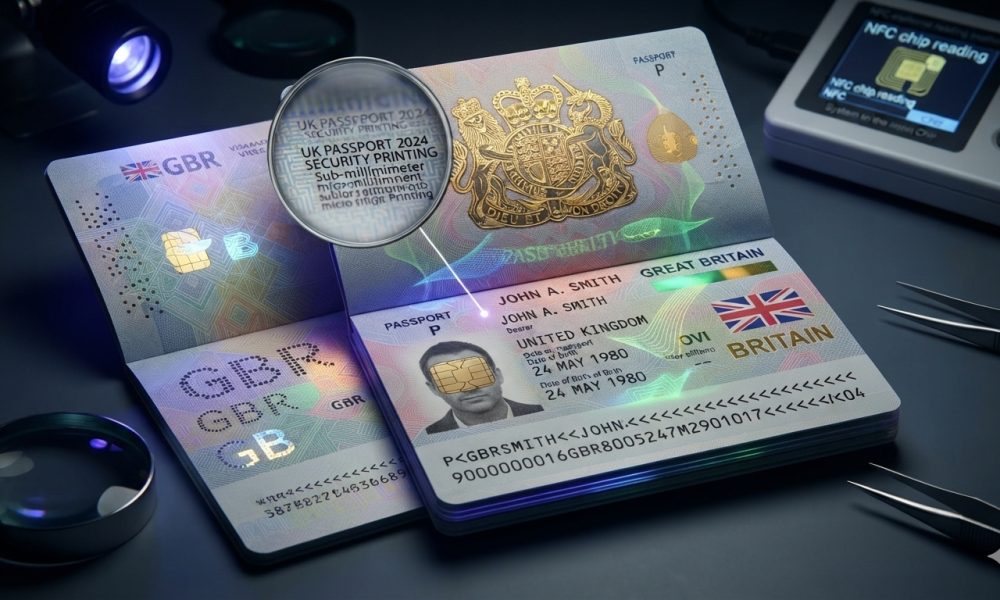
Specialized paper, embedded fibers, and watermarks provide safeguards that extend beyond the main identity page.
WASHINGTON, DC, October 1, 2026 — When travelers examine a modern passport, most attention naturally focuses on the identity page containing theholder’ss photograph, name, nationality, passport number, and other personal information, yet the ordinary-looking visa pages that follow can contain an extensive network of security features designed to expose alteration, substitution, counterfeiting, and unauthorized reproduction.
Those pages serve an obvious practical purpose by providing space for visas, immigration stamps, entry endorsements, residence permissions, and border-control markings, but governments also use them as part of the document’s overall security architecture.
Modern passport booklets rely on multiple overlapping protections because counterfeiters may target more than the identity page, and authorities need ways to determine whether every part of the booklet belongs to the same document the issuing government originally produced.
Specialized paper, watermarks, security fibers, ultraviolet-reactive features, complex Background printing, perforations, page numbering, and other manufacturing characteristics can all help document examiners identify inconsistencies that may indicate replacement pages or unauthorized reconstruction.
Visa Pages Are Part of the Passport Security System
A passport functions as a complete document, not simply a holder for one secure identity page.
The booklet construction, cover, stitching, data page, electronic components, visa pages, printing, page sequence, and security patterns can all contribute to an examiner’s assessment of whether the passport remains intact.
Someone attempting to manipulate a passport could theoretically focus on pages containing immigration history, visas, entry refusals, residence endorsements, or other information that the traveler would prefer to remove or conceal.
For that reason, governments design visa pages so they can’t be easily replaced with ordinary paper without creating visible or forensic inconsistencies.
An examiner who understands the expected characteristics of a particular passport model can compare suspect pages with authentic examples and assess whether paper composition, printing methods, watermarks, ultraviolet reactions, dimensions, numbering, or binding match the document’s official specifications.
Security Paper Is Different From Ordinary Printing Paper
Passport visa pages generally use specially manufactured security paper rather than conventional commercial paper.
Manufacturers can control the paper’s fiber composition, weight, thickness, texture, opacity, chemical characteristics, fluorescence, and physical response to different examinations.
Those characteristics help distinguish legitimate pages from substitutes produced with office paper, commercial stationery, or even high-quality specialty printing stock.
Security paper can also react differently under ultraviolet or transmitted light, providing features that remain largely invisible during ordinary use but become apparent when an inspector examines the passport using specialized equipment.
These physical properties are difficult to reproduce accurately because successful imitation would require more than copying the visible artwork printed on the page.
Watermarks Provide Security Within the Paper Itself
Watermarks remain one of the oldest and most effective ways to protect high-value documents because the Image forms during the paper manufacturing process rather than being printed afterward.
When an examiner holds a passport page against transmitted light, a genuine watermark can appear as variations in paper thickness that create lighter and darker regions.
Governments may use national symbols, coats of arms, portraits, geometric designs, repeating motifs, or combinations of several elements within these watermarks.
A high-quality watermark contains tonal variation and depth that ordinary printing can’t simulate convincingly.
Counterfeiters sometimes attempt to reproduce watermark-like images using ink, chemical treatments, or digital printing. Still, those imitations may behave differently under transmitted light because they sit on or near the paper surface instead of existing within its physical structure.
Embedded Fibers Add Another Layer of Authentication
Security paper may contain fibers introduced during manufacturing, allowing manufacturers to distribute tiny colored or fluorescent strands throughout the material.
Some fibers remain visible under normal light, while others appear only under ultraviolet illumination.
Because manufacturers introduce these fibers during paper production, their distribution becomes naturally irregular, making exact replication difficult.
The presence, color, length, fluorescence, density, and positioning of these fibers can provide useful information during document examination.
A counterfeit page made with ordinary commercial paper may contain none of these features or may try to imitate them through surface printing.
Under magnification or ultraviolet examination, those imitations can often appear substantially different from fibers physically embedded within authentic security paper.
Ultraviolet Features Can Reveal What Normal Light Cannot.
Many passport visa pages contain features designed specifically for examination under ultraviolet light.
Under normal illumination, a page may display decorative national imagery, geometric patterns, or relatively subdued colors, but under ultraviolet light, additional designs, symbols, fibers, numbers, or text may become visible.
These features allow inspectors to perform a rapid second-level examination without damaging the document.
Modern document inspection systems often include ultraviolet illumination because the technique can reveal differences invisible to the unaided eye.
A counterfeit page may reproduce the visible artwork accurately while failing to replicate the correct ultraviolet response.
Even genuine paper exposed to chemicals, excessive heat, washing, or other forms of manipulation can sometimes produce abnormal reactions that prompt further examination.
Background Printing Is More Complex Than It Appears
The decorative patterns on passport visa pages often serve a security function in addition to providing national imagery.
Governments may use extremely fine lines, complex geometric structures, guilloche patterns, microprinting, variable line thicknesses, and precisely registered colors.
These designs can be challenging to reproduce with standard printers because digital copying can introduce broken lines, altered spacing, blurred microtext, incorrect color transitions, or visible pixel structures.
Original security printing may use specialized presses and carefully controlled inks that create details difficult to reproduce using ordinary commercial equipment.
Under magnification, an examiner may identify differences not immediately visible at normal viewing distance.
Microprinting Creates Detail That Copies Poorly
Microprinting involves text or patterns printed at such a small scale that they may appear to be ordinary lines without magnification.
Once enlarged, those lines can reveal letters, numbers, abbreviations, national mottos, or other repeating information.
Authentic microprinting generally stays sharp and consistent under proper magnification.
A scanned or photocopied reproduction may transform the tiny characters into irregular dots, blurred lines, or unreadable shapes.
Authorities use microprinting because it lets them place authentication details throughout a document without affecting normal readability.
The feature can appear on visa pages, identity pages, covers, laminates, and other document components.
Page Numbers Can Carry Security Information
Passport page numbers may appear simple, but issuing authorities can integrate them into broader security designs.
Numbers may be printed in special fonts, combined with Background graphics, incorporated into perforations, repeated through ultraviolet features, or linked to other page-specific elements.
Some passport designs gradually change imagery or colors from one page to the next, creating a continuous sequence throughout the booklet.
If someone removes one page and inserts another, inconsistencies in numbering, design progression, stitching, ultraviolet patterns, or paper characteristics may become apparent.
This sequencing helps authorities assess whether the booklet remains complete and whether every page originated from the same production process.
Perforations Can Link Pages to the Passport Number
Some passports use laser perforation to reproduce the document number through multiple pages of the booklet.
When held against a light source, the tiny perforations can form letters and numbers that correspond with information displayed elsewhere in the document.
These holes require precise positioning and consistent dimensions.
If pages have been replaced, added, removed, or rearranged, the perforation sequence may no longer align correctly.
Laser perforation therefore creates a physical connection between multiple passport components and the document’s identifying information.
It also gives border officers another feature they can quickly examine without access to electronic databases.
The Binding Can Reveal Page Replacement
Passport security extends beyond individual pages to the way the booklet is assembled.
Governments use controlled stitching, binding techniques, threads, adhesives, and cover structures designed to withstand years of handling while making unauthorized disassembly more apparent.
Removing a page can damage the stitching, disturb thread patterns, create enlarged holes, affect page alignment, or produce unusual tension in the binding.
An attempt to replace the removed page may leave further evidence because matching the original manufacturing process precisely can be difficult.
Document examiners may therefore inspect the center stitching, page edges, binding alignment, and surrounding material when they suspect physical alteration.
A passport with perfect-looking individual pages could still raise concerns if its binding does not correspond with authentic production characteristics.
Security Thread May Be Incorporated Into Passport Paper
Some high-security documents incorporate security threads within the paper itself.
These threads can contain text, metallic characteristics, fluorescent elements, or other features that become visible under specific examinations.
The principle resembles security features used in banknotes and other government documents.
Because the thread becomes part of the paper during manufacturing, replicating it accurately requires access to specialized production capabilities.
A printed line designed to imitate an embedded thread may look acceptable in ordinary light but behave differently under transmitted light or magnification.
Chemical Sensitivity Can Expose Attempts at Erasure
Security paper can also be engineered to react when exposed to chemicals commonly associated with document alteration.
An individual trying to erase ink, remove an immigration stamp, alter a handwritten entry, or dissolve part of a visa may use solvents or bleaching agents.
Certain papers and inks can respond to such chemicals by changing color, staining, fluorescing differently, or showing visible surface damage.
These reactions help examiners identify areas where someone may have attempted to alter the document.
The effectiveness of such protections depends on the specific passport design, and countries do not publicly disclose every security characteristic used in their travel documents.
Visa Pages Help Protect Immigration History
Visa pages do more than provide space because they can record a traveler’s movement across international borders.
Immigration authorities may place arrival stamps, departure stamps, visa stickers, residence permits, refusals, cancellation marks, or other official endorsements in the booklet.
Removing or replacing those pages could conceal travel history or regulatory information, which is why page-integrity protections matter.
However, modern border control increasingly relies on electronic records as well, meaning physical passport stamps may represent only one part of a traveler’s immigration history.
A missing stamp does not necessarily erase an entry from government systems because immigration agencies may retain electronic arrival, departure, visa, and identity records independently of the physical passport.
Visa Stickers Have Their Own Security Features
When a government places a physical visa sticker inside a passport, that visa often contains a separate set of protections.
Security printing, holographic devices, optical effects, ultraviolet features, microtext, serial numbers, photographs, barcodes, machine-readable information, and specialized adhesives may all appear within the visa itself.
Authorities can compare the visa with the passport to determine whether the personal information matches and whether the visa appears to have been transferred from another document.
Evidence of peeling, altered adhesives, damaged surrounding paper, inconsistent numbering, or incorrect placement can prompt additional scrutiny.
The passport page and visa sticker therefore function together as two related but independently protected government documents.
Border Officers Examine Patterns, Not Just Individual Features
Professional document inspection rarely depends on finding one single feature that proves authenticity.
Instead, inspectors consider whether the document’s characteristics collectively match what they expect from an authentic passport of that country, document type, and issuing period.
A passport may therefore undergo several levels of inspection.
An officer may begin with the booklet’s visible appearance, examine the photograph and machine-readable information, inspect visa pages, check ultraviolet features, scan the electronic chip, compare the traveler’s face with the stored Image, and query authorized databases.
If something appears inconsistent, the document may move to secondary inspection where specialists have access to more advanced equipment and reference material.
Electronic Passports Have Not Made Physical Security Obsolete
The rapid expansion of biometric passports has sometimes created the misconception that physical document security no longer matters because border systems can read the electronic chip.
In practice, physical and electronic security complement each other.
Electronic data helps authorities verify digitally signed information, while the physical document remains essential when the chip cannot be read, when an officer needs to evaluate booklet integrity, or when investigators need to determine whether pages have been manipulated.
Electronic components can also suffer physical damage, while the printed document may remain readable.
For that reason, governments continue investing in both physical and digital security rather than replacing one system entirely with the other.
Normal Wear Does Not Automatically Mean Tampering
Passport holders should also understand the distinction between ordinary wear and evidence of deliberate alteration.
Frequent travelers may develop bent page corners, faded stamps, minor surface dirt, creasing, damaged covers, or other signs of regular use.
These conditions do not automatically make a passport fraudulent.
However, extensive water damage, torn pages, damaged binding, separated components, unauthorized markings, missing pages, or alterations near identifying information can create difficulties during border inspection.
Travelers who discover serious physical damage should contact the appropriate passport authority before international travel rather than attempting repairs themselves.
Using adhesive tape, glue, lamination, replacement paper, or other home repairs can potentially interfere with security features and make legitimate damage appear more suspicious.
Why Photographs and Scans Cannot Show Every Security Feature
Digital photographs of passport visa pages can reveal some visible artwork but cannot reproduce every physical characteristic that document examiners evaluate.
Watermark depth, paper texture, embedded fibers, ultraviolet fluorescence, microscopic printing, transmitted-light effects, chemical responses, tactile elements, binding characteristics, and page thickness may require inspection of the original document.
For this reason, a high-resolution photograph should never be treated as equivalent to forensic examination of the actual passport.
Online verification services can provide certain analytical capabilities, but they generally operate without the complete physical document, proprietary government reference databases, or specialized inspection equipment available to authorities.
Every Passport Generation Can Be Different
Governments periodically redesign passports, so two legitimate passports from the same country may include different security features depending on the year of issue.
Older documents may rely more heavily on paper-based security and laminates. At the same time, newer generations may incorporate polycarbonate data pages, advanced holographic features, biometric chips, transparent windows, or additional laser-personalized elements.
Visa page artwork can also change between generations.
Authorities therefore need accurate reference information for the specific document version under examination rather than assuming that every passport from one country should look identical.
This is one reason specialist document databases and government reference collections remain important tools for border agencies.
Passport Security Works Through Redundancy
The strongest passport systems intentionally use redundant safeguards.
If one feature becomes compromised, other features can still help expose the manipulation.
A counterfeit visa page might reproduce the printed design but fail the watermark examination.
A page produced on specialized paper might contain an incorrect ultraviolet pattern.
A convincing ultraviolet pattern might still use inaccurate microprinting.
Even a highly sophisticated physical reproduction could contain electronic information that fails digital authentication or doesn’t match government databases.
This layered structure dramatically increases the technical complexity of convincingly imitating a modern passport.
Understanding the Difference Between Appearance and Authenticity
A document can look authentic without being genuine, while a genuine document can sometimes appear unusual because of age, wear, damage, or manufacturing variations.
For that reason, visual appearance should never serve as the only basis for determining whether a passport was lawfully issued.
Authenticity ultimately depends on the issuing authority and the official government records connected to the document.
Physical security features support that determination by helping officials identify whether the booklet corresponds with known legitimate production methods.
Electronic authentication, biometric comparison, database searches, and issuing-authority confirmation can provide additional evidence when questions arise.
Why Visa Page Security Still Matters
As border management becomes increasingly digital, visa pages may appear less important than biometric chips and automated facial recognition, yet they remain an integral part of passport security.
They help protect the document’s structural integrity, preserve records of official endorsements, expose page substitution, and give border authorities additional independent methods for evaluating a passport.
The security value comes not from one hidden fiber, watermark, ultraviolet Image, or printing technique, but from the way those features combine with the entire passport system.
At Amicus International Consulting, lawful international citizenship, residency, identity documentation, and cross-border planning require careful attention to the difference between official government issuance and a document’s superficial appearance.
Modern passports make that distinction especially clear because what appears to be a simple booklet is actually a multilayered security instrument in which the pages, materials, printing, electronics, and government records work together.
The visa pages may receive far less attention than the biometric identity page. Still, their specialized paper, embedded fibers, watermarks, printing techniques, perforations, and booklet construction provide another important defensive layer in the global effort to protect the integrity of international travel documents.




