
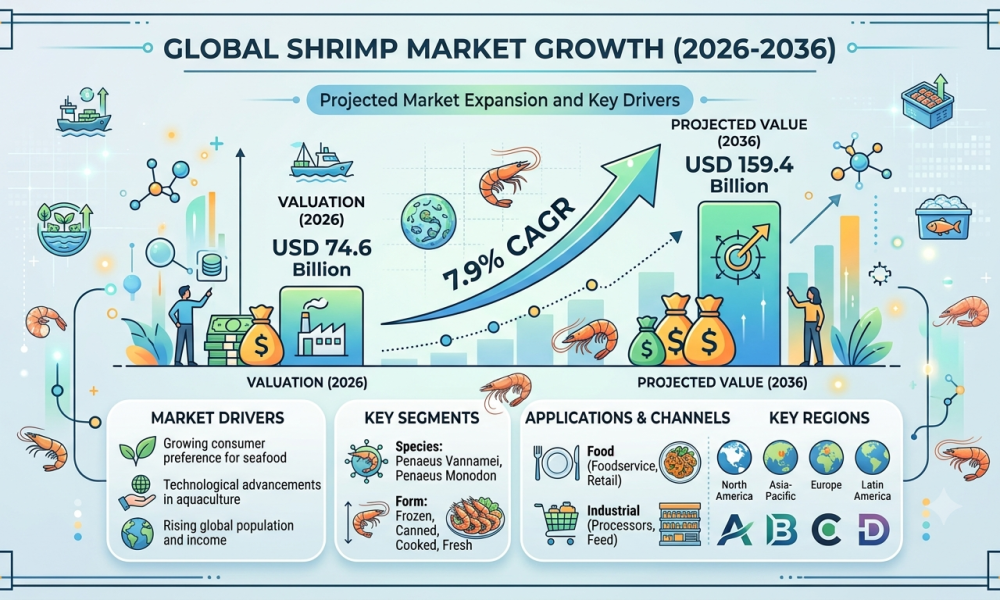
The global shrimp market is projected to grow from USD 74.6 billion in 2026 to USD 159.4 billion by 2036, registering a 7.9% CAGR during the forecast period. Demand is supported by expanding farmed shrimp production, standardized size grades, frozen seafood programs, retail and foodservice purchasing, and growing demand for convenient prepared formats. Farmed whiteleg shrimp is gaining importance as processors seek predictable harvest schedules and consistent commercial grades for recurring orders.
Frozen shrimp remains a key market format because it separates harvest timing from consumption and supports long-distance cold-chain distribution. Processors and importers can maintain size-graded inventory for retail and foodservice requirements, while peeled and prepared products create opportunities to generate higher value from existing shrimp volumes. Trade controls, tariffs, sanitary requirements, disease exposure, and feed costs remain important considerations for market participants.
Get detailed market forecasts, competitive benchmarking, and pricing trends: https://www.futuremarketinsights.com/reports/sample/rep-gb-1838
Global Segment Leaders
- Species – Farmed Whiteleg Shrimps: 43.4% in 2026. The segment leads due to scalable farm production and standardized commercial grades that support repeat retail and foodservice programs.
- Source – Conventional: 87.2% in 2026. Conventional shrimp benefits from broader origin availability and fewer segregation requirements, allowing retailers and importers greater sourcing flexibility.
- Form – Frozen: 44.5% in 2026. Frozen shrimp leads because of its extended shelf life and compatibility with long-distance cold-chain distribution. Importers can hold size-graded inventory and release products according to market demand.
- Sales Channel – Indirect: 40.4% in 2026. Indirect channels benefit from freight coordination and inventory aggregation, allowing importers and distributors to move shrimp from producing regions to concentrated retail and foodservice markets.
Country-Level Performance
The United Kingdom is projected to grow at the fastest pace among the profiled countries, with a 10.2% CAGR through 2036. Growth is supported by established supermarket and foodservice demand for frozen and chilled shrimp, while improved tariff economics for qualifying Indian prawns can create additional opportunities for contracted retail volumes.
Germany is forecast to record a 9.8% CAGR, supported by wholesalers supplying national grocery networks and established seafood distribution infrastructure. Shrimp remains among the key species handled through important German seafood hubs, while consistent pack specifications and dependable delivery remain important for retail programs.
The United States is projected to grow at a 9.3% CAGR, supported by broad retail demand and a deep import distribution network. Imported frozen warm-water shrimp remains important for retail and foodservice programs, while origin-specific duties can influence landed costs and sourcing decisions.
South Korea is expected to expand at an 8.9% CAGR, supported by mature refrigerated distribution, imported frozen shrimp supply, and established shrimp consumption across retail and foodservice channels. Convenience-oriented seafood portions also provide opportunities for processors targeting home-meal occasions.
Japan is forecast to grow at a 7.8% CAGR, supported by established frozen seafood demand and premium positioning for domestic prawns. Food-safety inspection requirements remain an important consideration for exporters seeking regular access to Japanese retail and foodservice channels.
Regional Context
The United Kingdom, Germany, and the United States represent the leading country growth group, with CAGRs of 10.2%, 9.8%, and 9.3%, respectively. Their markets benefit from established retail and foodservice distribution networks, imported shrimp programs, and demand for frozen and prepared formats.
South Korea and Japan represent additional mature Asian markets, with projected CAGRs of 8.9% and 7.8%. Refrigerated distribution, imported frozen supply, established seafood consumption, and premium product positioning support continued demand.
Across regions, farmed production is central to supply expansion. Farmed whiteleg shrimp provides repeatable size grades and scheduled harvest windows that help processors plan frozen seafood programs. At the same time, tariffs, trade remedies, sanitary controls, disease exposure, and feed costs can influence supply continuity and landed economics.
The full report covers North America, Latin America, Western Europe, Eastern Europe, East Asia, South Asia and Pacific, and the Middle East and Africa, with country-level analysis across major shrimp-producing and consuming markets.
Access full Report in PDF Format@ https://www.futuremarketinsights.com/reports/brochure/rep-gb-1838
Competitive Landscape
The competitive landscape includes Thai Union Group PCL, Charoen Pokphand Foods PCL, Minh Phu Seafood Corporation, Nueva Pescanova Group, Nissui Corporation, Avanti Feeds Limited, Apex Frozen Foods Limited, and Coastal Corporation Limited. Competition includes integrated shrimp producers, multinational seafood processors, and export specialists with freezing and prepared-product capabilities.
Market competition is shaped by farm access, processing capacity, traceability, cold-chain execution, destination-market approvals, product formats, and the ability to maintain consistent specifications across recurring retail and foodservice programs.
Thai Union Group PCL and Charoen Pokphand Foods PCL have integrated shrimp supply and processing operations serving retail and foodservice markets. Minh Phu Seafood Corporation and Nueva Pescanova Group participate across farming and processing activities, while Nissui Corporation and Indian processors such as Avanti Feeds Limited, Apex Frozen Foods Limited, and Coastal Corporation Limited compete through frozen preparation and international market access.
Analyst Perspective
“Shrimp programs earn better margins once processors control harvest timing and finished-form specifications before negotiating volume commitments. Commercial value rises further through traceable origins and cold-chain discipline because those controls protect buyer continuity during trade or disease disruptions.”
— Nandini Roy Choudhury, Principal Consultant, Future Market Insights
About Future Market Insights (FMI)
Future Market Insights, Inc. (ESOMAR certified, recipient of the Stevie Award, and a member of the Greater New York Chamber of Commerce) offers profound insights into the driving factors that are boosting demand in the market. FMI stands as the leading global provider of market intelligence, advisory services, consulting, and events for the Packaging, Food and Beverage, Consumer Technology, Healthcare, Industrial, and Chemicals markets. With a vast team of over 400 analysts worldwide, FMI provides global, regional, and local expertise on diverse domains and industry trends across more than 110 countries.



