
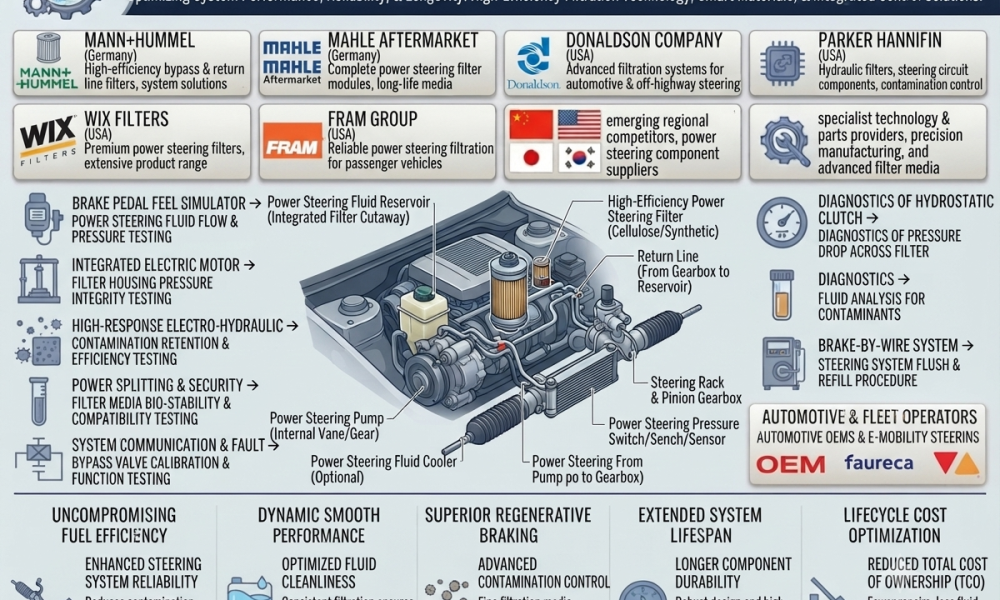
The global power steering filter market is projected to increase from USD 1.5 billion in 2026 to USD 2.4 billion by 2036, expanding at a 4.8% CAGR between 2026 and 2036. The market was valued at USD 1.4 billion in 2025. Demand is being supported by maintenance requirements for hydraulic and electro-hydraulic steering systems, particularly across the large installed base of passenger and commercial vehicles still using hydraulic steering architectures.
Power steering filter procurement is closely connected to vehicle maintenance schedules, fluid contamination management, and replacement requirements. Filters help remove contaminants from hydraulic steering fluid, supporting reliable operation of pumps, valves, steering gears, and other hydraulic components. Fleet maintenance managers and aftermarket buyers therefore evaluate filter media durability, fluid compatibility, vehicle-specific fitment, and replacement accessibility.
The installed base of hydraulic steering systems remains an important source of demand even as electric power steering adoption reduces the number of new hydraulic installations. Aging passenger vehicle fleets continue to require steering-system maintenance, while electro-hydraulic systems remain relevant in selected commercial vehicle applications where hydraulic assistance continues to support steering requirements.
SAE International’s updated hydraulic fluid cleanliness standards published in 2025 provide additional context for contamination-control requirements in hydraulic systems. Such standards support the importance of fluid cleanliness and appropriate filtration when maintaining steering-system performance.
Direct Fit Filters are expected to account for 59.0% share in 2026, reflecting the importance of vehicle-specific compatibility and installation accuracy. Passenger Cars are projected to represent 63.0% share by vehicle type, supported by the substantial installed base of hydraulic steering systems across older passenger vehicle models.
What Are the Key Segments in the Power Steering Filter Market?
- Direct Fit Filters are expected to account for 59.0% share in 2026 by filter type, supported by vehicle-specific fitment requirements that reduce installation errors and maintain steering-system compatibility.
- Passenger Cars are projected to represent 63.0% share in 2026 by vehicle type, reflecting the large hydraulic steering installed base across older passenger vehicle fleets.
- Aftermarket is anticipated to hold 54.0% share in 2026 by sales channel, supported by maintenance-driven filter replacement across vehicles already in service.
- Hydraulic Steering Systems remain a core demand source as aging vehicles require ongoing fluid contamination management and filtration during maintenance.
- Electro-Hydraulic Steering Systems provide an additional application opportunity, particularly in vehicle categories where hydraulic assistance remains part of the steering architecture.
Get detailed market forecasts, competitive benchmarking, and pricing trends:
https://www.futuremarketinsights.com/reports/sample/rep-gb-1685
Which Countries Are Showing the Strongest Growth in Power Steering Filters?
China is projected to record the fastest growth among the profiled countries, advancing at a 6.4% CAGR through 2036. Commercial vehicle fleet maintenance and hydraulic steering-system servicing are supporting filter procurement. The country’s large vehicle production and fleet base also provides an extensive installed population requiring replacement and maintenance products.
India is forecast to grow at a 6.0% CAGR, supported by vehicle fleet expansion and continued maintenance requirements for hydraulic steering systems. Aftermarket accessibility and broad vehicle application coverage are important for suppliers seeking to reach independent workshops, distributors, and fleet maintenance operations.
South Korea is projected to advance at a 5.2% CAGR, supported by established automotive manufacturing and an installed base of vehicles requiring steering-system maintenance. Buyers are expected to focus on filter quality, fluid compatibility, fitment, and reliable supply.
The United States is expected to grow at a 5.1% CAGR, with replacement demand supported by vehicles remaining in service beyond their original production cycles. Aftermarket distributors and maintenance providers evaluate filter performance and vehicle coverage when sourcing steering filtration products.
The United Kingdom is forecast to register a 4.6% CAGR, with demand influenced by maintenance requirements across the existing hydraulic steering fleet. Suppliers must provide accurate vehicle fitment and consistent replacement availability through aftermarket distribution channels.
How Is Regional Demand Shaping the Power Steering Filter Market?
Regional demand is increasingly influenced by the age and composition of vehicle fleets rather than new vehicle production alone. China and India provide opportunities through commercial and passenger vehicle maintenance, while North American and European markets continue to generate replacement requirements from vehicles remaining in operation.
The transition toward electric power steering creates a structural difference between new vehicle production and replacement demand. As electric steering adoption expands, fewer new vehicles require conventional hydraulic filters, but the installed hydraulic fleet continues to generate maintenance requirements. Suppliers therefore need to balance current replacement opportunities with longer-term changes in steering architecture.
What Is Changing the Competitive Landscape?
Competition is increasingly centered on filtration performance, vehicle application coverage, direct-fit accuracy, and aftermarket distribution. Buyers need filters that can operate with specified hydraulic fluids while maintaining consistent contamination-control performance throughout the replacement interval.
Mann+Hummel and MAHLE compete through comprehensive hydraulic filtration portfolios and established automotive filtration capabilities. Their broad product coverage supports applications where fleet operators and distributors require reliable filtration solutions across multiple vehicle platforms.
WIX Filters and Fram gain relevance through broad aftermarket distribution and consumer accessibility. Their positioning reflects the importance of product availability and vehicle-specific coverage in maintenance-driven filter purchasing.
Competitive differentiation increasingly depends on filter media technology, synthetic media durability, fluid compatibility, direct-fit coverage, replacement availability, and distributor relationships.
What Does the Analyst Say About the Power Steering Filter Market?
“Buyers are expected to judge direct fit filters on performance and total cost of ownership rather than headline price. Power steering filter adoption is expected to depend on hydraulic steering installed base maintenance and aftermarket replacement accessibility. Suppliers that combine synthetic media durability with broad vehicle coverage and aftermarket reach are likely to secure distributor supply agreements. Market success is projected to depend on maintaining filter replacement awareness as electric power steering adoption reduces new hydraulic system installations.”
– Nikhil Kaitwade, Principal Consultant, Future Market Insights
What Is Driving Demand for Power Steering Filters?
Aging Hydraulic Steering Fleets Sustain Replacement Demand
Power steering filter demand follows the installed base of hydraulic steering systems and their maintenance cycles. Vehicles remaining in service for extended periods continue to require fluid filtration and replacement components even as manufacturers shift new vehicle programs toward electric steering architectures.
Fluid Contamination Control Supports Steering Reliability
Hydraulic steering systems depend on clean fluid for reliable operation. Contamination can affect hydraulic components, making filtration an important part of steering-system maintenance. This supports demand for filters with appropriate media performance and fluid compatibility.
Direct-Fit Products Simplify Maintenance
Vehicle-specific direct-fit filters can reduce installation uncertainty by matching established mounting and connection requirements. This is particularly important for aftermarket distributors and repair facilities handling multiple vehicle applications.
Commercial Vehicles Maintain Hydraulic Applications
Commercial vehicles can continue to provide opportunities for hydraulic and electro-hydraulic steering filtration because fleet operators prioritize maintenance and vehicle uptime. Regular servicing creates recurring requirements for filtration products.
What Are the Key Market Restraints?
The transition from hydraulic to electric power steering represents a structural restraint for the market. New vehicle programs increasingly use electric steering architectures that do not require conventional hydraulic filtration, reducing the number of new hydraulic filter installations.
Filter replacement intervals can also limit purchasing frequency. Unlike components requiring frequent replacement, steering filters may be replaced according to specific maintenance schedules and vehicle operating conditions, making demand dependent on installed fleet age and servicing practices.
Another challenge is the diversity of vehicle applications. Filter dimensions, connections, media requirements, and hydraulic fluid compatibility can vary across vehicle models. Suppliers must maintain broad application coverage while controlling inventory and product complexity.
What Opportunities Exist for Power Steering Filter Manufacturers?
The large installed base of hydraulic steering vehicles provides continued opportunities for aftermarket suppliers. Companies that offer broad direct-fit coverage and maintain dependable distributor availability can address maintenance demand across aging fleets.
Synthetic filtration media provide another opportunity for product differentiation. Suppliers can focus on durable media solutions designed around hydraulic fluid cleanliness and extended service requirements while supporting vehicle-specific applications.
Fleet maintenance also offers opportunities for bundled filtration solutions. Suppliers that provide clear application information, replacement guidance, and consistent distribution can support maintenance managers seeking to standardize steering-system servicing across vehicle fleets.
Drive Your Business Growth Strategy: Checkout the Report for Key Insights!
https://www.futuremarketinsights.com/checkout/1685
How Is the Power Steering Filter Market Segmented?
The power steering filter industry is segmented by filter type, vehicle type, sales channel, steering system application, and region.
By Filter Type: Direct Fit Filters and other filter configurations.
By Vehicle Type: Passenger Cars, Commercial Vehicles, and other vehicle applications.
By Sales Channel: Aftermarket and OEM.
By Steering System: Hydraulic Power Steering and Electro-Hydraulic Power Steering.
By Region: North America, Latin America, Western Europe, Eastern Europe, East Asia, South Asia and Pacific, and Middle East and Africa.
Why Do Direct Fit Filters Represent a Significant Category?
Direct Fit Filters are projected to account for 59.0% share in 2026. Their vehicle-specific design can simplify replacement and reduce fitment uncertainty, making them relevant to aftermarket distributors, workshops, and vehicle owners maintaining hydraulic steering systems.
Why Are Passenger Cars Important to Market Development?
Passenger Cars are projected to hold 63.0% share in 2026. The large installed base of passenger vehicles using hydraulic steering systems provides a substantial replacement market, particularly as older vehicles remain in service and require continued steering-system maintenance.
How Does the Aftermarket Distribution Channel Influence Demand?
Aftermarket distribution is anticipated to represent 54.0% share in 2026. Replacement filters are typically purchased as part of vehicle maintenance rather than new vehicle assembly, making distributor coverage and product accessibility important factors in procurement.
What Are the Drivers, Restraints and Opportunities in the Power Steering Filter Market?
Power steering filters remain relevant to vehicle maintenance as suppliers balance the existing hydraulic steering installed base against the long-term transition toward electric steering.
- Driver: Aging hydraulic steering fleets and maintenance schedules sustain replacement demand.
- Restraint: Increasing adoption of electric power steering reduces hydraulic filter requirements in new vehicle programs.
- Opportunity: Direct-fit coverage, durable filtration media, and broad aftermarket distribution can support replacement demand across existing fleets.
What Is the Power Steering Filter Market Demand Outlook?
Demand is expected to remain supported by the existing hydraulic steering vehicle population and recurring maintenance requirements. Although electric power steering is reducing the number of new hydraulic steering installations, vehicles already operating with hydraulic systems continue to require fluid filtration and replacement components.
The market is therefore increasingly dependent on installed fleet age, maintenance practices, and aftermarket accessibility. Suppliers with broad vehicle coverage and dependable distribution can continue serving replacement demand as the vehicle fleet transitions toward electric steering.
Why Is Hydraulic Fluid Cleanliness Important?
Hydraulic steering systems rely on fluid to transfer pressure between system components. Maintaining appropriate fluid cleanliness helps protect steering-system components and supports reliable operation, making filtration an important part of maintenance procedures.
Why Does Vehicle-Specific Fitment Matter?
Power steering filter dimensions and connections can vary across vehicle applications. Direct-fit products designed for specific vehicle requirements can simplify installation and reduce compatibility issues for aftermarket repair and maintenance operations.
How Fast Are Key Countries Growing in the Power Steering Filter Market?
China is projected to grow at 6.4% CAGR, followed by India at 6.0%, South Korea at 5.2%, the United States at 5.1%, and the United Kingdom at 4.6% through 2036. These differences reflect variations in hydraulic steering fleet size, commercial vehicle maintenance, aftermarket distribution, vehicle age, and the pace of transition toward electric power steering.
About Future Market Insights
Future Market Insights (FMI) is a global market intelligence and consulting firm providing syndicated research, custom research, and strategic consulting services across automotive, transportation, aerospace, technology, industrial, and emerging sectors. FMI’s research combines primary research, proprietary forecasting models, and industry analysis to help organizations evaluate market opportunities, technology adoption, competitive dynamics, and investment trends.



