
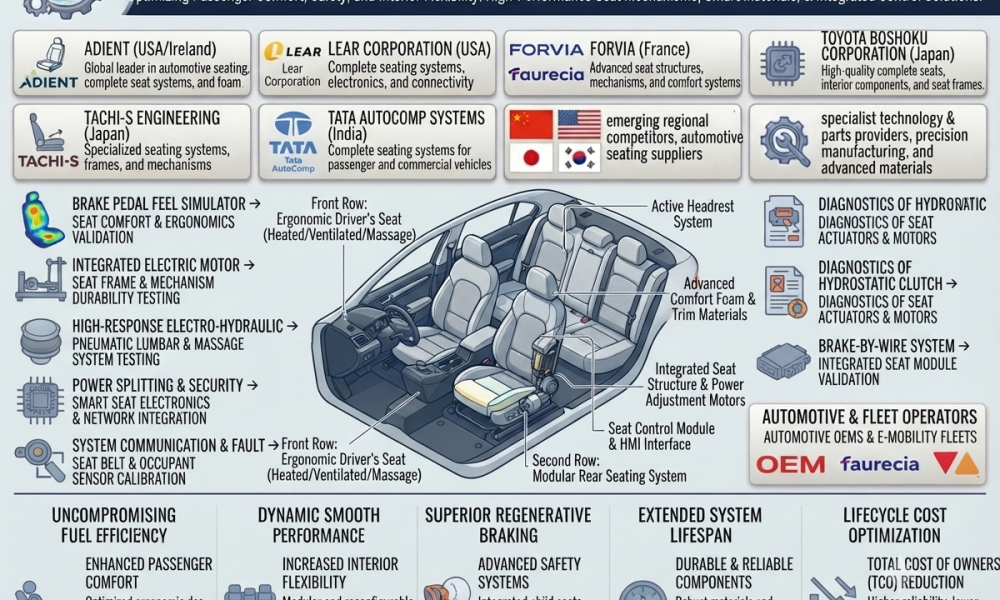
The global automotive seating systems market is projected to increase from USD 74.5 billion in 2026 to USD 113.5 billion by 2036, expanding at a 4.3% CAGR between 2026 and 2036. The market was valued at USD 71.4 billion in 2025. Demand is being shaped by vehicle production volumes, OEM platform design cycles, and growing consumer expectations for powered, heated, and comfortable seating across passenger vehicle programs.
Automotive seating systems have evolved beyond structural support to incorporate powered adjustment, heating, ventilation, ergonomic design, and electronic controls. Automakers increasingly evaluate seating suppliers according to their ability to integrate these functions while maintaining assembly-line efficiency, structural performance, material durability, and competitive costs.
OICA-reported global motor vehicle production in 2025 provides a substantial production base supporting seating procurement across vehicle platform lifecycles. Passenger cars remain the principal application area, while commercial vehicle programs provide additional demand for durable seating structures and materials.
Material selection is also becoming an important procurement consideration. Leather, fabric, and vinyl seating materials are evaluated against cost, durability, comfort, appearance, and sustainability requirements. Suppliers that can balance material performance with lightweight structural design can support automakers seeking efficiency improvements without reducing seating quality.
The expansion of powered and heated seating into mid-segment passenger vehicles is creating additional opportunities for suppliers. Seating systems increasingly connect mechanical structures with electrical components, controls, and comfort technologies, making platform integration an important factor in OEM sourcing decisions.
What Are the Key Segments in the Automotive Seating Systems Market?
- Passenger Cars are expected to account for 67.0% share in 2026 by vehicle type, supported by production volumes across hatchback, sedan, and SUV platforms.
- Bucket Seats are projected to hold 45.0% share in 2026 by seat type, reflecting their widespread use in passenger vehicle front-row seating.
- OEM is anticipated to represent 74.0% share in 2026 by distribution channel, driven by direct assembly-line procurement for new vehicle platforms.
- Powered and Heated Seats are gaining importance as automakers expand comfort features across passenger vehicle segments and integrate electronic controls into seating architectures.
- Leather, Fabric, and Vinyl Seats remain important material categories as manufacturers balance comfort, durability, appearance, cost, and sustainability requirements.
Get detailed market forecasts, competitive benchmarking, and pricing trends:
https://www.futuremarketinsights.com/reports/sample/rep-gb-1589
Which Countries Are Showing the Strongest Growth in Automotive Seating Systems?
Brazil is projected to record the fastest growth among the profiled markets, advancing at a 6.5% CAGR through 2036. Automotive production recovery and localization mandates are supporting demand for seating systems and related components. Local sourcing opportunities can encourage seat manufacturers to establish regional production and integration capabilities while supporting OEM platform requirements.
India is forecast to grow at a 4.5% CAGR, supported by expanding vehicle production and increasing demand for comfort-oriented seating features. Passenger vehicle programs are creating opportunities for suppliers offering lightweight structures, powered mechanisms, heating functions, and materials adapted to local production requirements.
China is projected to advance at a 4.0% CAGR, supported by its large automotive manufacturing base and continued development of passenger vehicle platforms. Seating suppliers are expected to compete through production scale, platform integration, electronic comfort features, and material innovation.
The United States is expected to grow at a 3.8% CAGR, with demand shaped by established vehicle production, consumer expectations for comfort features, and continued integration of powered seating functions. OEM programs require suppliers to meet strict platform specifications while maintaining consistent assembly-line delivery.
The United Kingdom is forecast to register a 3.6% CAGR, supported by passenger vehicle production and aftermarket requirements. Suppliers must address seating durability, material quality, ergonomic performance, and compatibility with changing vehicle platform specifications.
Germany is projected to expand at a 3.2% CAGR, with automotive seating procurement influenced by OEM engineering requirements, comfort technologies, lightweighting, and sustainability considerations. Seating suppliers are expected to support highly integrated vehicle platforms while maintaining cost and quality requirements.
How Is Regional Demand Shaping the Automotive Seating Systems Market?
Regional automotive manufacturing structures are influencing seating-system sourcing and supplier strategies. Brazil’s growth reflects production recovery and localization requirements, while India and China benefit from large-scale vehicle manufacturing and expanding passenger vehicle programs.
North American and European markets place greater emphasis on comfort technology, material quality, platform integration, and sustainability. Japanese-aligned OEM programs also provide opportunities for suppliers that can integrate seating structures and electronics while meeting detailed platform requirements.
Across regions, seating suppliers increasingly need to provide complete systems rather than isolated components. Structures, adjustment mechanisms, heating systems, electronics, and seat materials must operate as an integrated package throughout vehicle production and service cycles.
What Is Changing the Competitive Landscape?
Competition is increasingly centered on complete seating-system portfolios, platform integration, comfort technology, lightweight structures, and material innovation. OEMs are looking for suppliers capable of supporting seating programs from engineering development through production delivery.
Adient and Lear compete through complete seating-system portfolios with broad OEM platform coverage. Their capabilities support the integration of seating structures, mechanisms, comfort features, and associated components across multiple vehicle programs.
Forvia and Toyota Boshoku gain relevance where sustainable material innovation, seating technology, and Japanese OEM alignment influence procurement. Their capabilities reflect the growing importance of material development and platform-specific seating integration.
Competitive differentiation increasingly depends on ergonomic performance, lightweight structures, powered comfort functions, material durability, sustainability attributes, electronic integration, and reliable OEM program execution.
What Does the Analyst Say About the Automotive Seating Systems Market?
“Buyers are expected to judge passenger cars on performance and total cost of ownership rather than headline price. Automotive seating adoption is expected to depend on OEM platform design cycles and powered comfort feature expansion. Suppliers that combine lightweight structural design with comfort technology integration are likely to secure platform-level seating contracts. Market success is projected to depend on meeting sustainability and comfort expectations while maintaining cost competitiveness across global vehicle programs.”
– Nikhil Kaitwade, Principal Consultant, Future Market Insights
What Is Driving Demand for Automotive Seating Systems?
Vehicle Production Supports Seating Procurement
Seating-system demand follows vehicle-program awards and production schedules. Every new passenger vehicle platform requires seats engineered around vehicle dimensions, safety requirements, comfort expectations, and assembly-line processes, creating recurring OEM procurement opportunities.
Powered Comfort Features Expand Seating Content
Powered adjustment and heated seating are increasingly being incorporated into passenger vehicle programs beyond premium vehicle segments. These features increase the electronic and mechanical content of individual seats and create opportunities for suppliers with integrated technology capabilities.
Lightweight Structures Support Vehicle Efficiency
Automakers continue to evaluate opportunities to reduce vehicle mass. Seating suppliers can contribute through lightweight structural designs that maintain occupant support, durability, and safety while helping vehicle manufacturers address broader efficiency objectives.
Material Innovation Supports Sustainability Requirements
Leather, fabric, and vinyl materials are being evaluated through cost-performance and sustainability considerations. Suppliers capable of maintaining comfort and durability while addressing changing material requirements can support OEM efforts to develop more sustainable vehicle interiors.
What Are the Key Market Restraints?
Automotive seating systems require extensive validation because they combine structural, ergonomic, mechanical, electrical, and safety-related functions. Qualification requirements can increase development costs and extend timelines for new suppliers seeking OEM platform awards.
Increasing feature content can also raise system complexity. Powered adjustment, heating, ventilation, and electronic controls require additional components and integration work, increasing the number of functions that must operate reliably throughout the vehicle lifecycle.
Material costs represent another consideration. Seating manufacturers must balance premium appearance and comfort with OEM cost targets, durability requirements, and sustainability objectives, making material selection an important sourcing decision.
What Opportunities Exist for Automotive Seating System Manufacturers?
The expansion of powered and heated seating into mid-segment passenger vehicles provides opportunities for suppliers offering cost-effective comfort technologies. Modular seating architectures can allow manufacturers to offer multiple feature levels across vehicle variants while maintaining common underlying structures.
Lightweight seating structures also present opportunities as automakers seek vehicle efficiency improvements. Suppliers that combine reduced mass with structural durability and ergonomic performance can support broader platform-level lightweighting strategies.
Sustainable materials provide another development opportunity. Seating manufacturers can work with OEMs to introduce alternative material solutions while maintaining comfort, durability, appearance, and manufacturing compatibility.
Drive Your Business Growth Strategy: Checkout the Report for Key Insights!
https://www.futuremarketinsights.com/checkout/1589
How Is the Automotive Seating Systems Market Segmented?
The automotive seating systems industry is segmented by vehicle type, seat type, distribution channel, technology, material type, and region.
By Vehicle Type: Passenger Cars, Light Commercial Vehicles, Heavy Commercial Vehicles, and Others.
By Seat Type: Bucket, Split Seat, Bench Seat, and Others.
By Distribution Channel: OEM and Aftermarket.
By Technology: Powered and Heated, Heated, Powered, and Standard Seat.
By Material Type: Leather Seats, Fabric Seats, and Vinyl Seats.
By Region: North America, Latin America, Western Europe, Eastern Europe, East Asia, South Asia and Pacific, and Middle East and Africa.
Why Do Passenger Cars Represent a Significant Vehicle Category?
Passenger cars are projected to account for 67.0% share in 2026. High production volumes across hatchback, sedan, and SUV platforms create a substantial demand base for seating systems, while consumer expectations for comfort and powered functions increase the content value of individual seats.
Why Are Bucket Seats Important to Market Development?
Bucket seats are projected to hold 45.0% share in 2026 by seat type. Their widespread application in passenger vehicle front-row seating makes them a major procurement category for OEM seating suppliers.
How Does OEM Distribution Influence Demand?
OEM distribution is anticipated to represent 74.0% share in 2026. Direct procurement allows vehicle manufacturers to integrate seating systems into new vehicle platforms and specify structural, comfort, material, electronic, and assembly requirements before production begins.
What Are the Drivers, Restraints and Opportunities in the Automotive Seating Systems Market?
Automotive seating systems are becoming increasingly integrated vehicle components as automakers balance occupant comfort, structural performance, lightweighting, electronic features, and sustainability.
- Driver: Steady vehicle production and expanding powered comfort features are supporting seating-system procurement.
- Restraint: Complex validation, increasing electronic content, and material cost-performance requirements can increase development and manufacturing complexity.
- Opportunity: Lightweight structures, sustainable materials, and modular powered seating architectures can support broader platform adoption.
What Is the Automotive Seating Systems Market Demand Outlook?
Demand is expected to remain closely linked to global vehicle production and OEM platform development. Passenger cars will continue to provide a substantial demand base, while increasing comfort expectations can raise the technology content incorporated into individual seating systems.
The market is also moving toward greater integration between mechanical seating structures and electronic comfort systems. Powered adjustment, heating, and other comfort functions require suppliers to coordinate structures, mechanisms, electrical systems, controls, and materials within increasingly compact vehicle interiors.
Why Is Seating Comfort Technology Important?
Consumer expectations are encouraging automakers to expand powered and heated seating functions across broader passenger vehicle segments. Suppliers that can integrate comfort technologies while maintaining ergonomic performance and competitive costs can support OEM efforts to differentiate vehicle interiors.
Why Does Lightweight Structural Design Matter?
Seat structures contribute to overall vehicle mass. Lightweight designs can help automakers pursue efficiency targets while maintaining occupant support, durability, and structural requirements. This makes material selection and structural engineering important parts of seating-system development.
How Fast Are Key Countries Growing in the Automotive Seating Systems Market?
Brazil is projected to grow at 6.5% CAGR, followed by India at 4.5%, China at 4.0%, the United States at 3.8%, the United Kingdom at 3.6%, and Germany at 3.2% through 2036. These differences reflect variations in automotive production, localization policies, OEM platform cycles, consumer comfort expectations, seating technology adoption, and material-development priorities.
About Future Market Insights
Future Market Insights (FMI) is a global market intelligence and consulting firm providing syndicated research, custom research, and strategic consulting services across automotive, transportation, aerospace, technology, industrial, and emerging sectors. FMI’s research combines primary research, proprietary forecasting models, and industry analysis to help organizations evaluate market opportunities, technology adoption, competitive dynamics, and investment trends.



