
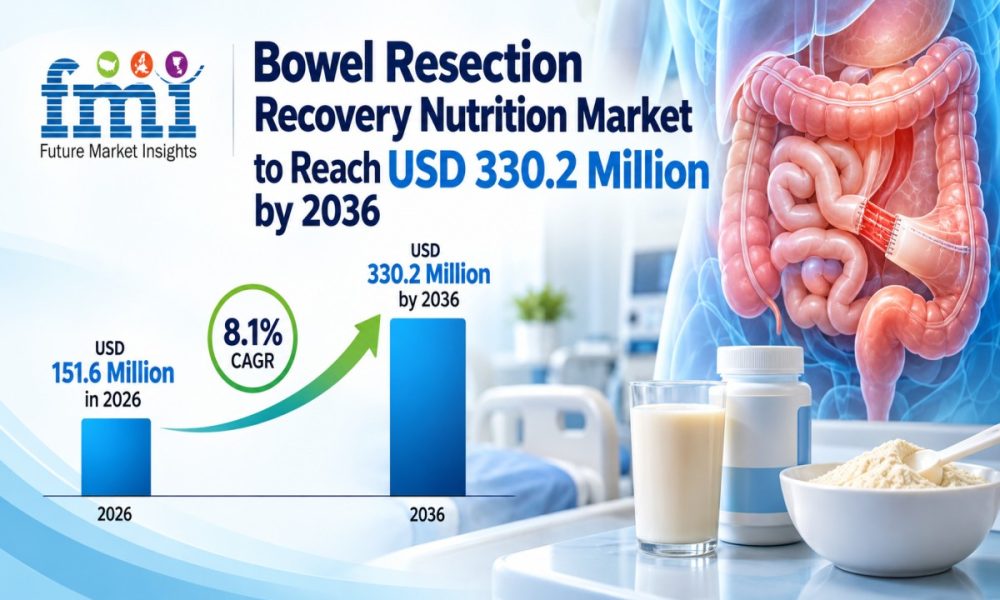
The global bowel resection recovery nutrition market is projected to reach USD 330.2 million by 2036, up from USD 151.6 million in 2026, expanding at a CAGR of 8.1% during the forecast period. According to the latest analysis by Future Market Insights (FMI), growing adoption of early postoperative oral and enteral feeding is strengthening demand for stage-specific nutrition products following bowel resection procedures.
Recovery protocols increasingly position nutrition as an active component of postoperative care. Earlier feeding allows clinicians to select formulations based on tolerance, digestive function, and nutritional requirements closer to the point of surgery. However, reimbursement rules and documentation requirements can affect continuity when patients transition from hospital care to home recovery.
Get Detailed Market Forecasts, Competitive Benchmarking, and Pricing Trends
https://www.futuremarketinsights.com/reports/sample/rep-gb-34966
Low-Residue Early Post-Op Nutrition Continues to Lead Product Demand
Low-residue early post-op nutrition is projected to account for 48.2% of the market in 2026, making it the leading product type. During the initial recovery period, patients often require manageable portions and lower-fibre intake while bowel tolerance gradually improves.
The defined early recovery window supports continued use of low-residue formulations before patients progress toward broader dietary intake. Oral nutritional supplements also provide concentrated protein and energy for patients experiencing limited appetite after surgery.
Small Bowel Resection Drives Specialized Nutrition Requirements
The small bowel segment is estimated to hold 49.9% market share in 2026, supported by the nutritional implications of reduced absorptive surface and fluid losses following substantial resections.
Patients recovering from small bowel procedures may require specialized oral or enteral formulations when conventional intake does not adequately meet nutritional requirements. Peptide-oriented formulas can become relevant where absorption is compromised and clinicians seek nutrition options designed to reduce digestive demands.
In-Hospital Phase Holds the Largest Market Share
The in-hospital phase is projected to account for 57.3% of market demand in 2026. Hospitals remain central to the initial selection and adjustment of postoperative nutrition because feeding plans can be modified rapidly according to nausea, stool output, tolerance, and overall recovery.
Direct clinical supervision also enables healthcare professionals to establish a nutrition plan before discharge. This makes hospital-based nutrition selection an important starting point for subsequent home recovery.
Hospitals Remain the Leading End User
Hospitals are forecast to represent 51.3% of the market in 2026, reflecting their role in nutritional assessment, product initiation, and supervised postoperative recovery.
Hospital formulary decisions can also influence the products patients continue using after discharge. When a formulation is well tolerated during admission, clinicians and community care teams may maintain the same nutritional approach during the early home-recovery period.
Early Feeding Protocols Create Growth Opportunities
The increasing adoption of early oral and enteral feeding protocols is a major growth driver for the bowel resection recovery nutrition market. Clinical nutrition is increasingly incorporated into postoperative pathways rather than being introduced only after prolonged inadequate intake.
At the same time, product continuity can be affected by reimbursement requirements, documentation, and differences between hospital and community coverage. These factors create a restraint for manufacturers seeking to convert hospital-based product initiation into repeat home orders.
South Korea Leads Country Growth at 8.4% CAGR
Among the highlighted countries, South Korea is projected to record an 8.4% CAGR through 2036, followed by the UK at 7.8%, the USA at 7.5%, Germany at 7.2%, and Japan at 6.4%.
South Korea’s concentrated specialist hospital network supports continued postoperative nutrition assessment, while the UK benefits from established hospital and home-enteral nutrition services. In the USA, broad hospital nutrition portfolios and retail supplement availability support market expansion, although reimbursement documentation can influence home continuation.
Competitive Landscape
The bowel resection recovery nutrition market features global medical nutrition companies alongside specialized providers focused on enteral nutrition, gastrointestinal tolerance, and postoperative support.
Key companies include Nestle Health Science, Abbott, Danone Nutricia, Fresenius Kabi, Kate Farms, B. Braun, Nutrisens Group, and Ajinomoto Co., Inc.
Competition is shaped by product breadth, clinical nutrition capabilities, hospital formulary access, tolerance-focused formulations, and the ability to support nutrition continuity after discharge.
Key Industry Developments
- In July 2025, Danone Nutricia completed its majority acquisition of Kate Farms, strengthening its specialized medical nutrition presence across hospital and home channels.
- In June 2025, Fresenius Kabi expanded its enteral nutrition research and development capabilities through a new R&D center in Gurugram, India.
- In March 2025, Nutrisens Group acquired a majority stake in Prodiet Medical Nutrition, expanding its oral and enteral nutrition presence in Latin America.
Analyst Perspective
Nandini Roy Choudhury, Principal Consultant at Future Market Insights, highlights the importance of matching nutrition products with different recovery stages. According to her analysis, bowel resection recovery nutrition should be assessed according to changing tolerance and nutritional needs throughout recovery.
Explore Exclusive Discounts on the Full Report
Bowel Resection Recovery Nutrition Market – https://www.futuremarketinsights.com/reports/bowel-resection-recovery-nutrition-market
Key Executive Benefits
- Decision-Ready Insights: Access segment-level and country-level market forecasts.
- Reduced Strategic Risk: Understand reimbursement, tolerance, and continuity barriers.
- Market Entry Confidence: Identify high-growth country opportunities and recovery phases.
- Competitive Advantage: Benchmark leading medical nutrition companies and their capabilities.
- Faster Growth Decisions: Identify product and channel opportunities across hospital and homecare settings.
- Primary Market Validation: Support strategy with primary and secondary market research.
To explore how FMI Custom Research can support your strategic priorities, connect with the team at [email protected].
About Future Market Insights (FMI)
Future Market Insights, Inc. is an ESOMAR-certified, ISO 9001:2015 market research and consulting organization trusted by Fortune 500 companies. With a global presence across the U.S., UK, India, and Dubai, FMI delivers data-driven insights across 30+ industries and 1,200 markets worldwide. Its research supports organizations with market intelligence, strategic planning, competitive benchmarking, and growth-focused decision-making.



