
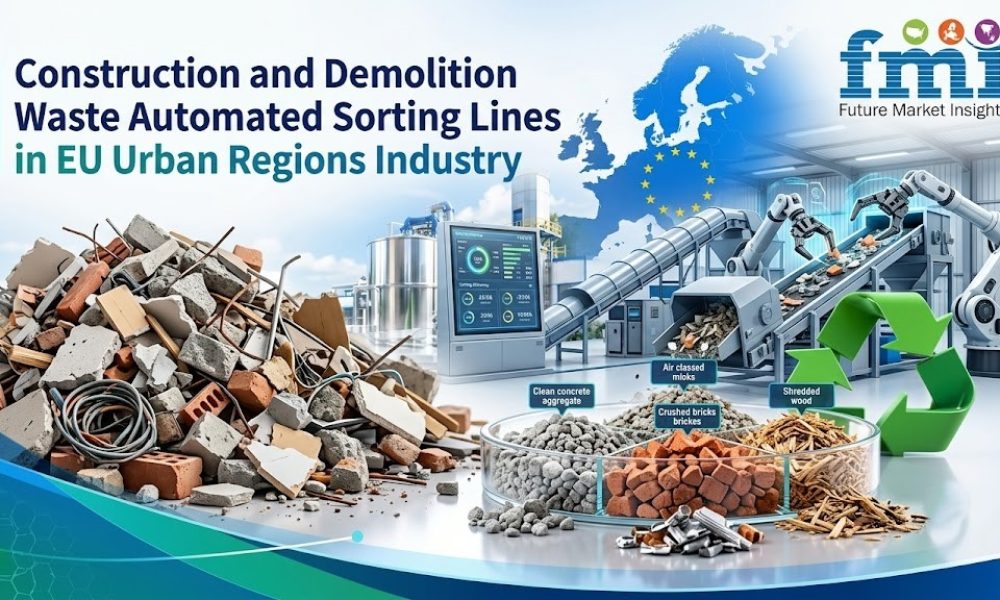
The Construction and Demolition Waste Automated Sorting Lines in EU Urban Regions market is estimated at USD 127.9 million in 2026 and is projected to reach USD 289.2 million by 2036, expanding at a CAGR of 8.5% during the forecast period. The market was valued at USD 117.9 million in 2025, representing an incremental opportunity of USD 162.5 million between 2026 and 2036, according to Future Market Insights (FMI).
Market expansion is being supported by rising landfill charges and stricter recovery requirements, which are increasing the value of cleaner output streams from mixed construction and demolition waste. Processing plants are also facing pressure from disposal cost inflation and inconsistent feedstock quality, prompting operators to assess sorting systems based on output purity, service intervals, retrofit compatibility, and payback discipline.
Get detailed market forecasts, competitive benchmarking, and pricing trends: https://www.futuremarketinsights.com/reports/sample/rep-gb-32741
Global Segment Leaders
- Optical sorting is projected to lead the technology segment with a 0% share in 2026. Sensor deployment allows facilities to identify materials within dense and mixed incoming loads, including wood grades and plastic polymers. Optical identification can reduce sorting mistakes associated with extended manual shifts, although dust accumulation remains an operating constraint requiring frequent lens cleaning and effective air extraction.
- By automation level, semi-automated systems are expected to account for 41.0% share in 2026. These configurations combine mechanical screening with selective robotic support while retaining manual quality checks. Their relatively manageable initial investment makes them relevant to mid-sized waste management operators seeking to modernize existing facilities without immediately adopting full automation.
- Mixed mineral waste is projected to hold a 0% share in 2026, supported by the large volumes of concrete, bricks, and plaster processed in C&D waste facilities. Crushing, screening, and classification capacity remain central to handling these heavy streams, while clean recycled aggregate output can improve the secondary sales mix.
- By installation type, retrofit lines lead with a 57.0% share, reflecting operator preference for upgrading existing facilities. Space constraints in dense urban areas and delays associated with developing new sites are encouraging operators to integrate sensors and robotic units into existing sheds and conveyor layouts.
- Recyclers account for 49.0% share in 2026, making them the largest end-user segment. These operators rely on efficient recovery of metals, wood, and mineral fractions to protect margins from variable incoming loads and support cleaner secondary-material output.
Country-Level Performance
- Denmark: The market is projected to expand at a 9.4% CAGR through 2036, supported by active redevelopment cycles and firm policy execution. Buyers are expected to prioritize detection quality, reporting capabilities, and compliance support.
- Germany: Germany is forecast to register a 9.2% CAGR, with strict recycling practices supporting demand for higher-specification sorting upgrades and retrofit-compatible systems.
- Netherlands: The market is expected to grow at a 9.0% CAGR, supported by land scarcity, tight disposal economics, infrastructure renewal, and demand for higher recovery from constrained sites.
- France: France is projected to record an 8.8% CAGR, with metropolitan redevelopment generating mixed demolition loads and keeping payback discipline and service reliability important to investment decisions.
- Spain: Spain is anticipated to expand at an 8.7% CAGR, supported by municipal pressure and infrastructure renewal.
- Italy: The market is expected to grow at an 8.3% CAGR, with adoption remaining closely linked to local retrofit economics and regional implementation conditions.
- Poland: Poland is projected to register an 8.1% CAGR, while facility retrofit cycles and local grant approvals continue to influence adoption timelines.
Investment Drivers and Opportunities
Landfill gate fees and stricter diversion obligations are increasing the incentive to recover more value before disposal. Public-project tender requirements can further accelerate investment when recycling performance and documented recovery become part of contract eligibility.
At the same time, permitting requirements, dust controls, noise considerations, structural reinforcement, and constrained urban layouts can delay equipment deployment. Compact modular systems provide an opportunity to address space limitations, although operators must ensure that smaller footprints can accommodate fluctuating demolition inflows.
Several opportunities are emerging across the market. Mobile sorting systems can allow processing directly at large demolition sites, while digital reporting technologies can support verifiable records of diverted tonnage. Specialized wood extraction systems can also help recover higher-value timber for downstream applications.
Competitive Landscape
Competition is increasingly extending beyond standalone hardware. Buyers are assessing software flexibility, upgrade potential, maintenance reliability, sensor adaptability, robotic performance, and predictive maintenance capabilities over the equipment lifecycle.
Established suppliers can benefit from operating data collected across live processing environments, supporting improvements in sensor calibration, fault detection, and material recognition. Smaller entrants may compete through targeted retrofit modules or specialized process upgrades addressing specific fractions within mixed demolition waste.
Key companies profiled in the market include TOMRA, STEINERT, STADLER, Pellenc ST, Recycleye, Binder+Co, and ZenRobotics (Terex Recycling Systems).
Access the Complete Report in PDF Format: https://www.futuremarketinsights.com/reports/brochure/rep-gb-32741
Report Scope
The FMI study covers the Construction and Demolition Waste Automated Sorting Lines in EU Urban Regions market by technology, automation level, waste fraction, installation type, end user, and region.
Technology segments include optical sorting, robotic sorting, magnetic sorting, eddy-current, and X-ray sorting. Automation levels comprise semi-automated, fully automated, and hybrid lines. Waste fractions include mixed mineral, mixed wood, metal-rich, gypsum-rich, plastic-rich, and glass-rich waste.
Installation types include retrofit, greenfield, and mobile lines, while end users include recyclers, contractors, municipalities, and transfer stations. Regional coverage spans the Nordics, DACH, Western Europe, Southern Europe, and Eastern Europe, with country-level analysis for Denmark, Germany, Netherlands, France, Spain, Italy, and Poland.
Business Impact
FMI helps organizations transform market complexity into strategic clarity, enabling leadership teams to identify growth opportunities faster, optimize resource allocation, strengthen competitive positioning, and make high-stakes business decisions with confidence.
To explore how FMI Custom Research can support your strategic priorities, please connect with our team at – [email protected]
About Future Market Insights (FMI)
Future Market Insights, Inc. (FMI) is an ESOMAR-certified, ISO 9001:2015 market research and consulting organization, trusted by Fortune 500 clients and global enterprises. With operations in the U.S., UK, India, and Dubai, FMI provides data-backed insights and strategic intelligence across 30+ industries and 1200 markets worldwide.



