
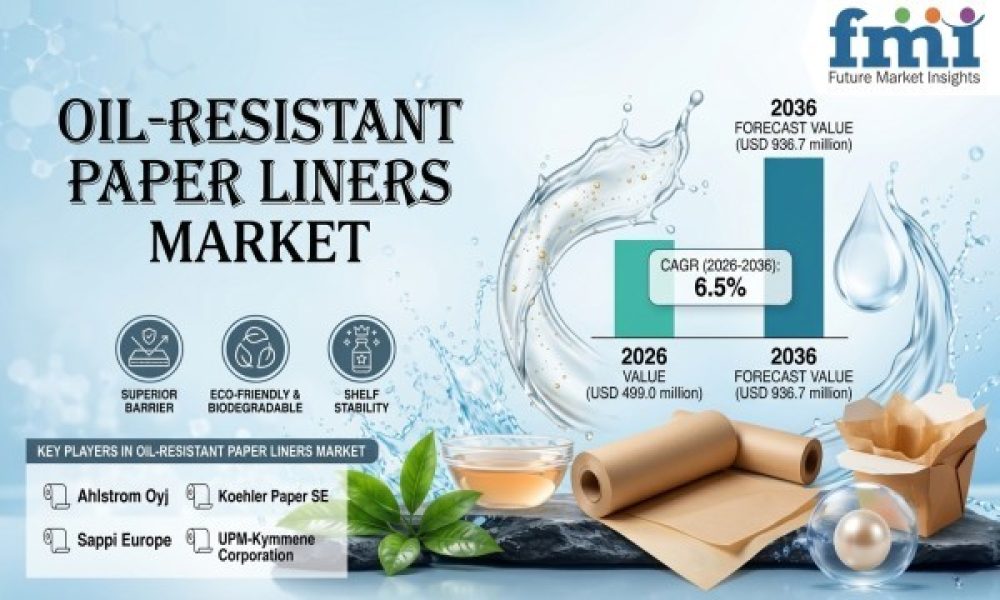
The global Oil-Resistant Paper Liners Market is projected to reach USD 936.7 million by 2036, up from USD 499.0 million in 2026, expanding at a 6.5% CAGR over the forecast period, according to the latest market analysis by Future Market Insights (FMI).
The market is being reshaped by changes in food-contact requirements and the need to replace grease-proofing chemistries without compromising performance during food preparation, holding, printing, cutting, and delivery. In January 2025, the FDA determined that 35 PFAS-related food-contact notifications for grease-proof paper were no longer effective, directing packaging programs toward qualified barrier-coated papers and other structures that can maintain oil holdout.
For paper mills, converters, restaurant procurement teams, and packaging distributors, the transition is not limited to chemistry replacement. Commercial approval depends on whether liners perform under actual food temperatures and holding periods while maintaining consistent converting characteristics across approved production sites.
Get detailed market forecasts, competitive benchmarking, and pricing trends:
https://www.futuremarketinsights.com/reports/sample/rep-gb-34576
PFAS-Free Liners Become a Major Product Category
PFAS-free oil-resistant liners are projected to account for 32.0% of product type revenue in 2026. Restaurant packaging teams are increasingly evaluating alternative structures against real service conditions, particularly where direct contact with oily foods creates demanding barrier requirements.
European food-contact rules also add pressure for documented alternatives. Defined PFAS limits apply to food packaging from August 12, 2026, increasing the importance of food-contact documentation alongside grease resistance.
The market’s product landscape includes PFAS-free oil-resistant liners, naturally densified greaseproof liners, coated oil-barrier liners, glassine-parchment liners, and other formats.
Lightweight Paper Grades Gain Commercial Relevance
Virgin kraft pulp is estimated to account for 34.0% of material revenue in 2026. Its controlled fiber strength and surface formation support coated and densified structures used across foodservice and bakery applications.
Meanwhile, the 30-50 GSM category is forecast to represent 44.0% of basis weight revenue in 2026. This range provides a balance between material use, handling strength, cutting performance, and practical placement in trays and wraps.
Application requirements also remain closely linked to food type. Fried foods and QSR are forecast to represent 34.0% of application revenue in 2026, reflecting direct exposure to hot oil and recurring single-service consumption.
Qualification Remains a Commercial Bottleneck
A key challenge is the difference between laboratory performance and actual restaurant service conditions. A liner may meet a grease-resistance test but experience problems during hot holding, printing, cutting, or repeated commercial conversion.
This creates additional qualification costs for restaurant groups and converters operating across multiple sites. Failed trials can increase material waste and delay approval before a product moves into scheduled purchasing.
The report identifies lightweight base grades combined with local coating trials and dependable regional inventory as an opportunity for suppliers seeking to shorten approval cycles.
Analyst Perspective
“Oil-resistant paper liners compete on oil holdout plus food-contact evidence and converting stability under actual restaurant service conditions. Manufacturers that shorten qualification without increasing sheet weight can convert regulatory replacement into scheduled foodservice orders.”
Nandini Roy Choudhury, Principal Consultant, Future Market Insights
Regional Growth Shows Different Qualification Conditions
Brazil is projected to record the highest CAGR among the five profiled countries at 6.9% through 2036. The United Kingdom follows at 6.4%, while Germany is forecast at 6.3%. The United States is projected to expand at 5.9%, followed by Japan at 5.1%.
These differences reflect varying foodservice structures, regulatory documentation requirements, converting capabilities, import conditions, and supplier qualification processes.
The United States provides substantial pilot opportunities through large restaurant and foodservice programs. Japan’s positive-list system places greater emphasis on detailed composition review for imported food-contact materials and resin layers.
Competitive Landscape
The market remains fragmented among specialty-paper manufacturers and producers serving direct food-contact formats.
Key companies profiled include Ahlstrom Oyj, Nordic Paper, delfortgroup AG, Twin Rivers Paper Company, Koehler Paper SE, Sappi Europe, UPM-Kymmene Corporation, and Seaman Paper Company.
Recent developments highlighted in the report include Koehler Paper SE’s April 2026 introduction of NexPlus OGR for burgers and fried-food wraps, UPM-Kymmene Corporation’s March 2026 low-coat-weight paper concept with Paramelt, and Ahlstrom Oyj’s May 2025 inauguration of the EUR 15 million PMZ5 parchmentizer in France.
Gain Comprehensive Knowledge—Read the Entire Report Now!
https://www.futuremarketinsights.com/reports/oil-resistant-paper-liners-market
Report Scope
The Oil-Resistant Paper Liners Market is segmented by product type, material, basis weight, application, end use, sales channel, and region. Coverage includes North America, Latin America, Europe, East Asia, South Asia and Pacific, and the Middle East and Africa.
The assessment covers 2026 to 2036 and provides revenue estimates in USD million alongside CAGR analysis. Countries profiled include Brazil, the United Kingdom, Germany, the United States, Japan, and more than 20 additional countries in the full report.
FMI Custom Research: Strategic Intelligence for Confident Decision-Making
In today’s rapidly evolving business environment, leadership teams need more than market data—they need clear, actionable intelligence tailored to their strategic objectives. FMI’s Custom Research solutions are designed around the specific business questions organizations need answered, enabling executives to evaluate growth opportunities, validate investments, assess competitive dynamics, and reduce uncertainty before making critical decisions. By combining deep industry expertise, primary research, and proprietary market intelligence, FMI delivers insights that help organizations move from assumptions to evidence-based strategies with greater speed and confidence.
Business Impact
FMI helps organizations transform market complexity into strategic clarity, enabling leadership teams to identify growth opportunities faster, optimize resource allocation, strengthen competitive positioning, and make high-stakes business decisions with confidence.
To explore how FMI Custom Research can support your strategic priorities, please connect with our team at – [email protected]
About Future Market Insights (FMI)
Future Market Insights, Inc. (FMI) is an ESOMAR-certified, ISO 9001:2015 market research and consulting organization, trusted by Fortune 500 clients and global enterprises. With operations in the U.S., UK, India, and Dubai, FMI provides data-backed insights and strategic intelligence across 30+ industries and 1200 markets worldwide.



