
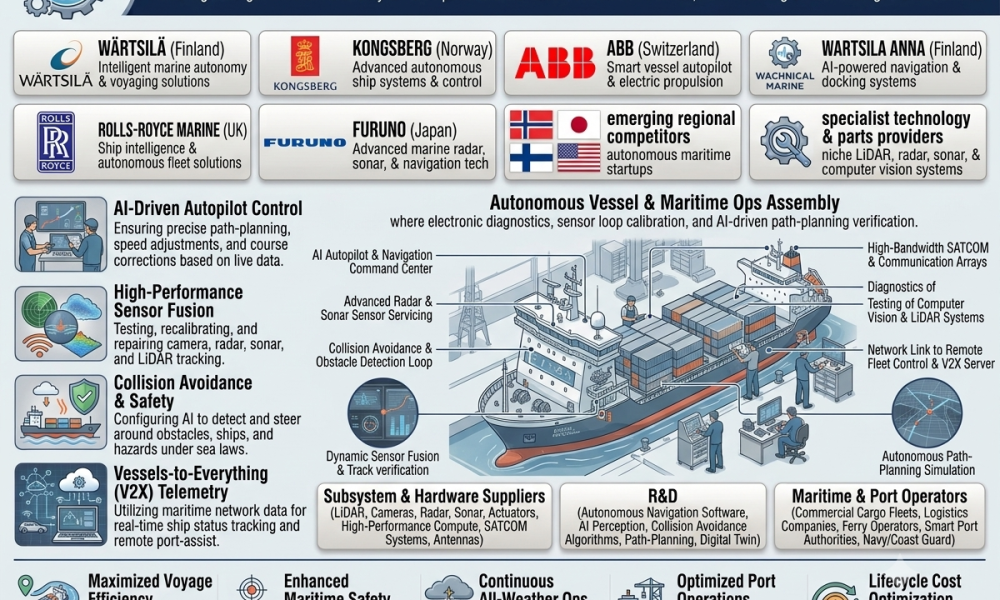
The global autonomous marine navigation (AI ship autopilot) market is projected to expand at a 27.5% CAGR between 2026 and 2036, increasing from USD 956.0 million in 2026 to USD 10,853.0 million by 2036. Demand is supported by the large installed base of commercial vessels and growing interest in supervised autonomous navigation systems that can improve route execution while maintaining human oversight.
The global commercial fleet provides a substantial addressable base for autonomous navigation upgrades. UNCTAD reported in September 2025 that the global fleet comprised approximately 112,500 commercial vessels of at least 100 gross tons at the start of 2025. Because many vessels remain in service for years, retrofit navigation systems provide an opportunity to introduce autonomous functions without waiting for complete vessel replacement.
Electronic chart safety systems supply route information that supervised autopilots can use for course control. Fleets are increasingly evaluating systems that provide clear alarms, transparent human-machine interaction, and a direct return to manual control when sensors, communications, or autonomous functions encounter abnormal conditions.
What Are the Key Segments in the Autonomous Marine Navigation (AI Ship Autopilot) Market?
The autonomous marine navigation market is being shaped by navigation technology, operating environment, software integration, vessel type, installation method, and regional regulatory requirements.
- AI Navigation Autopilot – 40.0%: AI navigation autopilot represents the leading technology category in 2026, reflecting growing demand for active course and speed control that can support supervised autonomous vessel operation.
- Ocean-going Transit Assist – 38.0%: Ocean-going transit assist is the leading application segment, supported by repeatable operating conditions in open water where automated route execution can be evaluated across extended voyages.
- Software – 48.0%: Software accounts for the leading component share in 2026 as controlled software updates can improve route decisions and navigation capabilities without requiring complete replacement of installed bridge hardware.
- Commercial Vessel Fleets: Merchant and commercial vessel operators represent an important addressable market as owners evaluate autonomous navigation technologies that can be integrated into existing fleet operations.
- Retrofit Programs: Retrofit installations provide a practical adoption pathway because autonomous navigation functions can be introduced into vessels already equipped with radar, steering systems, and other bridge equipment.
Get detailed market forecasts, competitive benchmarking, and pricing trends:
https://www.futuremarketinsights.com/reports/sample/rep-gb-34058
Which Countries Are Showing the Strongest Growth in Autonomous Marine Navigation?
South Korea: South Korea is projected to grow at a 30.0% CAGR between 2026 and 2036, representing the fastest-growing country in the supplied market comparison. Shipyard-carrier relationships and direct policy support are helping create a clearer pathway from autonomous navigation trials to commercial vessel installation.
The Ministry of Oceans and Fisheries stated in January 2025 that South Korea’s autonomous ships law took effect on January 3, 2025. Approved trials can use regulatory exceptions within designated areas, allowing developers and vessel operators to generate evidence that can support commercial approval. This regulatory framework can help connect autonomous navigation technology development with shipyard integration and fleet deployment.
European Union: The European Union is projected to expand at a 26.0% CAGR through 2036. Demand is being shaped by multi-port operations, software requirements across diverse commercial routes, and the need for navigation systems that can operate consistently within different maritime environments.
European fleets are expected to evaluate autonomous navigation systems according to operational reliability, software flexibility, integration requirements, and the ability to maintain human oversight. Multi-vessel and multi-port deployment can also increase the importance of standardized voyage records and system support.
Japan: Japan is projected to grow at a 25.0% CAGR through 2036. Autonomous navigation development is being influenced by strict operating requirements around crowded ports and the need to preserve direct bridge control when operating in higher-risk navigation environments.
Japan Coast Guard guidance issued in March 2025 directs vessels in Tokyo Bay to use manual steering instead of autopilot. Such requirements influence training, bridge procedures, and the marine communication systems used for shore supervision. Developers therefore need to demonstrate that autonomous functions can return control to bridge officers without delay or confusion.
How Is Regional Demand Shaping the Autonomous Marine Navigation Market?
Regional regulatory structures are influencing how autonomous marine navigation systems move from testing toward commercial use. South Korea is establishing designated pathways for autonomous ship trials, creating opportunities to connect regulatory approval with shipyard installation and carrier operations. The European Union is emphasizing navigation technologies capable of supporting multi-port operations and diverse commercial fleets.
Japan is placing greater emphasis on controlled autonomous operation around congested waterways. The requirement for manual steering in Tokyo Bay illustrates why developers must account for route-specific operating rules rather than assuming that the same autonomous control mode can be used across every maritime environment.
These differences are increasing the importance of localization. Suppliers need to understand local navigation rules, bridge procedures, communication infrastructure, training requirements, and manual-intervention protocols before deploying autonomous marine navigation systems across multiple regions.
What Is Changing the Competitive Landscape?
The competitive landscape includes maritime technology providers, navigation specialists, autonomy developers, and suppliers offering retrofit and vessel-integration capabilities. Competition is increasingly centered on the ability to connect autonomous navigation with existing bridge hardware while maintaining transparent human oversight.
Avikus and Kongsberg Maritime are expected to compete through shipyard-linked autonomous navigation capabilities and integration with broader vessel systems. Their positioning reflects demand for solutions that can connect course control with existing marine navigation architectures.
Orca AI is anticipated to attract attention through camera-based watchkeeping and situational-awareness technologies. Such capabilities can complement autonomous navigation by improving the vessel’s understanding of surrounding traffic and operating conditions.
Sea Machines Robotics is expected to compete through autonomy and remote-operation technologies supporting workboats and uncrewed vessels. Retrofit-oriented capabilities can provide an adoption pathway for operators seeking autonomous functions without replacing existing vessel fleets.
As fleets move from individual demonstrations toward recurring deployments, suppliers are likely to face greater requirements around installation support, software updates, voyage records, operator training, and system maintenance.
What Does the Analyst Say About the Autonomous Marine Navigation Market?
According to Nikhil Kaitwade, Principal Analyst at Future Market Insights, autonomous vessel adoption will depend on operational trust and reliable human-machine interaction rather than navigation autonomy alone.
“Autonomous vessel adoption will be determined by operational trust rather than navigation autonomy alone. Shipowners and maritime authorities are looking for systems that provide predictable human-machine interaction, transparent decision logic, and well-defined procedures for manual intervention during abnormal operating conditions. While integrated vessel platforms can accelerate initial deployment, long-term fleet strategies will favor solutions that preserve upgrade flexibility, generate auditable voyage records, and support safe operation across diverse vessel classes and operating environments.”
What Is Driving Demand for Autonomous Marine Navigation?
Large Commercial Fleet Creates a Broad Retrofit Opportunity
The installed commercial vessel base provides a substantial addressable market for autonomous navigation upgrades. With approximately 112,500 commercial vessels of at least 100 gross tons reported globally at the start of 2025, fleet owners have a significant pool of existing ships that could potentially receive autonomous navigation functions.
Retrofit deployment can allow operators to introduce supervised autonomy while continuing to use existing vessel assets. This approach can reduce dependence on newbuild cycles and allow technology suppliers to address vessels already operating on established routes.
AI-Based Course Control Improves Navigation Automation
AI navigation autopilot systems are projected to account for 40.0% of the market in 2026. Active course and speed control are becoming central to autonomous navigation development as shipowners evaluate systems capable of supporting repeatable voyage tasks.
The commercial value of these systems depends on how effectively they operate alongside bridge officers. Clear alarms, understandable decision logic, and rapid transfer to manual control remain important requirements for fleet operators and maritime authorities.
Ocean-Going Transit Provides Repeatable Operating Conditions
Ocean-going transit assist is projected to hold 38.0% of the market in 2026. Open-water operations provide comparatively repeatable navigation environments where autonomous route execution can be evaluated across extended voyages.
This application can also provide opportunities for operators to collect voyage data and assess system performance before expanding autonomous capabilities into more complex port approaches or congested waterways.
Retrofit Programs Accelerate Fleet-Level Adoption
Retrofit programs provide a pathway for introducing autonomy into existing vessels equipped with radar, steering equipment, electronic navigation systems, and other bridge technologies. This can help operators evaluate autonomous functions without waiting for new vessels to enter service.
Suppliers that can combine installation, software integration, training, maintenance, and remote support can address more of the operational requirements associated with retrofit deployment.
What Are the Key Market Restraints?
Autonomous navigation systems must operate within complex maritime environments where weather, traffic, sensor limitations, communication interruptions, and route-specific rules can affect performance. Maintaining predictable control transfer during abnormal conditions remains a central technical and operational requirement.
Regulatory differences can also increase deployment complexity. A navigation function approved for a designated trial area may not automatically receive approval for operation in a congested port or another jurisdiction. Suppliers therefore need to adapt control modes, documentation, training, and operating procedures to local requirements.
Integration with existing bridge systems creates another challenge. Autonomous navigation must communicate reliably with steering, radar, electronic charts, alarms, and other onboard systems. Compatibility requirements can increase installation time and qualification work, particularly for older vessels with different equipment configurations.
What Opportunities Exist for Autonomous Marine Navigation Manufacturers?
The transition from autonomous navigation demonstrations toward commercial fleet deployment creates opportunities for suppliers that can demonstrate reliable performance across practical vessel operations. Buyers increasingly require evidence showing how systems behave during routine navigation as well as during sensor faults, communication interruptions, and abnormal operating conditions.
There is also an opportunity to provide flexible software-led solutions. Software represents 48.0% of the component category in 2026, highlighting the importance of controlled updates and navigation intelligence that can improve system capability without replacing complete bridge hardware.
Suppliers can also expand their role through retrofit services, operator training, voyage-data management, remote supervision, and lifecycle support. These capabilities can help fleet operators manage autonomous navigation as a long-term operating function rather than a standalone equipment purchase.
Drive Your Business Growth Strategy: Checkout the Report for Key Insights!
https://www.futuremarketinsights.com/checkout/34058
How Is the Autonomous Marine Navigation (AI Ship Autopilot) Market Segmented?
The autonomous marine navigation industry is segmented by technology, application, component, end use, fit type, and region.
By Technology: AI navigation autopilot, autonomous route planning, collision avoidance and decision support, and supervised navigation systems.
By Application: Ocean-going transit assist, port approach and docking, coastal navigation, and workboat or offshore operations.
By Component: Software, navigation equipment, sensors and controls, communication systems, and services.
By End Use: Commercial shipping, offshore energy, passenger vessels, workboats, and defense or patrol vessels.
By Fit Type: Newbuild integration and retrofit installations.
By Region: North America, Latin America, Europe, East Asia, South Asia, Oceania, and the Middle East and Africa.
The segmentation enables maritime stakeholders to compare autonomous navigation requirements according to operating environment, vessel type, technology architecture, installation pathway, and regional regulatory conditions.
What Are the Drivers, Restraints and Opportunities in the Autonomous Marine Navigation Market?
The commercial case for autonomous marine navigation increasingly depends on validated course control, transparent human-machine interaction, retrofit flexibility, and reliable transfer between autonomous and manual operation.
- Autonomous navigation can improve route execution across repeatable vessel operations while maintaining human oversight.
- Retrofit systems provide access to the large installed commercial vessel base without requiring complete fleet replacement.
- Suppliers combining navigation software, bridge integration, voyage records, operator training, and lifecycle support can address broader fleet requirements.
What Is the Autonomous Marine Navigation Market Demand Outlook?
Demand for autonomous marine navigation is expected to remain connected to fleet modernization, supervised autonomy, and the need to improve navigation efficiency without removing human oversight. The market’s projected 27.5% CAGR from 2026 to 2036 reflects increasing interest in AI-based course control, ocean-going transit assistance, retrofit installations, and software-led navigation capabilities.
The market is projected to increase from USD 956.0 million in 2026 to USD 10,853.0 million by 2036. As maritime operators move beyond short demonstrations, commercial adoption is expected to depend increasingly on operational evidence, regulatory approval, integration compatibility, and dependable manual intervention procedures.
Why Is AI Navigation Autopilot the Leading Technology?
AI navigation autopilot is projected to account for 40.0% of the market in 2026. Active course and speed control remain central to autonomous navigation because they allow vessels to execute defined routes while supporting supervised operation from onboard or remote personnel.
The technology’s commercial value depends on predictable control behavior and the ability to communicate navigation decisions clearly to bridge officers.
Why Is Ocean-going Transit Assist Important?
Ocean-going transit assist is projected to represent 38.0% of the market in 2026. Open-water transit provides repeatable operating conditions that allow vessel operators to evaluate autonomous route execution over longer distances.
Performance records from these voyages can help developers and shipowners understand system behavior before extending autonomous functions into more complex coastal and port environments.
Why Is Software the Leading Component?
Software is projected to account for 48.0% of the component category in 2026. Navigation software can improve route decisions and autonomous functionality through controlled updates while allowing operators to retain existing bridge hardware.
This creates opportunities for suppliers to provide continuous software support, performance monitoring, and system upgrades throughout a vessel’s operating life.
How Fast Are Key Countries Growing in the Autonomous Marine Navigation Market?
South Korea is projected to grow at 30.0% CAGR, followed by the European Union at 26.0% CAGR and Japan at 25.0% CAGR between 2026 and 2036. Differences in autonomous shipping regulations, shipyard-carrier relationships, multi-port software requirements, and route-specific manual-control procedures are shaping the pace of autonomous marine navigation development across these markets.
About Future Market Insights
Future Market Insights (FMI) is an ESOMAR-certified business consulting and market research firm and a member of the Greater New York Chamber of Commerce. FMI provides market intelligence, syndicated research, consulting, and industry analysis across multiple sectors. Its research combines primary research, secondary research, and proprietary forecasting models to support strategic business decisions



