
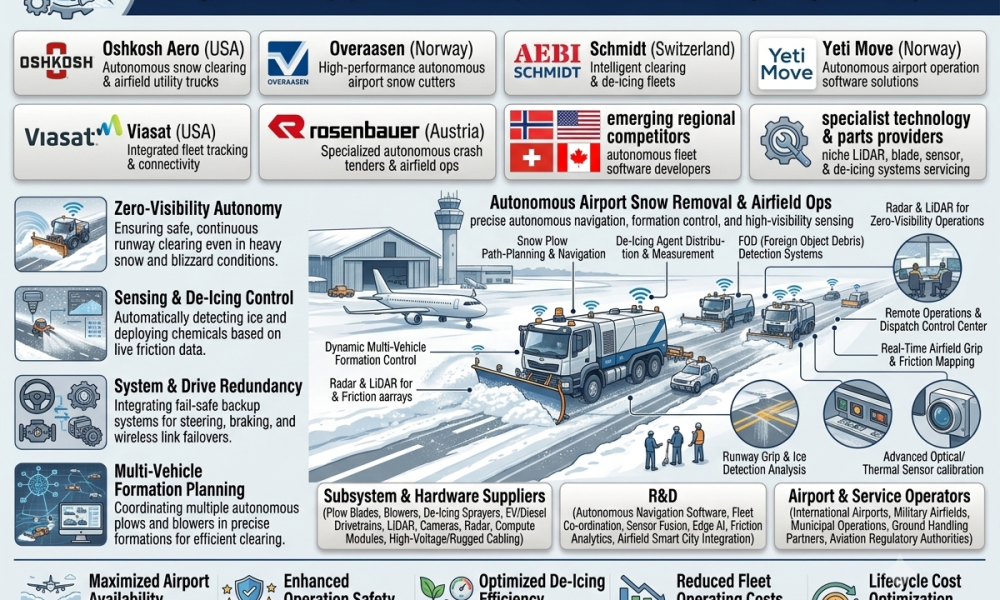
The global autonomous snow removal and airfield operations market is projected to expand at a 25.0% CAGR between 2026 and 2036, increasing from USD 188.0 million in 2026 to USD 1,751.0 million by 2036. Airports are increasingly evaluating autonomous equipment to maintain runway availability during winter conditions while reducing staff exposure around aircraft movement areas and improving response consistency during short operating windows.
Weather-related disruption remains an important operational concern for airports. The Federal Aviation Administration reported in March 2025 that 74.26% of system-impacting delays longer than 15 minutes from June 2017 through May 2023 were caused by weather. Winter operations therefore require airports to coordinate automated snow clearing with aircraft anti-ice systems, runway inspection procedures, and broader airfield recovery processes.
Airport operators are also placing greater emphasis on fleet readiness before severe weather arrives. Fleet health monitoring can help teams verify equipment availability, identify potential faults, and coordinate maintenance before snow events affect operations. Autonomous clearing vehicles must therefore demonstrate not only route consistency but also reliable technical support, inspection integration, and rapid recovery when individual units become unavailable.
What Are the Key Segments in the Autonomous Snow Removal & Airfield Ops Market?
The autonomous snow removal and airfield operations market is being shaped by specialized vehicle requirements, airfield applications, component integration, airport operating models, and service structures.
- Autonomous Airfield Plows – 40.0%: Autonomous airfield plows represent the leading vehicle type in 2026, supported by the clearer autonomy case presented by fixed runway routes and repeatable clearing patterns.
- Airfield Clearing – 48.0%: Airfield clearing represents the leading application category, reflecting the operational importance of restoring runway availability after snowfall and minimizing cascading schedule disruptions.
- Vehicles – 58.0%: Vehicles account for the leading component share in 2026, reflecting the high upfront value of specialized chassis, snow-clearing attachments, and associated airside equipment.
- Autonomous Plows, Sweepers, and Airfield Service Vehicles: Different vehicle configurations allow airports to match autonomous equipment with runway clearing, secondary airside routes, and supporting winter operations.
- Remote Supervision and Control Systems: Remote supervision remains an important element of autonomous airfield operations, allowing airport teams to monitor vehicle activity, respond to exceptions, and maintain operating records for safety review.
Get detailed market forecasts, competitive benchmarking, and pricing trends:
https://www.futuremarketinsights.com/reports/sample/rep-gb-34038
Which Countries Are Showing the Strongest Growth in Autonomous Snow Removal & Airfield Ops?
United States: The United States is projected to grow at a 26.0% CAGR between 2026 and 2036, making it the fastest-growing country in the supplied market comparison. US airports operate within a federal aviation certification framework that can support the repeated use of approved equipment specifications across multiple sites.
The ability to standardize equipment requirements across airport locations can help operators evaluate autonomous snow removal systems according to common performance and safety criteria. Airport teams are also assessing equipment readiness, service coverage, and maintenance response because a disabled clearing unit can reduce the time gained through automation elsewhere in the fleet.
Weather-related delays remain a significant operational consideration for US aviation. The Federal Aviation Administration’s analysis of system-impacting delays demonstrates the importance of maintaining airport operations during adverse weather conditions.
European Union: The European Union is projected to expand at a 24.0% CAGR through 2036. European airports operate under shared aviation rules, while individual national or local contracts can establish different service terms, response requirements, and maintenance arrangements.
This contracting environment influences how airport operators evaluate trial evidence, equipment support, spare-parts availability, and long-term maintenance commitments. Autonomous snow removal providers therefore need to demonstrate both operational reliability and the ability to support equipment throughout the winter operating season.
How Is Regional Demand Shaping the Autonomous Snow Removal & Airfield Ops Market?
Regional procurement priorities differ according to aviation regulations, winter weather conditions, airport infrastructure, contracting structures, and local service capabilities. The United States is benefiting from a common federal certification framework, while European airport procurement can involve varying national and local service requirements.
Across both regions, airport teams are increasingly evaluating autonomous snow removal as part of a wider airfield operations system rather than as an isolated vehicle purchase. Fleet readiness, remote supervision, runway inspection, aircraft anti-ice coordination, and technical maintenance all influence whether automation can deliver meaningful reductions in recovery time.
The commercial case also depends on consistent performance during actual winter events. Airports require equipment capable of operating repeatedly across defined routes while maintaining safe interactions with existing airside procedures and providing clear records for operational review.
What Is Changing the Competitive Landscape?
The competitive landscape includes autonomous mobility developers, airport ground equipment manufacturers, airfield operations technology companies, and specialized winter-service providers. Suppliers are differentiating through autonomous route capabilities, specialized vehicle platforms, controller visibility, fleet monitoring, and established ground equipment service networks.
Aurrigo International is expected to compete through autonomous vehicle technology and airside automation capabilities. Its participation reflects the growing role of autonomous mobility platforms in airport ground operations where repeatable routes can support controlled deployment.
Oshkosh AeroTech contributes specialized airport ground support equipment and service capabilities. Its position reflects the importance of combining airfield equipment engineering with established airport service and maintenance infrastructure.
ADB SAFEGATE participates in the broader airport operations technology ecosystem, with capabilities connected to airfield management and operational visibility. Integrated control and information systems can become increasingly relevant as autonomous vehicles are incorporated into airport workflows.
Anlon Technology Solutions contributes to the competitive environment through airport and airside technology solutions. Competition is increasingly centered on how effectively suppliers combine equipment, operational monitoring, and support capabilities rather than relying on vehicle automation alone.
As adoption expands, airport customers are expected to evaluate suppliers based on vehicle reliability, autonomous route performance, remote supervision, maintenance response, spare-parts coverage, and the ability to integrate equipment into existing airfield operating procedures.
What Does the Analyst Say About the Autonomous Snow Removal & Airfield Ops Market?
According to Nikhil Kaitwade, Principal Analyst at Future Market Insights, autonomous snow removal systems prove their value through dependable runway availability rather than vehicle automation alone.
“Autonomous snow removal systems prove their value through dependable runway availability rather than vehicle automation alone. Airport operators are looking for equipment that maintains safe clearing operations in changing winter conditions, supports predictable recovery from operational interruptions, and integrates smoothly with existing airside procedures. Long-term adoption will favor manufacturers that demonstrate reliable field performance, strong service networks, and practical operational support that helps airports minimize weather-related disruptions throughout the winter season.”
Airport procurement teams are therefore likely to assess automation alongside the wider operational chain. Equipment that performs reliably but lacks rapid maintenance support or clear handoff procedures may not deliver the expected reduction in runway recovery time.
Drive Your Business Growth Strategy: Checkout the Report for Key Insights!
https://www.futuremarketinsights.com/checkout/34038
What Is Driving Demand for Autonomous Snow Removal & Airfield Ops?
Runway Availability Supports Autonomous Clearing Adoption
Maintaining runway availability is a central driver of autonomous snow removal adoption. A runway closure can interrupt aircraft rotations, ground schedules, and connecting operations across the airport day, making recovery speed a direct capacity consideration.
Autonomous equipment can support repeatable clearing routes and allow airports to deploy vehicles consistently across predefined operating areas. The ability to perform these tasks under remote supervision can also reduce the requirement for personnel to remain continuously exposed to active airside environments during severe winter weather.
Weather-Related Delays Increase Operational Pressure
Weather remains a significant source of aviation disruption. The Federal Aviation Administration’s reported 74.26% share of system-impacting delays longer than 15 minutes caused by weather between June 2017 and May 2023 highlights the operational impact associated with adverse conditions.
For airports affected by snow and freezing weather, automated clearing can become part of a broader strategy for reducing the duration of operational interruptions. Integration with runway inspection and aircraft anti-ice processes remains important because clearing alone does not determine when a runway can safely return to service.
Fixed Routes Strengthen the Autonomy Case
Autonomous airfield plows benefit from repeatable routes and controlled operating environments. Unlike public roads with unpredictable traffic patterns, airport runways and designated airside routes can provide defined operating areas for autonomous vehicles.
This repeatability allows airport teams to establish route records, monitor equipment performance, and evaluate exception-handling requirements. Remote supervision can further support controlled deployment while keeping human operators involved in decisions requiring judgment or intervention.
Fleet Readiness Supports Winter Response
The value of autonomous snow removal depends on having sufficient equipment available when a storm approaches. Fleet health monitoring can help airport teams identify faults before deployment and coordinate maintenance across multiple vehicles.
A single unavailable unit can reduce overall clearing capacity and offset efficiency gains achieved elsewhere in the fleet. This makes preventive maintenance, spare-parts availability, technical support, and local service coverage important considerations in equipment purchasing decisions.
What Are the Key Market Restraints?
Integration with established airport operating procedures remains an important restraint. Autonomous snow removal vehicles must operate within controlled airside environments alongside aircraft, ground support equipment, inspection teams, and emergency procedures.
Airport operators also need confidence in safe stopping, remote intervention, communications reliability, and route management under changing weather conditions. Snow accumulation, visibility changes, surface conditions, and equipment faults can create situations requiring human intervention.
Long-term maintenance can create another procurement challenge. Airports may evaluate equipment differently depending on whether the supplier provides direct service, contracted maintenance, or a broader managed-operation model. Spare-parts coverage and technician availability can therefore influence adoption alongside the initial equipment price.
What Opportunities Exist for Autonomous Snow Removal & Airfield Ops Manufacturers?
The shift toward automated winter operations creates opportunities for manufacturers that can demonstrate reliable vehicle performance across repeated snow-clearing cycles. Suppliers capable of combining autonomous mobility with remote supervision and fleet health monitoring can address a broader portion of airport operational requirements.
There is also an opportunity to integrate autonomous snow removal with existing airfield management systems. Connecting vehicle status, route progress, maintenance alerts, runway inspection information, and operational controls can provide airport teams with greater visibility during severe weather events.
Service-based business models represent another opportunity. Airports may seek equipment-as-a-service, managed winter operations, or maintenance-backed contracts that reduce the internal burden of managing autonomous fleets. Suppliers with established local service networks can therefore differentiate through support capabilities beyond the vehicle itself.
How Is the Autonomous Snow Removal & Airfield Ops Market Segmented?
The autonomous snow removal and airfield operations industry is segmented by vehicle type, application, component, end-use, business model, and region.
By Vehicle Type: Autonomous airfield plows, autonomous sweepers, and other autonomous airfield service vehicles.
By Application: Airfield clearing, airport roadways, taxiway operations, and secondary airside areas.
By Component: Vehicles, control and autonomy systems, and services.
By End Use: Commercial airports, cargo airports, military airfields, and other aviation facilities.
By Business Model: Direct equipment purchases, service-based contracts, and retrofit programs.
By Region: North America, Latin America, Europe, East Asia, South Asia, Oceania, and the Middle East and Africa.
The segmentation enables airport stakeholders to compare autonomous winter equipment according to vehicle configuration, operational task, technology requirements, ownership structure, and regional aviation conditions.
What Are the Drivers, Restraints and Opportunities in the Autonomous Snow Removal & Airfield Ops Market?
The operational case for autonomous snow removal increasingly depends on dependable runway recovery, reliable fleet availability, safe remote supervision, and integration with established airport procedures.
- Autonomous airfield plows can perform repeatable clearing tasks on fixed routes while reducing personnel exposure during winter operations.
- Fleet health monitoring and remote supervision can help airports maintain equipment readiness and respond to operational interruptions.
- Suppliers combining autonomous vehicles with service networks, maintenance support, and integrated airfield visibility can address broader airport procurement requirements.
What Is the Autonomous Snow Removal & Airfield Ops Market Demand Outlook?
Demand for autonomous snow removal and airfield operations equipment is expected to remain connected to airport efforts to protect runway availability, reduce winter operational disruption, improve fleet readiness, and limit personnel exposure during severe weather.
The market is projected to increase from USD 188.0 million in 2026 to USD 1,751.0 million by 2036, expanding at a 25.0% CAGR. As airports move from isolated technology trials toward wider winter fleet deployment, procurement decisions are expected to increasingly consider autonomous route performance, safety procedures, maintenance response, remote supervision, and integration with runway inspection and airfield management systems.
Why Are Autonomous Airfield Plows the Leading Vehicle Type?
Autonomous airfield plows are projected to account for 40.0% of the vehicle type segment in 2026. Fixed runway routes and predictable clearing requirements create a controlled operating environment in which autonomous vehicle technology can be evaluated against measurable operational tasks.
The repeatability of runway clearing also enables airport teams to build operating records and assess whether automated equipment can consistently support winter recovery procedures.
Why Is Airfield Clearing the Leading Application?
Airfield clearing is projected to account for 48.0% of the application segment in 2026. Maintaining clear runways and associated operating surfaces is central to restoring aircraft movements following snow events.
Because runway closures can affect aircraft rotations and ground schedules across the operating day, airports have a direct operational incentive to improve the consistency and speed of winter clearing activities.
Why Are Vehicles the Leading Component?
Vehicles are projected to account for 58.0% of the component category in 2026. Specialized airport snow removal vehicles require dedicated chassis, attachments, propulsion systems, autonomy hardware, and other equipment capable of operating under demanding winter conditions.
The high equipment value also makes maintenance, fleet readiness, and service support important parts of the total procurement decision.
How Fast Are Key Countries Growing in the Autonomous Snow Removal & Airfield Ops Market?
The United States is projected to grow at 26.0% CAGR, followed by the European Union at 24.0% CAGR between 2026 and 2036. Differences in aviation certification structures, contracting practices, winter-service requirements, maintenance coverage, and airport fleet strategies are shaping the pace of autonomous snow removal and airfield operations adoption across these markets.
About Future Market Insights
Future Market Insights (FMI) is an ESOMAR-certified business consulting and market research firm and a member of the Greater New York Chamber of Commerce. FMI provides market intelligence, syndicated research, consulting, and industry analysis across multiple sectors. Its research combines primary research, secondary research, and proprietary forecasting models to support strategic business decisions.



