
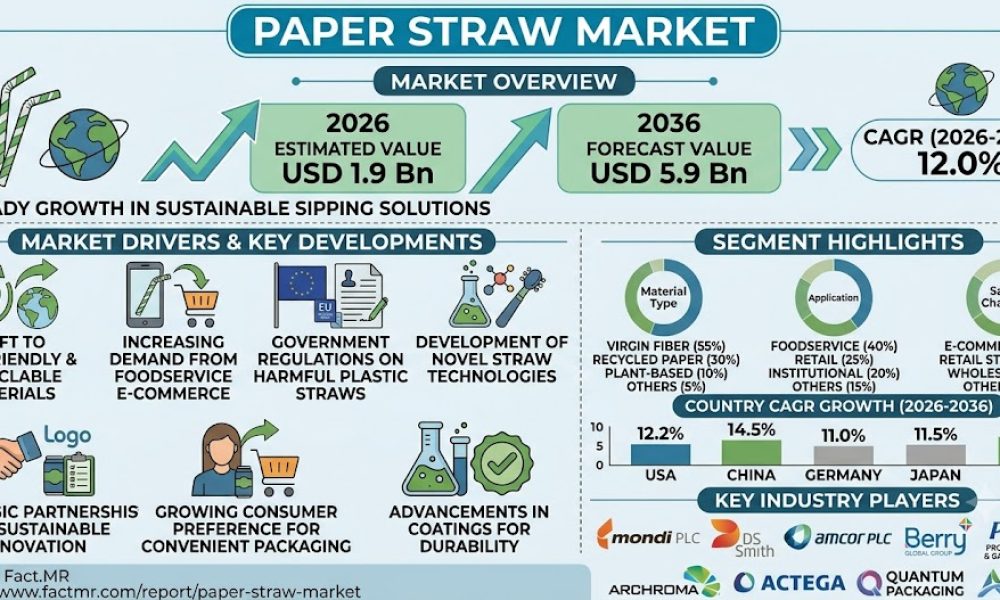
The global Paper Straw Market is projected to grow from USD 1.9 billion in 2026 to USD 5.9 billion by 2036, expanding at a 12.0% CAGR during the forecast period. The market was valued at USD 1.7 billion in 2025, with an absolute opportunity of USD 4.0 billion expected between 2026 and 2036.
Demand is being shaped by restrictions on single-use plastic straws, foodservice substitution, improving wet-strength paper technology and growing requirements for food-contact documentation. Restaurants, cafés, hospitality venues and beverage operators are also adopting standardized straw specifications across multiple outlets, creating recurring procurement demand.
Get Detailed Market Forecasts, Competitive Benchmarking, and Pricing Trends: https://www.factmr.com/connectus/sample?flag=S&rep_id=8765
Global Segment Leaders
- Printed Paper Straws — 72.6% share: Printed formats lead the Product segment because beverage and foodservice brands can use colors, graphics and customized designs to coordinate straws with cups, sleeves and other serving materials.
- Virgin Paper — 59.7% share: Virgin paper leads the Material segment because its consistent fiber furnish supports predictable winding, wall integrity, printing response and adhesive performance during commercial production.
- Foodservice — 42.3% share: Foodservice is the leading Application segment. Restaurants, cafés, beverage outlets and hospitality operators use straws continuously, while plastic-reduction policies are pushing these buyers to qualify alternative materials.
The report covers printed and non-printed paper straws, with virgin and recycled paper as the primary material categories. Applications include foodservice, household, institutional and other uses.
Country-Level Performance
- Germany — 13.1% CAGR: Germany is projected to expand at a 13.1% CAGR through 2036. The country’s ban on placing specified single-use plastic products, including drinking straws, on the market creates a direct replacement pathway for paper formats. Buyers also place emphasis on food-contact documentation, certified paper and reliable wet strength.
- Brazil — 12.0% CAGR: Brazil is projected to grow at a 12.0% CAGR. São Paulo’s Law No. 17.123 prohibits plastic straws in hotels, restaurants, bars, bakeries and other commercial establishments while permitting recyclable paper and other biodegradable alternatives. This supports demand across foodservice, hospitality and event channels.
- USA — 10.9% CAGR: The U.S. market is forecast to expand at a 10.9% CAGR. Demand is influenced by state, municipal and corporate foodservice policies rather than one nationwide plastic-straw rule. California’s requirements around on-request distribution of single-use foodware accessories are encouraging restaurant chains to standardize alternative serving formats.
- U.K. — 9.7% CAGR: The U.K. is projected to grow at a 9.7% CAGR. England has restricted the supply of single-use plastic straws since October 2020, subject to defined exemptions. This keeps paper-straw performance relevant across cafés, pubs, quick-service restaurants, takeaway counters and hospitality venues.
- Japan — 8.6% CAGR: Japan is projected to expand at an 8.6% CAGR. Drinking straws are included among specified plastic-use products under the country’s Plastic Resource Circulation framework, with paper straws cited as one option for reducing specified plastic use in restaurants, lodging, retail and delivery.
Regional Context
The Paper Straw Market covers North America, Latin America, Europe, East Asia, South Asia and Oceania, and the Middle East and Africa. Germany records the highest CAGR among the profiled countries, followed by Brazil, the USA, the U.K. and Japan.
Europe is seeing direct demand support from restrictions on single-use plastic straws. Brazil provides a regulatory substitution pathway through São Paulo’s foodservice rules. In the USA, fragmented state and local requirements are encouraging national restaurant chains to consider common alternative specifications. Japan’s resource-circulation framework is supporting operator-led substitution across foodservice and hospitality.
Market Drivers and Opportunities
Plastic-straw restrictions and formal reduction rules have an estimated +1.7 percentage-point impact on CAGR, making them the largest listed driver. Foodservice substitution contributes an estimated +1.4 percentage points, while custom-printed straw procurement adds approximately +1.0 percentage point. Improvements in wet-strength multi-ply paper have an estimated +0.8 percentage-point impact.
Key opportunities include:
- Custom printing and private-label programs: These have an estimated +0.9 percentage-point impact on CAGR and allow foodservice brands to use straws as part of their serving presentation.
- High-durability formats: Smoothies, specialty drinks and cocktails require larger diameters and stronger constructions, creating an opportunity for suppliers able to maintain rigidity during longer consumption periods.
- Institutional procurement: Schools, healthcare facilities and offices represent a potential long-term demand channel, particularly in Europe, the USA and Japan.
- Recycled-paper designs: Suppliers that combine recycled fiber with food-contact compliance and adequate wet strength can address buyers seeking lower-impact material options.
The market also faces practical constraints. Softening, sogginess and mouthfeel concerns during prolonged use have an estimated -1.0 percentage-point impact on CAGR. A unit-cost premium versus conventional alternatives, food-contact compliance requirements for inks and adhesives, and the increasing use of strawless lids and reusable formats can further limit adoption.
Competitive Landscape
Key companies profiled in the Paper Straw Market include Huhtamäki, Bygreen, Charta Global, Inc., OkStraw Paper Straws, Footprint LLC, BioPak UK, UFlex Limited, Hoffmaster Group Inc., The Paper Straw Co, Transcend Packaging Ltd. and Canada Brown Eco Products Ltd.
Competition is centered on wet strength, diameter options, food-contact compliance, fiber sourcing, printing quality and supply consistency. Buyers increasingly need straws that remain functional for the expected beverage-use period while meeting procurement and regulatory specifications.
Huhtamaki competes through certified fiber and food-safety documentation, with its current paper straws using 100% PEFC-certified paper. BioPak UK offers 3-ply FSC Mix paper straws in different diameters and uses flexographic printing with food-contact-safe inks for branded foodservice programs.
The competitive environment is therefore moving beyond simple plastic replacement. Suppliers need to demonstrate consistent converting, reliable wet performance and the ability to supply customized specifications across multi-site foodservice operations.
Analyst Perspective
Shambhu Nath Jha, Principal Consultant at Fact.MR, states:
“Paper-straw procurement is moving from a simple plastic-replacement decision to a performance and specification decision. Foodservice buyers need a straw that keeps rigidity through the beverage-use window, meets food-contact requirements and can be supplied at chain scale. Suppliers that combine stable multilayer converting, certified fibre and reliable custom printing are positioned to win repeat contracts as plastic restrictions broaden.”
The report’s strategic assessment indicates that converters should match ply count, paper basis weight and adhesive application to beverage dwell time rather than relying on one construction for every use. Foodservice chains also need to qualify products according to beverage viscosity, diameter, serving temperature and expected consumption time.
Explore More Related Studies Published by Fact.MR Research:
Electric Air Duster Market
Candle Making Kit Market
About Fact.MR
Fact.MR is a market research and consulting firm providing syndicated and customized research across packaging, food and beverage, consumer goods, healthcare, technology, industrial goods, and chemical and materials markets. Its research combines primary research, secondary sources, company analysis and market modeling to support business planning and strategic decisions.



