
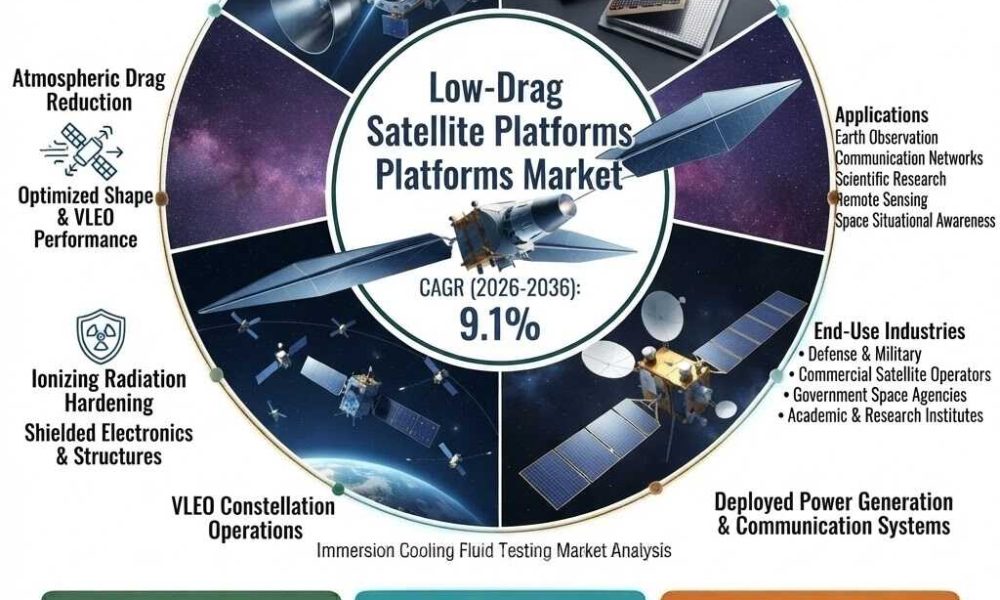
The global Low-Drag Satellite Platforms Market is projected to increase from USD 14.9 billion in 2026 to USD 35.5 billion by 2036, registering a 9.1% CAGR during the 2026–2036 forecast period. The market reached USD 13.6 billion in 2025, with an absolute opportunity of USD 20.6 billion expected between 2026 and 2036.
Demand is being supported by lower-altitude Earth observation architectures, proliferated defence and ISR constellations, electric station-keeping efficiency, and compact bus manufacturing at constellation scale. In August 2025, the Federal Aviation Administration marked the 1,000th licensed or permitted commercial space operation, reflecting continued expansion of commercial space activity and launch access.
Get detailed market forecasts, competitive benchmarking, and pricing trends https://www.factmr.com/connectus/sample?flag=S&rep_id=16569
Global Segment Leaders
- Bus Aerodynamics: Slender low-area bus — 32.0% share in 2026; smaller frontal area helps reduce aerodynamic drag in lower orbits.
- Operating Orbit: 120–180 km — 28.0% share in 2026; the band combines close-to-Earth mission benefits with substantial drag-control requirements.
- Drag Management: Electric compensation — 35.0% share in 2026; direct electric thrust can compensate for velocity losses caused by atmospheric drag.
- Mission: Earth observation — 31.0% share in 2026; lower orbits can shorten sensing distance and support Earth-observation missions.
Country-Level Performance
| Country | CAGR | Key Growth Driver |
| United States | 10.1% | In September 2025, Space Systems Command reported that 21 Tranche 1 Transport Layer satellites had been successfully delivered on orbit for the Space Development Agency’s Proliferated Warfighter Space Architecture. |
| Germany | 9.8% | In November 2025, the German Aerospace Center said Germany was contributing about EUR 5.4 billion to ESA programs supporting satnav and Earth observation work. |
| France | 9.5% | In July 2025, CNES said the CO3D constellation uses four small Earth observation satellites, supporting demand for compact platforms with precise pointing. |
| United Kingdom | 9.1% | In February 2025, the UK Space Agency awarded GBP 16 million to satellite-constellation projects under its C-LEO programme. |
| Japan | 7.9% | Japan’s Cabinet Office says the Space Strategy Fund has a target of about JPY 1 trillion covering satellites, space transportation, and exploration. |
Regional Context
The United States, Germany, and France represent the faster-growing country markets in the report. U.S. demand is linked to large LEO defence programs, high launch activity, and common small-bus requirements. Germany’s growth is supported by public space funding, satnav programs, and Earth observation work, while France is benefiting from compact Earth observation missions and sovereign space capabilities.
The United Kingdom is forecast to grow at 9.1%, supported by LEO communications, constellation projects, and a widening supplier base. Japan records the slower growth rate among the five profiled countries at 7.9%, with public space funding and domestic satellite and Earth observation programs supporting demand.
Full regional coverage spans North America, Latin America, Western Europe, Eastern Europe, East Asia, South Asia & Pacific, and Middle East & Africa, with five countries specifically profiled in the country-level analysis.
Competitive Landscape
Key companies profiled in the Low-Drag Satellite Platforms Market include Airbus Defence and Space, Thales Alenia Space, Redwire, and York Space Systems. Airbus Defence and Space supports high-rate LEO satellite production and Earth-observation platforms, while Redwire has a direct VLEO position through its SabreSat and Phantom spacecraft. Thales Alenia Space contributes to the IRIS² LEO constellation through digital and secure telecommunications payloads, while York Space Systems supplies spacecraft for the Space Development Agency’s Transport Layer. Recent developments cited in the report include Airbus being awarded an Eutelsat contract for a further 340 low Earth orbit OneWeb satellites in January 2026, and York Space Systems deploying the second layer of the T1TL Transport System in July 2026.
Japan is forecast to grow at 7.9% CAGR through 2036. Japan’s Cabinet Office says the Space Strategy Fund has a target of about JPY 1 trillion and supports three areas: satellites, space transportation, and exploration. Domestic bus work is forecast to gain where low-height missions need slim shapes and efficient orbit control.
To view related Reports
About Fact MR
(Fact MR) is a leading provider of market research and consulting services, offering syndicated and customized research across industries including aerospace, defense, and satellite communications.



