
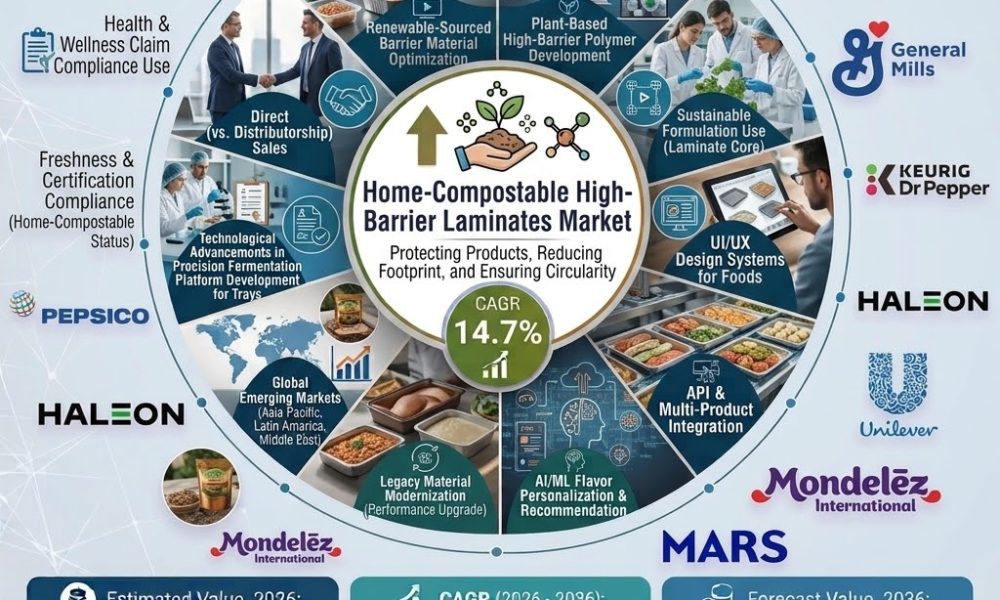
The global home-compostable high-barrier laminates market is valued at USD 2.8 billion in 2026 and is projected to reach USD 10.9 billion by 2036, expanding at a 14.7% CAGR during the forecast period. The market reached USD 2.4 billion in 2025, creating an absolute opportunity of USD 8.1 billion between 2026 and 2036.
Demand is being shaped by the need to protect food and snacks from oxygen and moisture while reducing dependence on conventional flexible laminates. Pack makers are also looking for materials that can run on existing film, coating, and lamination lines. On April 29, 2026, BASF said its certified home-compostable ecovio grades support extrusion coating, film extrusion, and lamination, with adjustable oxygen and moisture barriers. California’s CalRecycle also announced on May 1, 2026, that SB 54 packaging regulations require a 25% reduction in covered single-use plastic material by 2032 against the 2023 baseline.
Get Detailed Market Forecasts, Competitive Benchmarking, and Pricing Trends: https://www.factmr.com/connectus/sample?flag=S&rep_id=16554
Global Segment Leaders
- PLA-Based Laminates – 36.0%: PLA-based structures lead the laminate platform segment in 2026. Their compatibility with established film, coating, and lamination routes supports their use in flexible packaging.
- High Oxygen Barrier – 31.0%: High oxygen barrier structures account for the largest share of the barrier-level segment. They are used where oxidation can affect food quality and shelf life.
- Single-Serve Sachets – 29.0%: Single-serve sachets lead the pack-format segment. These small packs require reliable seals and strong product protection while using relatively little material.
- Industrial Compostable – 33.0%: Industrial compostable systems hold the largest share of the end-of-life segment. Controlled composting facilities provide more stable conditions for established composting and certification routes.
The report also covers PHA-based, cellulose-based, PBAT/starch, and paper-biopolymer laminates. Barrier options include moisture, grease, aroma, and combined ultra-barrier structures. Other pack formats include snack pouches, flow wraps, lidding webs, and stand-up pouches.
Country-Level Performance
- China – 15.3% CAGR: China records the highest growth rate among the five profiled countries. The National Bureau of Statistics reported on January 20, 2026, that online retail sales of food increased 14.5% in 2025. Higher online food activity supports demand for small flexible formats such as sachets and pouches.
- United States – 14.8% CAGR: U.S. growth is supported by its large food-packaging base and state-level packaging rules. The USDA Economic Research Service reported on June 11, 2026, that U.S. food spending reached USD 2.51 trillion in 2025, creating a substantial base for barrier packaging applications.
- Japan – 14.8% CAGR: Japan’s market is linked to processed food and compact retail-pack formats. The USDA Foreign Agricultural Service reported on April 1, 2026, that Japan’s food-processing sector was valued at USD 174 billion in 2025, despite contracting by 3% during the year.
- Germany – 14.6% CAGR: Germany’s growth is supported by ready-meal production and packaging requirements. Destatis reported on January 14, 2026, that German manufacturers produced 1.7 million tonnes of ready meals in 2024.
- France – 14.1% CAGR: France records the lowest CAGR among the profiled countries. INSEE reported on July 21, 2026, that French food, beverage, and tobacco manufacturing recorded EUR 207 billion in production value in 2025, providing a broad base for food-packaging applications.
Regional Context
The five-country comparison spans 1.2 percentage points, from China’s 15.3% CAGR to France’s 14.1%. China leads as online food sales and flexible-packaging demand create opportunities for compostable sachets and pouches.
The United States and Japan both record 14.8% CAGR, although their demand settings differ. U.S. growth is tied to its large food-spending base and packaging regulations, while Japan’s market is influenced by processed-food production and compact pack formats.
Germany follows at 14.6%, supported by ready-meal production and packaging requirements. France records 14.1%, with its large food-manufacturing base and packaging-waste policy shaping material trials.
The report covers North America, Latin America, Western Europe, Eastern Europe, East Asia, South Asia & Pacific, and Middle East & Africa, with detailed country analysis for the United States, China, Germany, Japan, and France.
Competitive Landscape
The competitive landscape includes BASF, Novamont, TIPA, and Futamura Chemical. These companies address different parts of the compostable flexible-packaging value chain, including biopolymers, cellulose films, coatings, laminates, and finished flexible structures.
BASF supplies its ecovio® portfolio for flexible packaging. On April 29, 2026, the company announced new ecovio grades designed for flexible packaging applications, including extrusion coating, film extrusion, and lamination. The portfolio addresses oxygen, moisture, grease, and liquid-barrier requirements.
Novamont supplies MATER-BI® biodegradable and compostable polymers for film, coating, and lamination applications. Its materials provide a platform for converters developing compostable flexible packaging.
TIPA specializes in compostable flexible packaging, with solutions designed for applications where compostability and flexible-pack performance need to be combined.
Futamura Chemical supplies NatureFlex™ cellulose-based compostable films. The report notes that the range includes home- and industrial-compostable films with high oxygen and gas barriers, moisture-barrier options, printability, and heat-seal grades.
Across the competitive landscape, suppliers are differentiating through barrier performance, sealing behavior, compostability certification, printability, and compatibility with existing converting processes. The report also highlights the need to test finished packs after printing, sealing, and storage rather than assessing resin identity alone.
Analyst Opinion
Shambhu Nath Jha, Principal Consultant at Fact.MR, states:
“The commercial test is simple: the finished pack must keep its barrier and seal performance during use. Brand owners are expected to ask for clear proof on oxygen control and moisture resistance. They also need clear composting claims. Firms that pair material know-how with pack maker support can shorten testing work.”
Explore More Related Studies Published by Fact.MR Research:
Bio Polymer Processing Aids Market
Halogen-Free Extrusion Aids Market
About Fact.MR
Fact.MR is a leading provider of market research and consulting services, offering syndicated and customized research across industries including Consumer Goods, Healthcare, and Chemicals & Materials.



