
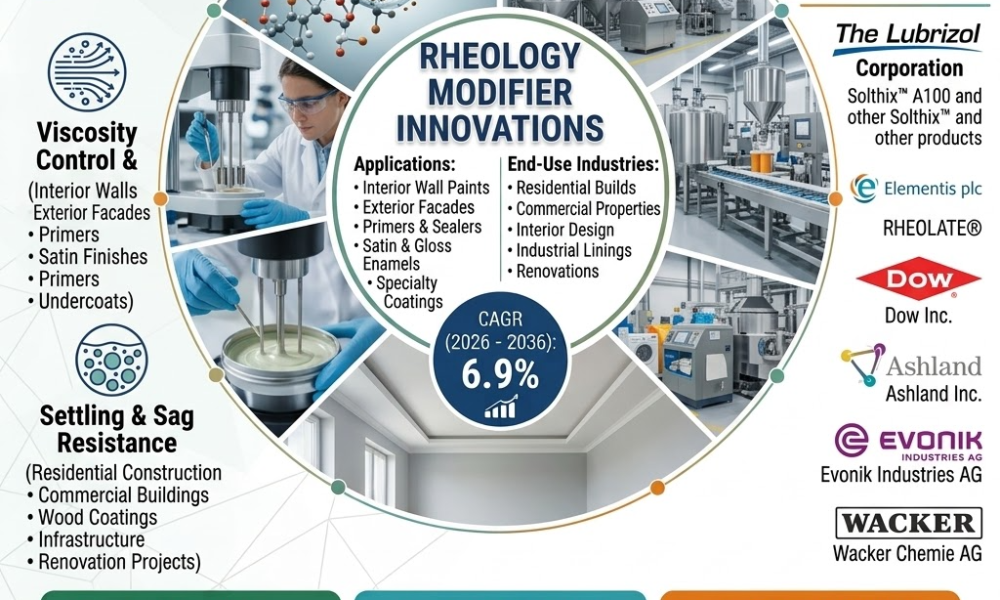
The global Architectural Rheology Modifiers Market is projected to increase from USD 1.8 billion in 2026 to USD 3.5 billion by 2036, advancing at a 7.0% CAGR, according to Fact.MR analysis. The market crossed USD 1.7 billion in 2025 as paint formulators refined waterborne architectural paint systems around viscosity control, sag resistance, application feel, and low-VOC requirements.
The market is expected to create an absolute opportunity of USD 1.71 billion through 2036. Demand is being shaped by recurring interior repaint activity, construction and renovation cycles, contractor requirements for lower spatter, and the need for consistent viscosity after tinting. The U.S. Census Bureau reported construction spending of USD 2,164.4 billion in 2025, providing a measurable construction base for architectural coating demand.
Get detailed market forecasts, competitive benchmarking, and pricing trends
Cellulosic HEC and HMHEC account for 34.0% share
Cellulosic HEC and HMHEC are expected to hold a 34.0% share of the Architectural Rheology Modifiers Market in 2026. Their position is linked to broad use in waterborne architectural paints, particularly where formulators need dependable storage viscosity and sag resistance.
Low-shear and sag control is projected to account for 30.0% share during 2026. Vertical-wall application keeps anti-sag performance central to product design, while mid-shear and KU build influence brush loading and roller pickup.
Interior wall paints represent another major demand center. The segment is anticipated to capture 38.0% share in 2026, supported by repaint frequency and the breadth of do-it-yourself channels. Acrylic latex is estimated to represent 36.0% of the formulation platform segment, reflecting its use in washable, low-odor and durable architectural coatings.
Rheology modifiers help paints maintain application properties after colorants are added. This requirement is particularly relevant to tint-center operators that need repeatable viscosity across multiple paint bases.
Low-VOC reformulation changes additive requirements
Low-VOC architectural paint reformulation is identified as a leading market driver, with an estimated +1.4% impact on CAGR. Formulators are replacing solvent-heavy viscosity packages with additives designed to retain application feel, flow and finish quality in premium interior paints.
Interior repaint and renovation cycles represent another demand driver, with a +1.2% impact on CAGR. Sag and spatter control contributes an estimated +0.9%, while waterborne acrylic latex penetration adds approximately +0.8%.
Bio-based additive development also remains relevant. BASF SE stated in June 2025 that its Rheovis range had moved toward bio-based ethyl acrylate, with up to 35% biogenic content and up to 30% lower product carbon footprint compared with fossil-based versions.
Shambhu Nath Jha, Principal Consultant at Fact.MR, said, “Rheology is now a performance language inside architectural paints. Formulators are expected to select modifiers by application feel, storage stability and low-VOC binder fit. Suppliers need cellulosic depth, associative thickening know-how and clear lab guidance.”
Raw-material and additive-cost sensitivity remains a restraint, carrying an estimated -0.6% impact on CAGR. Compatibility limits across acrylic, VAE and styrene-acrylic latex platforms can also extend laboratory testing before commercial production.
Germany records the fastest growth among analyzed markets
Germany is projected to advance at a 7.9% CAGR through 2036, supported by permit recovery and renovation-grade paint demand. Destatis reported that 238,500 dwellings were approved in Germany during 2025, representing a 10.8% increase from 2024.
The USA is expected to record a 7.5% CAGR. The U.S. Census Bureau reported that local permit offices authorized 1,431,616 privately owned housing units during 2025, supporting demand for acrylic latex systems requiring reliable sag control across tinted interior paints.
The UK is projected to expand at 7.0% CAGR. Construction repair activity supports additives that improve roller pickup and help limit visible application defects in occupied homes.
The Netherlands is estimated to grow at 6.7% CAGR through 2036, while Japan is forecast to register 6.3%. Statistics Netherlands reported that nearly 80,000 homes were added to the country’s housing stock in 2025. In Japan, MLIT reported a 13.7% rise in private construction orders among 50 major contractors during fiscal 2025.
Suppliers focus on application-specific rheology systems
Ashland Inc. participates through Aquaflow™ and Aquavis™ associative thickener platforms. Its May 2026 American Coatings Show release highlighted Aquavis™ ULS 250 and ULS 255 for Stormer viscosity build, formulation control, flow and leveling, with ULS 255 identified as a low-VOC option.
Dow Inc. supplies ACRYSOL™ rheology modifiers for waterborne architectural coatings. ACRYSOL™ DR-125 is positioned for medium-shear KU viscosity in interior and exterior paints, while ACRYSOL™ DR-73 addresses mid-shear KU and high-shear ICI viscosity.
Nouryon offers Bermocoll® cellulose ethers, including Bermocoll® EHM MAX, which the company featured for architectural paints in March 2025. BASF SE competes through Rheovis®, Attagel®, Attaflow® and Efka® platforms. Elementis plc and The Lubrizol Corporation add further competition through RHEOLATE® and Solthix™ A100 products.
“Paint manufacturers need predictable formulation behavior before moving a rheology package into commercial batches,” said Shambhu Nath Jha, Principal Consultant at Fact.MR. “That makes application testing, compatibility work and technical support increasingly relevant for suppliers.”
The Fact.MR assessment draws on more than 120 sources, 35 company portfolios, 25 countries and more than 20 interviews with additive suppliers, paint formulators, distributors, contractors and brand teams. The analysis covers chemistry, shear regime, paint segment, formulation platform and regional demand from 2026 to 2036.
To View Top Reports
About Fact.MR
Fact.MR is a market research and consulting firm providing syndicated and customized research across global industries. Its research combines primary interviews, desk research, company portfolio analysis and quantitative market forecasting to support business planning and strategic decision-making.



