
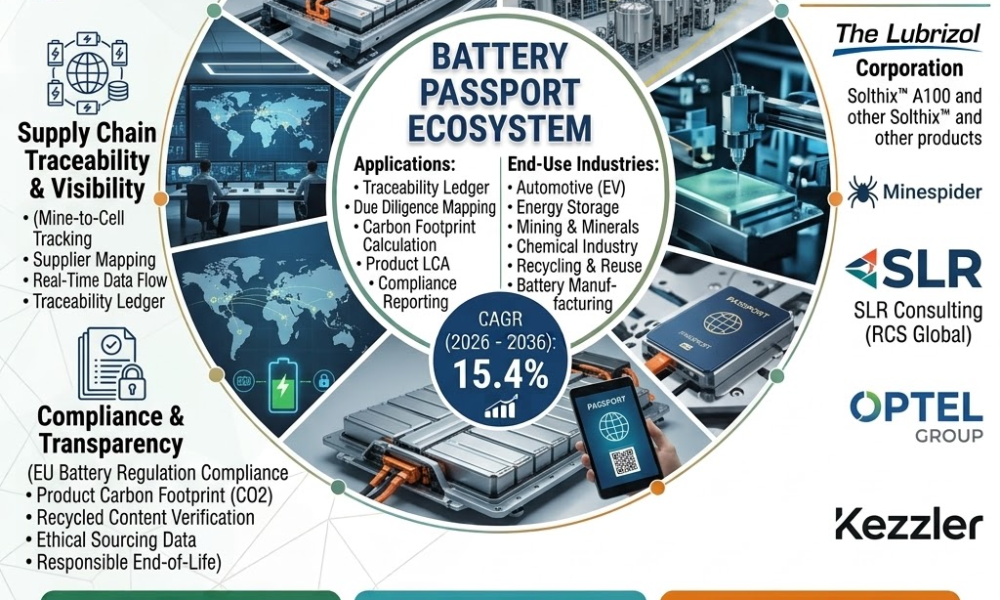
The global Battery Passport Market is projected to grow from USD 400.0 million in 2026 to USD 1,675.4 million by 2036, expanding at a 15.4% CAGR, according to Fact.MR. The market reached USD 346.6 million in 2025, with regulatory preparation, electric vehicle battery data requirements, and lifecycle traceability shaping demand through 2036.
The market is expected to generate an absolute opportunity of USD 1,275.4 million between 2026 and 2036. The European Commission’s battery passport framework is a central demand driver, with the implementation timeline listing July 20, 2026 for the Digital Product Passport Registry to become operational, subject to applicable publication requirements.
Battery passports are becoming a data-management requirement for companies involved in battery production and use. Manufacturers need structured records covering battery identity, performance, and lifecycle information, while automotive companies need QR-linked records for batteries subject to passport requirements.
Get detailed market forecasts, competitive benchmarking, and pricing trends
Battery Passport Market is a market for software and services that create, maintain, verify, and share digital battery passport records for covered batteries.
Battery Passport Software leads the product segment
Battery Passport Software is expected to account for 63.7% of market share in 2026. The segment benefits from demand for maintained records that remain accessible after production and through service events.
Data management platforms organize supplier files and battery identifiers. Compliance management software helps companies manage required information, while implementation and managed services support organizations dealing with fragmented supplier records.
Blockchain Technology is projected to account for 36.9% share in 2026. Blockchain-based systems can support traceable records when material, component, and ownership events move between multiple organizations.
Cloud Based Deployment is anticipated to capture 58.4% share in 2026. Cloud platforms allow suppliers, manufacturers, automotive companies, and other participants to update and access defined passport information without duplicating every internal database.
Lithium Ion Batteries and Electric Vehicles shape demand
Lithium Ion Batteries are estimated to represent 72.6% share in 2026. Electric vehicles are forecast to account for 49.3% of market demand during the same year, reflecting the relevance of passport requirements to EV batteries entering the European market.
Battery Manufacturers are projected to hold 34.8% share by end use in 2026. These companies coordinate chemistry records and component evidence before finished batteries reach customers.
The United States Energy Information Administration reported in July 2026 that hybrids, battery electric vehicles, and plug-in hybrids represented 24% of U.S. light-duty vehicle sales during the second quarter of 2026. This provides an important operating context for battery data systems serving vehicle manufacturers and exporters.
Germany records the fastest country-level growth
Germany is projected to register a 17.7% CAGR through 2036. The country benefits from EU regulatory proximity and established battery manufacturing activity.
The Federal Ministry for Economic Affairs and Energy reported that 545,142 battery electric passenger cars were newly registered in Germany during 2025. Battery passport activity is therefore expected to concentrate around production data, supplier verification, and export-ready records.
Brazil follows with a projected 16.1% CAGR. The United States is estimated to expand at 14.6%, while the United Kingdom and Japan are forecast to record CAGRs of 13.1% and 11.5%, respectively.
These markets face different implementation conditions. Regulatory timing, battery manufacturing depth, supplier readiness, and electrified vehicle adoption influence how companies approach passport systems.
Regulatory preparation creates new data requirements
The European Commission’s framework makes battery identification and performance information central to passport records. Passport data can also support repair, reuse, and recycling decisions by giving downstream participants access to relevant lifecycle evidence.
Supplier data ownership remains a restraint. Battery passport records can require information from material suppliers, cell manufacturers, module producers, and pack manufacturers, creating additional coordination requirements.
Sensitive commercial information presents another challenge. Passport platforms need permission controls that allow required information to reach regulators and partners without exposing confidential supplier relationships.
Managed supplier onboarding represents a further opportunity. Smaller suppliers may still maintain evidence through certificates and spreadsheets, creating demand for services that convert those records into structured passport fields.
Competitive landscape focuses on traceability and verification
Circulor, Circularise, Minespider, SLR Consulting (RCS Global), OPTEL GROUP, and Kezzler are among the companies profiled in the Battery Passport Market.
In June 2026, Bureau Veritas and Circulor announced a strategic collaboration covering battery passport implementation, supply-chain traceability, verification, carbon-footprint assessments, responsible sourcing, and regulatory alignment.
Circularise became a Supporting Partner in BatteryPass-Ready in February 2026. The initiative focuses on testing battery passport data completeness, plausibility, system consistency, and interoperability.
Kezzler’s second-quarter 2026 platform updates expanded its Digital Product Passport capabilities, including Product Passport template management.
Shambhu Nath Jha, Principal Consultant at Fact.MR, said, “Battery passports turn compliance into a maintained data operation. Manufacturers need platforms that keep evidence current after production and shipment, while effective solutions combine battery-specific data models, permission controls and verification workflows in one operating layer.”
The operational focus is becoming clearer. Companies need data ownership before platform selection, while automotive manufacturers need vehicle identifiers connected with battery passport records at the model-program stage.
About the Battery Passport Market Report
The Fact.MR Battery Passport Market report analyzes software and services used to create, maintain, verify, and share digital battery passport records. The study covers product, technology, deployment, battery type, application, end use, and regional markets.
The analysis draws on more than 120 sources, over 35 company portfolios, 25+ countries, and more than 20 industry interviews. The report covers North America, Latin America, Western Europe, Eastern Europe, East Asia, South Asia and Pacific, and Middle East and Africa.
For related market context, Fact.MR also tracks [LINK: blockchain vehicle traceability market] across automotive supply-chain applications.
To View Top Reports
About Fact.MR
Fact.MR is a market research and consulting firm providing syndicated and customized research across industries. Its research combines primary interviews, secondary sources, company activity, regulatory developments, market sizing, and forecasting to assess changing business conditions.



