
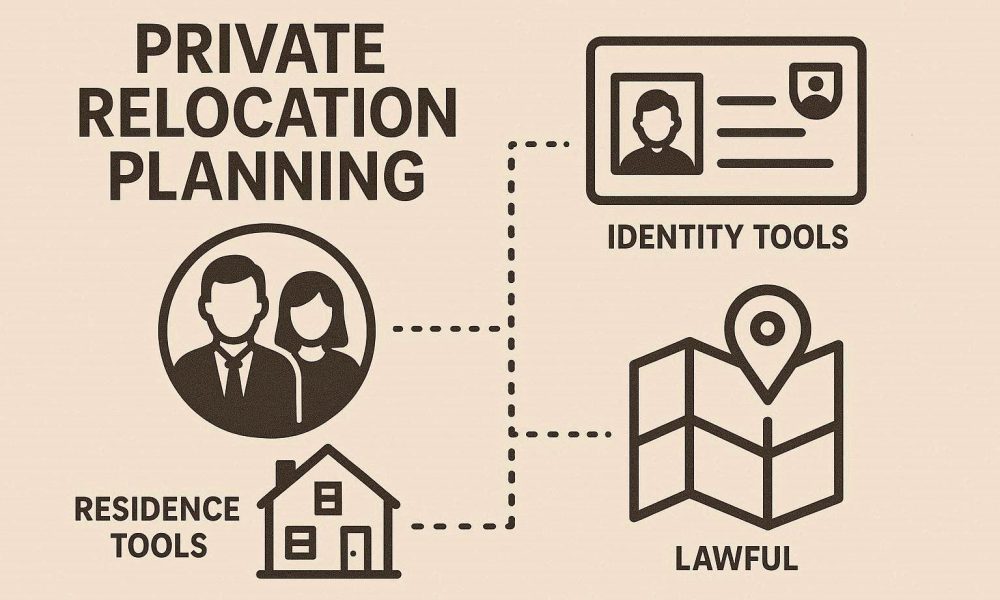
Discreet move strategies for high-profile clients are built around second citizenship, residence rights, documented identity updates, and private logistics that still hold up under review.
WASHINGTON, DC, June 25, 2026
For high-profile clients in 2026, private relocation is no longer about disappearing. It is about relocating lawfully and quietly, with enough legal, banking, and documentation discipline that a single move does not trigger unnecessary exposure across every part of life at once.
Serious relocation planning now depends on residence rights, travel status, identity coherence, banking access, and tax clarity, all working together within a single framework. What the law can support is mobility through lawful status. What it does not support is creating multiple contradictory personas for the same person. The U.S. government’s guidance on dual nationality reflects that reality by recognizing that one person may hold more than one nationality while still carrying legal obligations tied to each country involved.
That distinction matters because many clients use the language of secrecy when what they actually need is lawful privacy. They want to move without broadcasting every detail of the transition. They want fewer unnecessary disclosures to landlords, intermediaries, banks, or service providers. They want more than one place from which to live legally, travel predictably, and bank coherently. Those goals are valid, but they are achieved through legal status, disciplined records, and quiet logistics rather than through invented identities. A private move that survives scrutiny is almost always built on one truthful record trail, not two competing ones.
Start with legal status, not with logistics
The first mistake in relocation planning is focusing on flights, movers, property searches, or communications channels before the underlying legal platform is settled. For high-profile clients, the stronger sequence usually begins with status. Can the client reside lawfully in the destination country? Do they already have a second nationality, or do they need one? Are they relocating on the basis of citizenship, residence permission, family ties, work authorization, or a longer-term naturalization strategy? Until that legal question is answered, everything else remains fragile, because the move may look quiet on the surface while still creating stress across banking, property, and tax systems later.
This is why lawful second citizenship or residence rights are often the real foundation of private relocation. A second nationality can broaden mobility and reduce dependence on a single political or administrative system. A residence right can create a legal basis on which housing, banking, and local integration become easier to manage. Neither creates a second self. Both create a stronger legal basis for one real person to move and operate with less friction. Families reviewing how lawful mobility, banking, and continuity should fit together often begin by examining the broader framework through Amicus International Consulting.
Update the identity record before the visible life changes
Once the legal basis for relocation is clear, the next issue is record alignment. Many private moves become more visible than necessary because the outward life changes before the underlying records do. A client changes countries, changes how they present themselves publicly, changes their banking arrangements, and perhaps even changes their legal name, yet the civil and identity documents underlying those changes remain unresolved. That sequence creates avoidable friction. Institutions then start asking basic questions all at once, which is exactly what a privacy-conscious move is meant to avoid.
The stronger approach is to let the deep record move first. If there has been a lawful name change, the supporting legal basis and identity documents should be updated in the correct order. The USCIS policy guidance on travel and identity documents reflects the broader rule that secure identity documents depend on lawful identifying information and supporting evidence when documents are reissued or updated. That matters well beyond immigration paperwork. It affects banking, property, work history, and travel. A coherent relocation is one in which the legal file, the travel file, and the banking file tell the same truthful story before the visible life is treated as settled. The client is still one continuous person. The records simply become cleaner and more aligned with the present reality.
Coordinate the move quietly by separating functions
Private relocation becomes much easier when the move is not treated as a single event handled through a single channel. High-profile clients often expose themselves unnecessarily by allowing housing, banking, travel, communications, and family logistics to flow through too few people or too few institutions. The result is that too many counterparties see too much of the broader picture. Privacy weakens not because the move was unlawful, but because the move was administratively loud.
A better structure separates functions. One team or adviser may handle legal status and residence filings. Another may handle banking and source-of-funds documentation. Another may manage housing or local setup through narrow instructions rather than broad disclosures. A family office may coordinate the sequence without giving every participant access to the full plan. This is not concealment. It is controlled compartmentalization. Each participant sees what their function requires, and no more. That is one of the most reliable ways to make a move quieter without compromising its legality.
Secure communications matter more than dramatic measures
Many clients overestimate exotic privacy tools and underestimate basic communications discipline. In real relocation planning, privacy is more often lost through ordinary email habits, overbroad forwarding, casual sharing of passport scans, housing documents, banking letters, or itinerary details than through spectacular breaches. High-profile clients often create their own exposure by copying too many people, reusing the wrong channels, or allowing sensitive material to circulate without clear boundaries.
The stronger habit is boring and deliberate. Use a limited number of trusted channels. Keep legal, banking, and relocation documents out of casual inboxes whenever possible. Separate strategic conversations from scheduling chatter. Avoid sending full document sets to people who need only one page or one answer. Within a family office or adviser network, not everyone needs the same level of visibility. A private move benefits from governance more than from theatrics. The quieter the communications architecture, the less likely it is that the relocation becomes overexposed through convenience rather than through necessity.
Housing should be lawful, bankable, and low-drama
Securing new living arrangements is often where relocation plans become noisy. Property managers, brokers, landlords, utilities, and local service providers may all demand information, yet not all of them need the same information or the same level of detail. A family that treats every housing request as an excuse to reveal its whole financial and personal picture usually creates more exposure than necessary. At the same time, trying to hide the lawful basis for residence or the true beneficial user of a property can create its own risks. The answer is disciplined sufficiency. Disclose what is required to legally rent, buy, or occupy, but do not turn each housing interaction into a complete financial autobiography.
This is especially important when the move involves more than one jurisdiction. A principal may be resident in one place, bank in another, and acquire or lease a property through a structure or adviser network that involves a third. That can be entirely lawful, but it must be coherent. Local housing arrangements should be supported by a clear, lawful basis for residence, a defensible source-of-funds explanation, and a banking path that can withstand ordinary review. Private relocation works best when the living arrangement can survive scrutiny quietly, rather than when it depends on someone not asking obvious questions. Clients working through those broader issues often link relocation planning to a more formal second-citizenship strategy.
Banking, tax, and residence must match early
One of the least visible but most important parts of private relocation is tax and banking alignment. Families often think they can relocate first and sort out the reporting and account structure later. In practice, that usually creates a louder transition. Banks start asking why the client is now operating from a new country. Advisers ask whether the tax residence has changed. Local institutions ask for proof of status. If those questions are all answered after the move, the family ends up repeatedly narrating its transition to different institutions. That is exactly what a private plan should prevent.
For U.S.-linked clients, the IRS continues to make clear that U.S. citizens and resident aliens generally remain subject to worldwide income reporting even when living abroad. That means foreign residence and foreign accounts do not erase domestic obligations. They add structure that must be documented correctly. More broadly, the modern transparency environment means reporting and information exchange are not retreating. That makes planning more important, not less. A family that wants a quiet move should therefore map banking, residence, and tax consequences in advance so that the post-move explanation is already built into the structure.
The real privacy benefit comes from coherence
High-profile clients often assume that a private relocation must look complicated from the outside. In reality, the strongest privacy benefit usually comes from coherence. When legal status, identity records, housing, banking, communications, and tax logic all point in the same direction, fewer institutions need to ask more questions. The move becomes quieter because it makes sense. By contrast, when one country shows one version of the client, a bank sees another, and local records suggest a third, visibility increases even if the client’s goal was discretion.
That is why the lawful path to a private move is almost always less dramatic than people expect. One truthful identity. One legally supportable residence basis. One coherent chain of documentation. Several carefully separated logistical and banking functions. Limited disclosure to each participant. Annual review after the move to ensure the structure still matches the family’s actual geography and obligations. That is not glamorous, but it is durable. It is also far more likely to survive normal banking, travel, and regulatory scrutiny over time.
The practical rule is simple. Private relocation becomes durable when the move can be explained by lawful status, authentic documents, and a single human being whose life remains coherent across jurisdictions. If the plan depends on multiple identities or incompatible stories, it is not a lawful privacy strategy at all.




