
Privacy and Security Benefits for Executives, Founders, Public Figures, and Globally Mobile Professionals Seeking Lawful Mobility and Reduced Exposure
WASHINGTON, DC, June 20, 2026
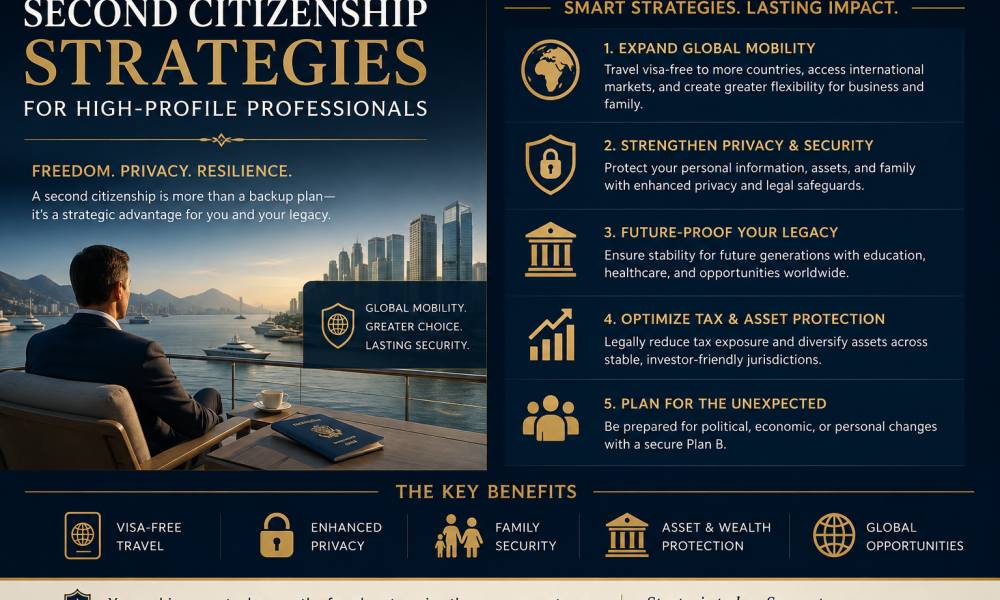
Second citizenship strategies for high-profile professionals have become increasingly important as executives, founders, public figures, investors, and prominent advisers face growing exposure through digital records, public databases, political risk, business visibility, and cross-border mobility constraints.
For individuals whose names, addresses, travel patterns, family details, business interests, and financial relationships can attract unwanted attention, second citizenship is increasingly viewed as a lawful planning tool that supports privacy, security, and operational resilience.
The strongest strategy is not about disappearing, avoiding obligations, or creating a false identity, because legitimate second citizenship planning depends on government-issued documents, accurate tax advice, compliant banking, lawful passport use, and consistent disclosure where required.
High-profile professionals face a different privacy environment.
Executives and public figures operate in a world where personal information can spread quickly through corporate filings, press coverage, litigation records, property databases, social media, travel platforms, data brokers, and commercial intelligence tools.
That visibility can create risks that ordinary professionals may never face, including targeted harassment, reputational pressure, family security concerns, hostile litigation, extortion attempts, political exposure, and unwanted attention from competitors or activists.
Reuters’ ongoing coverage of data privacy developments shows how personal information, commercial data practices, and privacy disputes remain central issues in the modern digital economy.
For high-profile professionals, the concern is not only that information exists but also that disconnected records can be combined into detailed maps of residence, travel, family life, asset ownership, and business activity.
Second citizenship should be viewed as a lawful option.
Second citizenship provides lawful optionality by granting a qualified person additional nationality rights, mobility choices, consular access, residence options, and contingency-planning capacity through official government recognition.
That optionality can matter when a founder must travel quickly to meet investors, when an executive needs a safer temporary residence, or when a family office requires additional planning flexibility during political or business uncertainty.
However, second citizenship should never be treated as an alternate persona, because a passport issued by another government still belongs to the same truthful person and must be integrated into banking, tax, and travel records.
A strong second citizenship strategy, therefore, creates more lawful options while preserving credibility with banks, immigration authorities, tax advisers, trustees, insurers, and regulated business counterparties.
Reducing personal exposure begins with document discipline.
Second citizenship can reduce personal exposure only when the surrounding document system is organized, secure, and consistent across all institutions that handle sensitive records.
A high-profile professional should maintain a controlled identity file containing passports, citizenship certificates, residence permits, tax numbers, proof of address, legal name records, family documents, and professional adviser contacts.
This file should not circulate casually among assistants, vendors, booking agents, or informal advisers, because every unnecessary copy creates another opportunity for personal information to be lost, forwarded, breached, or misused.
The privacy benefit comes from controlled disclosure, meaning the proper government or regulated institution receives accurate information while unnecessary parties receive only what is required for their limited role.
Passport use must remain compliant.
High-profile professionals with more than one citizenship should understand that passport use is governed by country-specific rules, not personal convenience or privacy preference.
The U.S. State Department explains that dual nationals must use a U.S. passport when entering or leaving the United States, showing why lawful travel planning requires attention to nationality obligations.
Other countries may impose their own rules, including entry and exit requirements, military service obligations, tax consequences, consular limitations, or restrictions on dual nationality recognition.
A second passport is safest when each journey is planned with accurate booking names, proper visas, consistent residence documents, and a clear understanding of which passport to present in each situation.
Business interests require continuity planning.
High-profile professionals often hold business interests that depend on their ability to travel, sign documents, meet partners, open accounts, negotiate deals, and respond quickly during disruptions.
A second citizenship can support business continuity by giving the professional another lawful base for travel, residence, banking conversations, and family relocation if conditions in one jurisdiction become unstable.
This can be especially important for founders, investment managers, media executives, medical innovators, energy professionals, defense contractors, technology leaders, and advisers working in politically sensitive sectors.
The citizenship strategy should be integrated with corporate governance, banking authority, intellectual property records, insurance coverage, succession planning, and emergency decision-making procedures, because a passport alone does not protect the enterprise.
Privacy benefits depend on banking compatibility.
A second citizenship has limited practical value if the professional’s banks, custodians, trustees, and investment platforms cannot understand how the new passport fits into the overall financial profile.
The role of documented tax identity is reflected in guidance on how a universal tax identification number operates, as financial institutions need reliable links among accounts, taxpayers, and beneficial owners.
A high-profile professional should update banking records as required, confirm tax residence treatment, document the source of wealth, and ensure that entity ownership records remain consistent following changes in citizenship or residence.
This protects privacy because organized banking files reduce the need for repeated document requests, whereas incomplete explanations often prompt broader internal review and unnecessary circulation of sensitive records.
Second citizenship does not erase tax obligations.
High-profile professionals should never assume that second citizenship automatically changes tax residence, reporting duties, foreign account obligations, or business taxation, because those questions depend on specific laws and personal facts.
Tax residence may be influenced by physical presence, domicile, family location, business control, citizenship rules, treaty provisions, permanent establishments, and the location of management decisions.
A lawful citizenship strategy should therefore include tax review before the passport is used for banking, relocation, investment structures, or business expansion.
The safest privacy plan is one in which citizenship, residence, tax identity, and banking records tell a consistent story that can be defended if reviewed by legitimate authorities.
Discreet residency planning protects families.
Residency planning is often the most practical benefit of second citizenship for high-profile professionals, as a passport may enable residency options that protect family members during periods of stress.
Executives may need a secondary base when public controversy escalates, litigation becomes aggressive, business travel increases, or personal security advisers recommend a lower-profile lifestyle.
Residency planning should be lawful, documented, and realistic, with valid residence rights, housing records, insurance coverage, school documentation where relevant, and accurate tax analysis.
The purpose is not to create artificial residence claims, but to provide a safe and credible place where the professional and family can live quietly if circumstances require relocation.
Discreet travel requires planning, not secrecy.
High-profile professionals can travel discreetly without misleading authorities by limiting public exposure of their itineraries, reducing unnecessary app tracking, controlling accommodation details, and using secure communication with advisers and family members.
Discreet travel should still use valid passports, accurate tickets, truthful immigration declarations, lawful visas, and hotel registrations that comply with local requirements.
Modern identity systems make inconsistent travel behavior harder to explain, and resources on electronic passport security show why passports now function within a wider verification environment.
The goal is low public visibility, not invisible official movement, because long-term mobility depends on credibility with border officials, banks, insurers, and consular authorities.
Digital exposure must be managed before movement begins.
Second citizenship does not protect a public figure if real-time travel is broadcast on social media, in cloud photo backups, via location-sharing apps, in ride-share records, through loyalty programs, and on unsecured booking platforms.
Professionals should review phone settings, app permissions, travel accounts, payment platforms, hotel profiles, family sharing tools, and public social media habits before departing.
This review should include spouses, children, assistants, drivers, and security personnel, because one person’s careless post can reveal the entire household’s location.
The strongest travel privacy plan is usually simple: share less publicly, delay posting, limit location data, use secure channels, and ensure that only trusted people receive itinerary details.
Accommodation details should be protected carefully.
Accommodation privacy is especially important for executives and public figures because hotel names, villa addresses, room numbers, and arrival times can expose physical security vulnerabilities.
A discreet accommodation plan uses reputable providers, verified booking channels, limited circulation of itineraries, secure transmission of documents, and clear rules on who may receive addresses or guest information.
Where local law requires guest registration, the client should comply, because privacy planning should never turn ordinary accommodation into an immigration or legal issue.
The protection comes from preventing unnecessary third parties from learning the details, not from withholding required information from hotels or authorities entitled to collect it.
Business travel should separate personal and corporate exposure.
High-profile professionals often combine personal, family, and business travel, which can create privacy problems when assistants, vendors, hotel staff, investors, and household contacts all receive overlapping information.
Separate booking records, payment accounts, document folders, and communication channels can help keep private family details away from business vendors while protecting corporate strategy from casual exposure.
This separation should be administrative rather than deceptive, because banks, insurers, and tax advisers may still need accurate records showing business purpose, expense classification, and identity details.
A clean separation supports privacy, accounting, and security because each record has a clear purpose, and fewer unnecessary parties receive sensitive information.
Public figures need controlled address management.
Personal addresses can become sensitive for public figures, especially when media attention, litigation, activism, political conflict, or business controversy increases unwanted contact.
Second citizenship and residence planning can support address protection when the professional has lawful residence options, secure mail handling, vetted property arrangements, and controlled vendor access.
Address privacy should not rely on false residence claims, because banks, tax authorities, and immigration authorities may need accurate address information and supporting documents.
A lawful address plan distinguishes legal residence, tax residence, mailing address, family address, business address, and temporary accommodation, so that each institution receives the correct information for its role.
Intellectual property requires cross-border protection.
High-profile professionals in technology, media, healthcare, finance, energy, design, and entertainment may hold valuable intellectual property that becomes vulnerable as their businesses expand internationally.
Second citizenship can help the professional access new markets and advisers, but intellectual property still requires contracts, registrations, trade-secret controls, secure archives, employee agreements, and jurisdiction-specific legal strategy.
A founder’s mobility is useful only if the company’s intellectual property remains protected while the founder travels, relocates, or builds operations in another country.
The best citizenship strategy, therefore, connects personal mobility to business governance, ensuring that patents, trademarks, confidential files, licensing arrangements, and ownership records remain controlled across borders.
Family offices should integrate second citizenship into governance.
Family offices increasingly treat second citizenship as part of broader governance, because principals, spouses, children, trustees, directors, and beneficiaries may all need coordinated documents and privacy rules.
The family office should maintain secure records showing passports, residence permits, school documents, medical files, emergency contacts, banking authority, trust roles, and travel procedures.
This protects privacy across generations because sensitive family information is handled through defined access rules rather than casual email threads, shared folders, or informal assistant networks.
A second citizenship strategy becomes more useful when it is integrated into family governance, succession planning, asset protection, and emergency readiness.
Public exposure can affect deal strategy.
High-profile professionals often need discretion because their travel, residence, or citizenship decisions can reveal corporate strategy, acquisition plans, investor negotiations, or preparation for relocation.
A founder’s repeated visits to a new jurisdiction may signal future expansion, while a public executive’s family relocation may invite speculation about business risk or political concerns.
Second citizenship planning should therefore include a communication strategy, because the professional may need to explain lawful mobility planning without creating unnecessary public narratives.
The goal is not secrecy from regulators or shareholders where disclosure is required, but careful control of unnecessary signals that could harm business interests or family security.
Second citizenship can support crisis response.
Crisis response is one of the strongest reasons high-profile professionals pursue second citizenship, because problems often appear faster than immigration, banking, and residence systems can be built from scratch.
A business dispute, public threat, political shock, medical emergency, civil unrest, bank disruption, or reputational event may require immediate lawful travel or temporary residence in a safer location.
Second citizenship can provide an additional layer of flexibility when the professional already has valid documents, up-to-date bank records, secure travel plans, and family procedures in place.
The strategy is strongest when prepared quietly in advance, because emergency citizenship planning undertaken during a crisis often leads to errors, exposure, and unnecessary urgency.
Professional advisers are essential gatekeepers.
Second-citizenship strategies for high-profile professionals should involve qualified immigration counsel, tax advisers, private bankers, corporate lawyers, security advisers, and, where appropriate, family office administrators.
Each adviser should work from a single approved factual record so the professional does not create conflicting explanations of citizenship, residence, tax, or banking across institutions.
Advisers should also reject any request involving false documents, misleading biographies, hidden beneficial ownership, or the use of passports to evade lawful obligations.
A serious professional should want advisers who protect credibility, because credibility is the foundation of privacy, mobility, and long-term access to business.
Due diligence should be expected and welcomed.
Reputable citizenship programs and financial institutions will conduct due diligence, including identity checks, source-of-funds reviews, sanctions screening, police certificate checks, professional background verification, and family document reviews.
High-profile professionals may face heightened scrutiny because their public role, political connections, litigation history, or business visibility may warrant more careful review.
This process can feel intrusive, but it protects the value of citizenship by ensuring the passport is issued through a credible system that can withstand later banking and travel scrutiny.
The safest applicants prepare complete records in advance because organized due diligence usually creates less exposure than rushed responses to questions that arise.
Regular review keeps the profile clean.
Second citizenship and residence planning should be reviewed at least annually, especially for high-profile professionals whose business roles, addresses, passports, tax status, and family needs may change quickly.
The review should confirm that passports remain valid, residence permits are current, banking files match tax status, corporate records reflect current authority, and travel procedures remain practical.
It should also check whether old addresses, expired documents, former business roles, or outdated family records are still visible in active files.
Maintenance protects privacy because small inconsistencies can become large problems when banks, border officials, insurers, or journalists begin comparing records.
Second citizenship is most valuable when integrated.
Second citizenship is not a standalone privacy solution because it works best when integrated with banking passports, tax planning, residence strategy, document security, family governance, and business-continuity planning.
For high-profile professionals, integration means that every passport, bank account, entity, residence document, adviser record, and travel procedure supports a single coherent and truthful profile.
This approach reduces personal exposure, protects business interests, and supports discreet travel without creating contradictions that could invite scrutiny.
The professional gains lawful mobility and privacy because the system is accurate, secure, and prepared for the next public, political, or business challenge.
The future belongs to privacy with credibility.
Second-citizenship strategies for high-profile professionals will continue to grow as executives, founders, and public figures face greater exposure through data brokers, electronic passports, global banking reviews, and public-records systems.
The strongest strategies reduce personal exposure through controlled disclosure, protect business interests through continuity planning, and support discreet travel through lawful document coordination.
They do not promise invisibility, because no serious plan can eliminate border records, tax obligations, bank due diligence, or disclosure duties owed to legitimate institutions.
For high-profile professionals, second citizenship is most powerful when used as a lawful resilience tool: quiet, documented, compliant, and ready to protect mobility, family security, and business continuity when visibility becomes a risk.




