
Amicus International Consulting compares the most discreet and secure second-citizenship options available today for applicants who value confidentiality, disciplined file handling, and reduced public exposure.
WASHINGTON, DC, June 15, 2026
Privacy has become one of the most important filters in citizenship-by-investment planning, because serious applicants now care as much about information control as they do about mobility.
Amicus International Consulting says the conversation has changed materially in 2026, especially among founders, high-net-worth families, and internationally exposed principals.
A few years ago, most applicants began by asking which passport offered the broadest travel access, the fastest approval timeline, or the most visible prestige.
Today, more applicants begin elsewhere entirely because they want to know which jurisdiction handles their files most carefully, which program exposes them to the least unnecessary scrutiny, and which legal route keeps their personal information within a more disciplined administrative structure.
That shift matters because no legitimate citizenship-by-investment program offers anonymity, invisibility, or freedom from due diligence. Every lawful program knows who the applicant is, reviews the source of funds, and reserves the right to share information when required by law.
The real privacy question in 2026 is not which passport lets a person disappear. The real privacy question is which program handles lawful disclosure with the greatest restraint.
That is a narrower question, but it is also the one sophisticated applicants are now asking. They are comparing how applications are filed, how information moves through the system, how much reliance is placed on authorized agents, how clearly privacy commitments are stated, and how much unnecessary noise there is in the process.
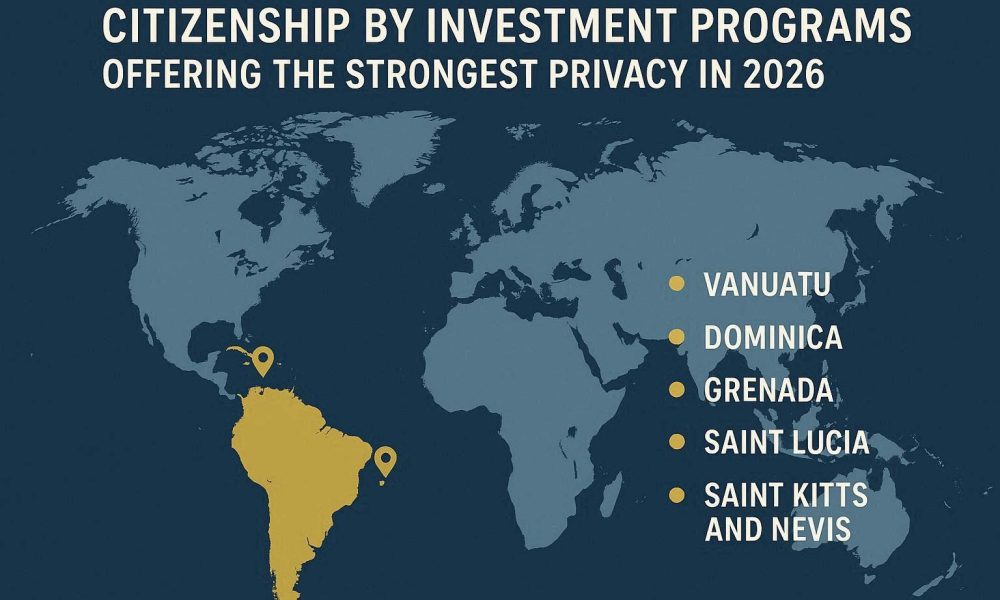
Amicus’s 2026 view is straightforward. Among the major active Caribbean citizenship-by-investment programs with clearly available official privacy or process-control signals, St. Kitts and Nevis ranks first, Antigua and Barbuda ranks second, and Dominica ranks third.
That is not a passport-power list. It is not a tax ranking. It is not a speed ranking. It is a privacy-centered ranking based on confidentiality architecture, process discipline, and public-exposure management.
The strongest privacy program is not necessarily the one with the lightest checks. It is usually the one with the most controlled checks, the clearest official channels, and the fewest avoidable points of exposure.
Why privacy now matters more in second-citizenship planning
Wealthy applicants are no longer treating privacy as a side benefit. They increasingly see it as part of risk management.
That change is easy to understand when modern exposure is considered honestly. One citizenship file may contain family data, passport records, financial information, supporting business documents, residence details, and source-of-funds evidence. Once that file begins moving through a process, the applicant wants to know exactly who is handling it and under what official structure.
For public figures, founders, litigants, politically exposed families, and globally mobile executives, that concern becomes even sharper. These applicants often have greater visibility than ordinary investors, and they already understand that overexposure can lead to commercial, personal, and reputational consequences.
They are not necessarily asking for secrecy. Most are asking for an order. They want a government-administered process that feels contained, predictable, and less vulnerable to unnecessary circulation of personal and financial information.
In practical terms, privacy in this market now means disciplined administration rather than mystery. The quieter and more controlled the process feels, the stronger the privacy case becomes.
That is one reason the market has matured. Clients increasingly understand that weak administration can be worse for privacy than strong due diligence. A loose process often means more intermediaries, more duplicated submissions, more scattered records, and less certainty about where sensitive information traveled. A stronger process may feel stricter, but it often creates less unnecessary exposure overall.
St. Kitts and Nevis ranks first
Amicus places St. Kitts and Nevis in first position for privacy among the leading active Caribbean citizenship-by-investment programs in 2026.
That ranking does not mean St. Kitts is secretive. It means the official framework currently looks more mature, more centralized, and more disciplined in its handling posture than its closest competitors.
The official St. Kitts and Nevis Citizenship Unit privacy policy explicitly states that users may visit anonymously, that personal information is collected when voluntarily submitted, and that the unit does not sell, trade, or rent personal identification information. That language matters because it gives applicants a visible official signal about how information is treated at the point of contact.
Beyond the wording of the privacy policy, St. Kitts benefits from something more important. Its current official posture strongly emphasizes statutory governance, controlled channels, and modernized process control. The broader public presentation of the program is that of a centralized government authority with defined procedures rather than a loosely promoted passport product.
That difference is exactly why St. Kitts ranks first. Privacy-minded applicants are usually better protected by disciplined official control than by a softer process that appears easier but actually scatters information more widely.
St. Kitts also appears stronger because it has leaned visibly into integrity, procedural modernization, and more centralized administration. For applicants, that usually translates into a process that feels more contained and less improvisational.
There is also an important trade-off here. A stronger privacy framework does not mean lighter due diligence. In fact, it often means the opposite. St. Kitts is not first because it asks fewer questions. It is first because the questions appear to be asked inside a tighter structure. That distinction is crucial. Privacy in a lawful CBI context is about controlled handling, not relaxed scrutiny.
For serious applicants, that is often the right balance. They do not want a weak system. They want a system that can properly manage sensitive material while maintaining international credibility.
Antigua and Barbuda ranks second
Antigua and Barbuda ranks second because it combines a formal government-run structure with an unusually clear official warning about information control and applicant safety.
The government’s Antigua and Barbuda Citizenship by Investment Program caution notice is one of the more important public-facing privacy signals in the Caribbean market. It tells potential applicants to work only through licensed agents and approved service providers to protect their personal and financial information.
That wording is significant because it addresses a real privacy problem in the market. Sensitive exposure often occurs not at the level of final government decision, but at the level of uncontrolled promotion, unauthorized marketing, or unapproved intermediaries. Antigua’s official material directly addresses that risk.
Antigua performs strongly because it recognizes that privacy is not only about government data storage. It is also about controlling the channel through which the applicant enters the system.
That gives Antigua a serious privacy advantage, especially for family applicants and business principals who are more concerned with file control than with making their process look glamorous.
Antigua’s broader appeal also lies in balance. It remains a recognizable government-centered route; it offers several qualifying structures; and it does so within a formal, official framework rather than a fragmented or informal market environment.
Where Antigua falls slightly behind St. Kitts is in the visible maturity of public privacy posture and overall governance signaling. The privacy logic is strong, but the broader official presentation does not look quite as centralized or as administratively refined as St. Kitts in 2026. That does not weaken Antigua’s credibility. It simply places it second rather than first.
For many applicants, especially families who value flexibility and still want a respectable level of confidentiality, Antigua remains one of the most serious options available.
Dominica ranks third
Dominica remains an established and credible citizenship-by-investment jurisdiction, but, specifically on privacy, it ranks third in Amicus’ 2026 assessment.
The official Dominica CBIU privacy policy states that users may visit anonymously, that personal information is collected only when voluntarily submitted, and that protective measures are in place to prevent unauthorized access. Dominica’s official materials also make clear that the application process is confidential, while acknowledging that due diligence agencies and international partners may be involved where necessary.
Those are meaningful protections. They keep Dominica well inside the serious category, and they make clear that confidentiality remains part of the program’s official posture.
Dominica ranks third, not because it lacks privacy safeguards, but because its visible public privacy architecture looks thinner and less developed than the top two programs when compared side by side.
That difference is important. Dominica still benefits from institutional continuity, long-running program experience, and an official government-administered process. For many applicants, those qualities remain attractive.
What places it below St. Kitts and Antigua is that the public-facing privacy case appears more website-policy-oriented and less visibly tied to broader governance signaling or explicit channel-control warnings. In simpler terms, Dominica still looks credible, but it does not look as privacy-forward in its official communications as the other two.
For applicants whose main concern is confidentiality structure rather than pure pricing, speed, or simplicity, that difference is enough to move Dominica into third place. It remains a viable shortlist option, but not the privacy leader.
What “discreet” should mean in 2026
One of the biggest problems in the citizenship market is the misuse of the word discreet. Too often, it is treated as though it means hidden, untraceable, or free from scrutiny. In lawful practice, it should mean something else.
A discreet program should be government-administered, careful about data handling, serious about approved channels, and unlikely to generate unnecessary exposure through noisy marketing or weak process control.
That is a much more useful standard, because it aligns with reality. No lawful applicant should expect to disappear from the file. The better objective is to avoid unnecessary duplication, uncontrolled intermediaries, scattered records, and the kind of casual handling that later becomes a privacy risk.
The most discreet program is therefore not the one with the fewest rules. It is the one where rules, channels, and file handling are tightly controlled so that the applicant is not exposed beyond what the law requires.
This is why sophisticated clients now ask different questions from casual buyers. They ask who holds the file, how many hands touch it, whether the government is visibly in control, whether unauthorized marketing is restricted, and whether the privacy posture feels like a real administrative commitment rather than a sales line.
Once those questions are asked, the ranking often looks very different from older passport-market assumptions.
How applicants should actually choose
No privacy ranking should be treated as a substitute for case-specific planning. A family with strong confidentiality concerns may rank the programs one way. A founder with commercial mobility priorities may rank them differently. A politically exposed household may care less about price and more about administrative discipline.
That said, privacy-minded applicants are usually best served by focusing on four things. First, whether the program appears to be controlled through an official government-centered process. Second, whether privacy commitments are stated clearly enough to matter. Third, whether the use of agents and service providers is tightly restricted. Fourth, whether the overall process feels disciplined rather than noisy.
Those four filters do not eliminate risk. They do improve the quality of the structure into which the applicant is stepping.
The best privacy choice is rarely the program that sounds the most secret. It is usually the one who behaves the most professionally from first contact through final approval.
That is exactly why St. Kitts and Nevis currently leads, why Antigua and Barbuda follows closely behind, and why Dominica remains credible but third in this specific category.
For applicants who want a more structured assessment of privacy, mobility, and documentation strategy, Amicus International Consulting operates in the area where lawful second-citizenship planning increasingly overlaps with personal security, family continuity, and information control.
In 2026, the strongest citizenship-by-investment privacy option is not the one that promises fantasy. It is the one that handles lawful reality with the greatest discipline.




