
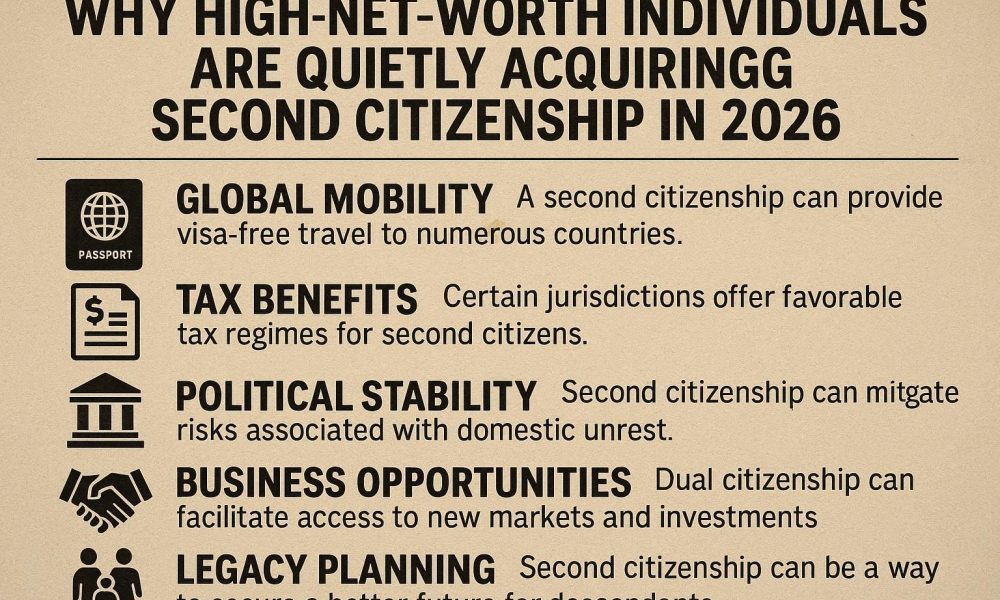
Amicus International Consulting examines why wealthy families, founders, and internationally exposed principals are increasingly treating second citizenship as a discreet strategic asset rather than a lifestyle accessory.
WASHINGTON, DC, June 14, 2026
High-net-worth individuals are not pursuing second citizenship in 2026 because it sounds glamorous. They are pursuing it because the world now feels more concentrated, more exposed, and less forgiving.
Amicus International Consulting says the strongest demand is coming from clients who already understand risk because their wealth, mobility, family continuity, and public exposure now depend too heavily on a single jurisdiction.
That concentration problem is becoming harder to ignore, especially for people whose lives span multiple banking systems, several operating markets, politically sensitive regions, and an increasingly transparent compliance environment.
A decade ago, second citizenship often carried a luxurious aura because it was marketed as travel freedom, prestige, and lifestyle enhancement rather than hard questions about resilience and control.
In 2026, that framing has changed materially because wealthy clients increasingly approach citizenship planning the same way they approach asset allocation, jurisdictional diversification, and family governance.
The modern multi-citizenship strategy is not about collecting passports for display. It is about reducing dependence on a single legal system when that dependence begins to seem unnecessarily dangerous.
That danger can take several forms at once. It may be political uncertainty, regulatory tightening, family security concerns, reputational exposure, worsening tax unpredictability, capital friction, or simply constrained mobility.
What matters is not that every risk becomes acute immediately. What matters is that wealthy families now recognize that optionality is easier to build before pressure arrives.
That is one reason the broader wealth environment matters. Knight Frank’s Wealth Report 2026 describes wealth as increasingly mobile, while highlighting how private capital is adapting to fractured geopolitical conditions.
Amicus says that conclusion mirrors what sophisticated clients are already doing privately, because they are moving from nationality as inheritance toward nationality as structured contingency planning.
The wealthy are buying resilience, not symbolism
The first major driver is resilience, as affluent families now view second citizenship as a lawful backup structure that can preserve freedom of movement, choice of residence, and continuity of decision-making.
In previous market cycles, many wealthy clients treated residence and citizenship planning as optional enhancements that might become useful one day, but did not require immediate attention.
That is no longer the prevailing mood. Families with substantial operating businesses, children studying abroad, complex estates, and cross-border banking exposure increasingly want redundancy built into their personal legal status.
A second citizenship provides that redundancy in ways a visa never can, because nationality creates a deeper legal anchor than temporary permission, discretionary entry, or residence tolerance alone.
This matters when external conditions shift suddenly. A client may need to relocate family members, spend longer periods abroad, change tax residence, or reposition commercial leadership without bureaucratic improvisation.
For wealthy individuals, second citizenship is increasingly understood as a personal balance-sheet asset. It may not appear beside equity holdings, but it can shape the value of everything else.
That is particularly true where family structures are involved, because spouses, children, succession plans, educational choices, and healthcare access all become more manageable when optionality already exists.
The people driving this trend are rarely impulsive. They are often the opposite, because they are trying to solve tomorrow’s problems before those problems harden into time-sensitive legal and logistical constraints.
Henley & Partners’ Residence and Citizenship Programs Report 2026 describes this broader market recalibration as part of a global repositioning of capital and talent.
Amicus says the language may differ from client to client, but the behavior is recognizable. Wealthy families increasingly want more than one lawful place from which to live, operate, and recover.
Privacy has become a front-end concern
A second major reason for rising demand is privacy, though not in the crude sense of secrecy that outsiders often imagine when citizenship planning enters public discussion.
The privacy issue is not whether a government knows who the applicant is. The privacy issue is whether a family remains overexposed because every meaningful aspect of life depends on one national framework.
High-net-worth individuals live with a level of visibility that most ordinary applicants never experience. Their banking activity, business dealings, litigation exposure, travel patterns, and personal security concerns create a different baseline.
That visibility becomes more dangerous when it is paired with digital overexposure, shallow administrative structures, or a home-country environment that has become politically noisy or commercially unstable.
Many of these clients are not looking to vanish. They are looking to reduce the unnecessary concentration of information, status, and family dependency in a single system.
That is why second citizenship increasingly sits alongside privacy planning rather than outside it. A second nationality can create a cleaner legal fallback without forcing families into reactive decisions later.
The clients most focused on this benefit are often founders, public-facing principals, politically exposed families, and wealthy households whose names already draw enough attention without additional jurisdictional scrutiny.
For them, the value of second citizenship is often quiet rather than theatrical. It creates lawful room to move, restructure, or de-risk without turning every future decision into a public emergency.
Amicus says this is one of the least-understood parts of the market because the public still imagines passport planning as image management rather than exposure management.
In reality, the most discreet clients are usually pursuing second citizenship for reasons that look far more defensive than glamorous once the family’s full risk map is understood.
Mobility is now directly tied to commercial strategy
Another major driver is business mobility, because the wealthy are often not simply investors but controllers of operating companies, capital pools, partnerships, and international family enterprises.
When those people are limited by one nationality, the friction does not remain personal. It quickly becomes commercial, especially where travel, local presence, and decision-making speed affect enterprise performance.
A second citizenship can reduce bottlenecks that would otherwise slow negotiation, market access, residence planning, and cross-border operational continuity for principals whose companies already function internationally.
That is why more entrepreneurs are entering this market. They are not necessarily looking for prestige. They are looking for lawful operating flexibility when a single passport no longer aligns with the business’s geography.
A founder with customers in one region, suppliers in another, banking exposure elsewhere, and family needs across several countries often sees nationality planning differently from a lifestyle buyer.
For that founder, second citizenship becomes part of leadership resilience. It creates a cleaner platform from which to travel, remain, sign, relocate, and reassure counterparties when circumstances change abruptly.
This logic resembles supply-chain diversification because the wealthy increasingly understand that relying on a single route, country, or legal identity is fragile in a fragmented world.
What wealthy principals are really acquiring is not just movement. They are acquiring decision-making room, and that room becomes more valuable when markets, governments, or risks shift faster than expected.
That explains why the trend remains stronger among internationally exposed business owners than among casual luxury buyers. The passport matters, but the operating flexibility behind it matters more.
Family continuity now sits beside asset continuity
The next major force is family continuity, as wealthy clients often find that succession, education, residence, healthcare, and inheritance planning become more stable with jurisdictional redundancy.
A family office may structure trusts, companies, and investment holdings carefully, yet still leave the family itself overly dependent on a single nationality and a single residence framework.
That imbalance is now being corrected more frequently because wealthy families increasingly understand that the people around the wealth need diversification as much as the wealth itself.
Second citizenship has become part of family governance because continuity planning now includes where heirs can live, study, work, and recover if one country becomes less useful.
This is especially important where younger generations are concerned. Parents do not always know where children will live later, but they increasingly want them to have more than one lawful platform.
That desire is not always driven by fear. Sometimes it is driven by pragmatism, because globally active families simply want the next generation to inherit optionality rather than dependence.
In practice, this makes second citizenship feel less like a luxury line item and more like an extension of succession planning, residence planning, and long-term family governance.
The market is becoming quieter, not louder
One of the paradoxes of 2026 is that demand is rising while many clients want the process discussed less publicly, marketed less theatrically, and integrated more quietly into broader planning.
That is why Amicus sees a widening gap between public narratives around passport acquisition and private client behavior. The public narrative still imagines spectacle, while the private market increasingly prefers discretion.
The wealthiest applicants rarely want attention around second citizenship. They want a lawful structure that becomes part of a larger private strategy around mobility, continuity, and long-term control.
This preference for discretion is not surprising. High-net-worth families usually do not want to advertise contingency planning because it works best when tested in private.
That is also why the strongest applicants tend to approach citizenship planning with the same discipline they apply to tax structuring, governance design, and risk compartmentalization.
They want coherence, legal depth, and reliable execution. They do not want slogans, rushed decisions, or superficial claims that collapse under banking or regulatory review later.
Amicus says this is where structured guidance matters, because second citizenship planning works best when it is aligned with privacy goals, business geography, and family realities from the outset.
For families thinking through that process in a disciplined way, Amicus International Consulting and its work in second-citizenship planning increasingly sit at the intersection of mobility strategy, privacy, continuity, and long-range legal planning.
The trend is rising because wealthy individuals are no longer treating second citizenship as an indulgence. They are treating it as a lawful optionality in a world where optionality itself has become a premium.
That is why demand is quietly growing in 2026. Not because the global elite suddenly want novelty, but because they now understand the cost of having nowhere else to stand.




