
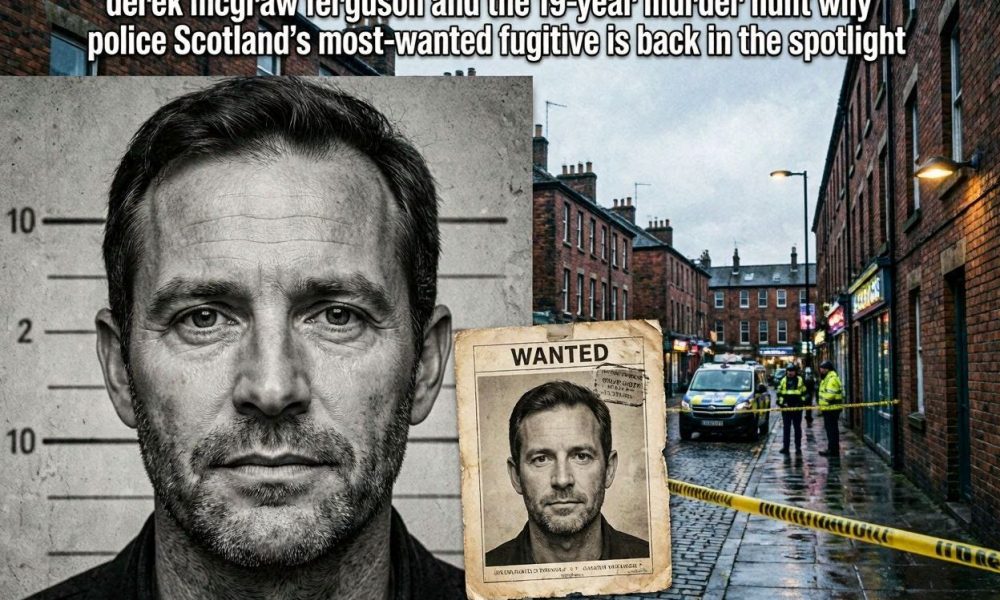
The 62-year-old remains wanted in connection with the 2007 killing of Thomas Cameron outside the Auchinairn Tavern near Glasgow, while investigators warn he may be living under an alias as the renewed Spain-linked appeal intensifies pressure on one of Scotland’s longest-running fugitives.
WASHINGTON, DC, May 16, 2026.
Derek McGraw Ferguson has returned to the center of a major international fugitive appeal nearly nineteen years after the killing of Thomas Cameron, because the 62-year-old Glasgow-born suspect remains wanted by Police Scotland and has now been placed again before the public through the National Crime Agency’s latest Spain-focused Most Wanted campaign.
The renewed attention is striking not only because of the age of the homicide investigation, but also because authorities continue to describe Ferguson as a fugitive who may have spent years living beyond ordinary recognition, possibly under another name, possibly with a different accent, and potentially inside the kind of expatriate environment investigators believe can shield long-term suspects from casual detection.
A 2007 killing that never left the police file has now been pushed back into international public view.
Police Scotland has said Ferguson is wanted in connection with the murder of Thomas Cameron, who was killed outside a public house on Auchinairn Road in Bishopbriggs on June 28, 2007, after leaving the tavern where he worked and approaching two men in the nearby car park during the early evening.
The renewed 2026 campaign has placed that unresolved killing beside other major United Kingdom fugitive cases involving murder, fraud, narcotics trafficking, sexual offenses, and money laundering, creating a single public message that serious allegations do not lose their urgency merely because a suspect has avoided arrest for a long period outside the immediate reach of local investigators.
Ferguson’s case stands out because the passage of time has become part of the manhunt rather than a reason to lower expectations.
Nearly two decades have passed since Cameron’s death, yet Police Scotland has repeatedly maintained that the investigation remains active, that an international warrant continues to exist, and that renewed public appeals are warranted because a fugitive’s routines, relationships, loyalties, and physical appearance may all change in ways that eventually create new investigative openings.
That logic matters in a case like this because a suspect who allegedly remained beyond arrest for many years may have counted on fading public memory, generational changes in local witnesses, and the practical difficulty of sustaining attention across borders, while investigators are now using anniversaries, fresh media exposure, and updated imagery to make the old case feel immediate again.
The latest NCA appeal suggests Spain remains central to the search, even if certainty about Ferguson’s exact location has never been publicly established.
The National Crime Agency said the twelve men named in its newest Operation Captura campaign are believed to be hiding in Spain or to have links with the country, and it singled out Ferguson as one of Police Scotland’s Most Wanted fugitives while highlighting the importance of age-progressed images in long-running cases where appearance may have changed substantially.
Police Scotland previously stated that officers believed Ferguson may be in Spain, that he was unlikely to be known there by his original name, and that he might not be speaking with a Scottish accent, three details that together reveal how investigators think about long-term concealment not as disappearance, but as active social adaptation.
A fugitive who changes his name, accent, and apparent age presents a different challenge from a suspect who simply leaves town.
In a short-running search, officers may rely heavily on fresh sightings, travel records, associates, and familiar habits, yet in a case extending across nineteen years, the law enforcement problem becomes more psychological and sociological, because investigators must imagine how a person ages, where he might feel comfortable, and what kinds of communities would allow a false personal history to survive routine conversation.
That is why updated visual reconstructions matter, since a wanted image from 2007 may no longer trigger recognition in 2026, whereas an age-progressed face can help a neighbor, shopkeeper, landlord, or expatriate acquaintance connect a present-day person with a historic appeal that otherwise feels visually trapped in another era.
Police Scotland’s facial reconstruction strategy shows how modern fugitive work increasingly depends on rebuilding the present-day face of an old suspect.
In 2023, Police Scotland released an innovative age-progressed visual sequence designed to show how Ferguson might appear later in life, combining estimated aging, facial changes, and forensic input into a public presentation intended to refresh recognition after 16 years.
The technique reflects a wider reality in major manhunts, because fugitives do not merely move geographically, they also age into new appearances, alter grooming, gain or lose weight, wear glasses, choose facial hair strategically, or exploit the assumptions of people who remember only a decades-old photograph that no longer captures the most likely present-day resemblance.
The killing of Thomas Cameron remains at the moral center of the appeal, and that focus explains why the case has stayed publicly alive.
Contemporary reporting on the renewed campaign described Cameron as a 49-year-old father of three who had left the pub where he worked shortly before he was shot, and that human detail keeps the case rooted in a specific family loss rather than allowing it to dissolve into the abstraction of a long fugitive file.
That emotional center gives Police Scotland’s repeated appeals their force, because the investigation is not framed as a bureaucratic effort to close an old ledger, but as a continuing attempt to secure accountability for a family and community whose experience of the killing has outlasted the original evening by almost two decades.
The latest campaign also shows how murder fugitives are now pursued through coordinated public pressure instead of isolated local appeals.
Operation Captura, which marks its twentieth anniversary in 2026, is a multi-agency initiative involving the National Crime Agency, Crimestoppers, Spanish law enforcement partners, the Spanish Ministry of Interior, and United Kingdom policing, with officials saying the campaign has helped locate the overwhelming majority of fugitives publicly featured since its launch.
That record gives renewed appeals additional credibility, because they are not simply symbolic commemorations of old cases, but part of a system that has repeatedly generated arrests by combining media visibility, anonymous tips, overseas police partnerships, and the practical knowledge that fugitives often remain socially connected even while trying to vanish legally.
Spain’s role in the appeal reflects both history and demographic reality, particularly in communities where British fugitives may hope to blend into ordinary expatriate life.
The NCA has argued that fugitives sometimes attempt to stay under the radar by merging into large British expatriate populations, and Ferguson’s case fits that concern because earlier Police Scotland materials emphasized the possibility that he might use another name, another accent, and a deliberately ordinary profile rather than relying on dramatic isolation in remote terrain.
This matters because a fugitive hiding in a socially familiar environment does not need to sever every connection with language, culture, or routine, yet that same comfort can become a vulnerability once public images circulate widely enough that people begin reconsidering a neighbor’s biography, a regular customer’s unexplained caution, or a local acquaintance’s unusual resistance to background questions.
International fugitive work depends on patience, but it also depends on creating the right moment for someone else to speak.
The NCA’s campaign messaging emphasizes that loyalties change and time moves on, an important insight in a nineteenth-year murder hunt because associates who once kept silent may no longer feel bound by old relationships, family circumstances may have shifted, and expatriate contacts may decide that withholding information is no longer tolerable.
That principle mirrors the broader logic behind international fugitive operations, because public pressure rarely works in isolation; it is most effective when paired with police intelligence, cross-border coordination, updated imagery, and information from people who finally choose to question what they know about a person living under a carefully managed past.
The public appeal is therefore not only about sightings but also about destabilizing the story a fugitive tells those around him.
A person living under an alias succeeds only while neighbors, friends, employers, landlords, and romantic partners accept the biography presented to them, and a high-profile appeal interrupts that acceptance by introducing specific details that may suddenly connect unexplained caution, limited documentation, or inconsistent personal history with a named suspect in a serious criminal case.
That is one reason publicity can matter even after many years, because the campaign does not require every viewer to recognize Ferguson instantly; it only needs one person close enough to a suspicious identity to question whether a seemingly ordinary older man in Spain could plausibly match the rebuilt image and long-standing warning signs.
The age of the case may actually sharpen public attention, because a nineteen-year absence suggests an unusually durable evasion strategy.
In ordinary wanted-person matters, a short period on the run may be explained by panic, poor judgment, or improvised flight, but a case extending from 2007 to 2026 creates a different impression, namely that a suspect may have developed a stable method for remaining outside ordinary accountability despite sustained efforts by police to find him.
That durability is precisely what makes renewed visibility necessary, because every additional year without arrest can reinforce a fugitive’s confidence, while every refreshed campaign reminds the public and the suspect alike that institutional memory has not dissolved, that warrants remain active, and that investigative persistence still has time to work.
The search for Ferguson also highlights why aliases matter in murder investigations that cross borders and survive multiple generations of public attention.
Police Scotland’s warning that Ferguson may not use his original name is especially significant because an alias can help a person rent property, form casual relationships, obtain work informally, and distance daily life from searchable public records, even if the alias does not withstand the deeper scrutiny that arrives after a credible tip reaches investigators.
Analysis of how officials identify and locate most-wanted fugitives has increasingly focused on the small inconsistencies that can unravel long-term concealment, including contradictory personal histories, unusual gaps in documentation, changing social circles, and suspicious efforts to remain physically visible while biographically obscure.
Digital investigation has changed the odds for fugitives, even when the original crime belongs to a pre-smartphone era.
A suspect who disappeared in 2007 entered a world with fewer digital traces than the one that exists in 2026, yet anyone living today must navigate mobile devices, cameras, travel databases, banking access, online communication, and images shared by other people, all of which can turn social existence into a recoverable trail once investigators have a plausible target.
The growing intersection of identity verification, cross-border database cooperation, and public-image reconstruction has made long-running fugitive hunts increasingly resilient, a theme also explored in the analysis of how false identities and international mobility are detected over time.
The continuing focus on Ferguson signals that cold public memory and active police memory are not the same thing.
Members of the wider public may remember only fragments of the 2007 killing, or may have been children when Thomas Cameron died, yet the official investigation has remained structured around a live warrant, renewed information appeals, visual updates, and repeated requests for assistance from people who may know where Ferguson is now or how he has lived since leaving public view.
That distinction is vital because fugitives sometimes benefit from the assumption that old cases have faded from institutional priority, while the latest campaign communicates the opposite message, namely that serious unresolved violence can be returned to center stage whenever law enforcement believes renewed publicity could reach a different witness population or unlock a previously dormant lead.
The Spanish connection places Ferguson inside a wider map of UK fugitives who may rely on distance while underestimating partnership policing.
The 2026 Most Wanted campaign includes men linked to alleged drug trafficking, fraud, sexual offenses, and homicide, and the NCA used the launch to underline that Spain should not be treated as a safe haven, because British and Spanish agencies have spent two decades refining a shared model for turning public tips into coordinated enforcement action.
That framework matters for Ferguson because the search has clearly outlasted the limitations of a purely local murder inquiry, and the case now belongs to an international enforcement architecture that treats overseas concealment as a solvable operational problem rather than a permanent escape route beyond realistic police reach.
Long-running fugitives often rely on their ordinary lives serving as camouflage, and that is exactly what renewed campaigns aim to disrupt.
A man who has spent years abroad may appear settled, aged, and unremarkable, which can make him harder to connect with a decades-old wanted notice, yet campaigns like this are designed to reverse that comfort by putting old allegations into the present tense and asking communities to view familiar faces through a more investigative lens.
The appeal is especially forceful where authorities warn that a suspect may be using another identity, because the public is not simply being asked whether it recognizes a photograph, but whether it recognizes a pattern of guarded behavior, partial biography, unusual reluctance around documents, or personal details that never seem to fit together completely.
For Cameron’s family, the campaign’s endurance carries its own meaning, even before any arrest occurs.
Every renewed appeal communicates that the killing remains unresolved but not abandoned, that the passage of years has not erased the legal seriousness of the allegation, and that investigators are still prepared to return publicly to the case whenever new tools, new partnerships, or new international exposure may improve the chances of locating the wanted suspect.
That message does not substitute for justice, but it matters in long homicide cases because public institutions are being judged not only by whether an arrest occurs quickly, but also by whether they sustain commitment after anniversaries pass, media attention thins, and the fugitive’s absence risks becoming part of the background.
The most difficult fugitives are sometimes those who have successfully made themselves seem ordinary, not those who appear theatrical or openly menacing.
Police warnings about aliases and altered accents point toward a manhunt shaped by understatement rather than spectacle, because the suspect investigators seek may not present himself as a notorious fugitive at all, but as a quietly established resident whose life depends on keeping curiosity low and biography vague enough to avoid challenge.
That is precisely why the public appeal remains essential: official agencies can build intelligence files and work across borders, but people living near a fugitive may notice small human details that no database captures easily, including evasive stories, mismatched timelines, sudden disappearances, or discomfort when past experiences are discussed casually.
Rewards and anonymous reporting remain important because decades-old murder hunts often turn on information from people who never came forward earlier.
Police Scotland has previously offered financial incentives through Crimestoppers for information leading to Ferguson’s arrest, while maintaining dedicated reporting channels so people can submit potentially useful details anonymously if they fear involvement, retaliation, or exposure after years of remaining silent.
That approach recognizes a practical truth about long-running fugitive cases: witnesses, former associates, and people who encountered a suspect abroad may all assess risk differently over time, and carefully designed reporting channels can convert private suspicion into information that investigators can finally test.
The renewed hunt for Derek McGraw Ferguson is therefore larger than one name on one campaign poster.
It is a test of whether law enforcement can keep a murder allegation visible across nineteen years, whether fresh imaging can revive recognition after a suspect’s face has naturally changed, whether international cooperation can penetrate social camouflage abroad, and whether public memory can be deliberately reactivated when investigators believe one decisive lead may still exist.
For now, Ferguson remains wanted in connection with Thomas Cameron’s 2007 murder, the Spain-linked appeal remains active, and the central message from British authorities is unmistakable, because time has passed, appearances may have changed, names may have changed, but the search itself has not ended.




