
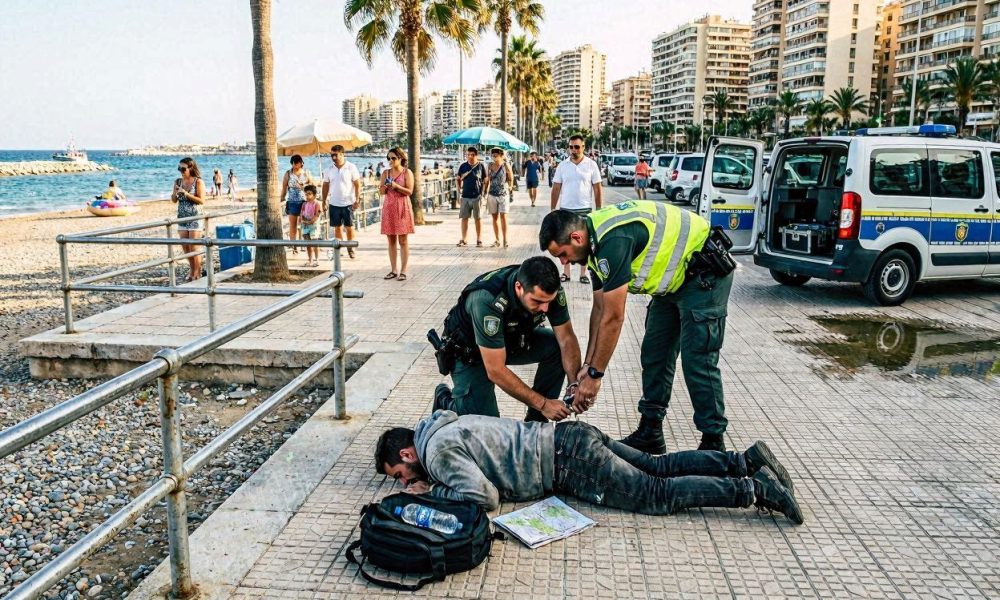
The 49-year-old, sought over cocaine importation, money laundering, false passport offenses, and breaching a Serious Crime Prevention Order, was arrested in Spain within hours of a renewed international appeal placing him back in the public spotlight.
WASHINGTON, DC, May 16, 2026. Simon Dutton’s arrest in La Nucía, near Benidorm, has transformed what began as another international fugitive appeal into a fast-moving case study in cross-border policing, because the 49-year-old was taken into custody on May 14, 2026, only hours after British authorities renewed public attention on his alleged crimes and reported links to Spain.
Dutton, originally from Bolton in Greater Manchester, had been wanted by Greater Manchester Police over allegations involving cocaine importation, money laundering, false passport offenses, and breaches of a Serious Crime Prevention Order, while the National Crime Agency also described him as a man sought for recall to prison after a previous sentence tied to large-scale cocaine smuggling and laundering activity.
The arrest landed at the exact moment British authorities were trying to prove that Spain is no longer a dependable hiding place for fugitives.
The timing gave the operation unusual force because investigators were not simply announcing another wanted suspect to an international audience; they were simultaneously demonstrating that the machinery behind Operation Captura could still produce a decisive result, even in cases involving seasoned suspects believed to understand the advantages of mobility, concealment, and loosely connected expatriate networks.
According to public accounts of the case, Dutton was arrested after cooperation between Spain’s Guardia Civil and the United Kingdom’s National Crime Agency, with the detention occurring in La Nucía, a town inland from Benidorm that sits within a broader Costa Blanca corridor long watched by investigators assessing how fugitives use British expatriate communities, holiday traffic, and informal social networks to become less conspicuous abroad.
The speed of the arrest, described in contemporaneous reporting on Dutton’s detention in Spain, meant that his name moved from a newly refreshed most-wanted campaign into an active extradition story before the public could absorb the initial appeal, giving British and Spanish officials a striking early success during the 20th anniversary year of Operation Captura.
Dutton’s case drew attention because it combined narcotics trafficking allegations with the practical tools commonly associated with long-term evasion.
The allegations surrounding Dutton reached beyond drug distribution itself, because false passport offenses and a Serious Crime Prevention Order breach suggest authorities were also focused on the mechanisms that can help an offender cross borders, obscure identity, maintain access to money, and continue operating despite earlier judicial restrictions intended to limit future criminal conduct.
British authorities said Dutton had previously been sentenced for organizing large-scale cocaine importations and money laundering, with one interception linked to that criminal activity valued at roughly £1.5 million, a figure that helps explain why law enforcement agencies treated the matter as more than a routine fugitive recall and instead positioned it within the broader campaign against serious organized crime.
The significance of that earlier sentence matters because it places the arrest inside a much wider enforcement narrative in which drug trafficking, laundering, forged documents, and cross-border concealment increasingly appear not as isolated offenses, but as mutually reinforcing parts of a criminal infrastructure designed to absorb arrests, relocate operators, and continue generating revenue under pressure.
The Spanish investigation reportedly widened after a suspicious suitcase led authorities toward a larger trafficking and document-fraud network.
Spanish reporting and British media accounts stated that the local investigation began in November 2025, after the manager of a parcel delivery service in Benidorm alerted authorities to a suspicious suitcase later found to contain approximately 16 kilograms of drugs destined for the United Kingdom, a discovery that pushed investigators toward a broader network rather than a single courier incident.
As the inquiry developed, Spanish investigators identified additional suspects, including Dutton, and later carried out searches in Benidorm and La Nucía that reportedly uncovered narcotics, cash, false documentation, and vehicles said to have been used by the group, while three other people outside the formal most-wanted campaign were arrested on allegations involving drug trafficking and document forgery.
That detail is important because it suggests Dutton’s detention did not arise solely from a publicity campaign or an anonymous tip landing after a poster release, but from an active operational track already moving through Spanish law enforcement channels, with the public appeal amplifying an investigation that had gathered momentum through local intelligence, package monitoring, and coordinated searches.
False passport allegations place the case inside a larger international struggle over identity systems, border integrity, and criminal mobility.
The wider concern is not limited to one British fugitive, because governments have repeatedly warned that passport and visa fraud can support organized crime, financial crime, and cross-border evasion whenever offenders obtain forged travel documents, misuse genuine identity materials, or build alternate profiles capable of surviving routine checks, a risk outlined by the U.S. State Department in its guidance on passport and visa fraud.
That concern resonates strongly in Dutton’s case, because the alleged false passport offenses sit beside money laundering and narcotics allegations, forming a familiar triangle in organized crime investigations where illicit profits require movement, movement requires identification, and identification fraud can help a suspect delay detection long enough to rebuild contacts, relocate assets, or preserve access to cross-border facilitators.
Public interest in such cases has increased as law enforcement agencies place greater emphasis on document examination, biometric comparison, digital travel records, and border intelligence, while identity-fraud specialists have also noted that forged documents are often exposed through small inconsistencies, mismatched supporting records, or unusual travel patterns, themes explored in a detailed analysis of how fake passports are detected and exposed.
Operation Captura’s 20-year record explains why the arrest carried symbolic value beyond a single detention.
The National Crime Agency said the latest Spain-focused appeal marked the 20th anniversary of Operation Captura, a long-running collaboration involving British law enforcement, Crimestoppers, the Spanish Ministry of Interior, and Spanish policing partners, which has now helped trace and arrest 98 of 111 fugitives publicly highlighted through repeated campaigns over two decades.
That number gives the operation credibility, but the Dutton arrest gave it immediacy, because officials were able to announce a concrete capture almost as soon as the new campaign launched, reinforcing their central message that Spain should not be treated as a neutral waiting room where serious offenders can blend into a dense expatriate population while assuming that legal distance will protect them indefinitely.
Officials have repeatedly argued that some fugitives living abroad continue offending rather than merely hiding, which is why operations aimed at locating wanted suspects increasingly focus on social circles, rented homes, transport patterns, financial habits, and identity anomalies instead of waiting for a suspect to cross a border voluntarily or make a plainly visible mistake in public.
Spain’s appeal to British fugitives has long been understood, but investigators now appear more determined to turn that familiarity into a vulnerability.
For years, Spain’s large British expatriate population, extensive tourist economy, and easy movement across coastal regions made it attractive to individuals hoping to settle into communities where English accents, British cultural references, and frequent short-term arrivals would not stand out, but that same demographic density has become a useful investigative map for officers pursuing high-priority suspects.
The Costa Blanca, the Costa del Sol, and other expatriate-heavy regions create an unusual law enforcement environment because fugitives may believe they can disappear into familiar social settings, yet those same settings often produce patterns of association, gossip, transport reliance, and housing footprints that investigators can exploit once a suspect’s image, aliases, or behavioral habits begin circulating locally.
Dutton’s arrest near Benidorm, therefore, fits a recurring pattern in which suspected offenders appear to view southern Spain as a place to stay socially connected while physically removed from British policing pressure, although the success of Operation Captura suggests that investigators increasingly understand the logic of those communities and have learned how to narrow the gap between concealment and identification.
The case also shows why public fugitive appeals still matter in an age dominated by surveillance, databases, and cross-border intelligence sharing.
High-tech investigative tools can be powerful, but appeals remain valuable because they reach people who notice ordinary details, including a face at a café, a neighbor renting under unusual circumstances, a business contact who suddenly pays in cash, or a local resident who recognizes behavior that seems inconsistent with the person’s public explanation for living abroad.
Crimestoppers and the National Crime Agency have long relied on that dynamic, arguing that loyalties change and that people who once remained silent may later decide that providing information anonymously is safer, more responsible, or simply overdue, particularly when the suspect is wanted for offenses involving drugs, violence, fraud, or serious breaches of court-imposed restrictions.
The broader fugitive-tracking lesson is that modern investigations rarely depend on a single breakthrough, because progress often emerges from the accumulation of fragments, including local suspicions, document inconsistencies, communications data, travel history, and social exposure, a reality examined in reporting on how officials identify and locate most-wanted fugitives.
Dutton now faces a process that may be less dramatic than the arrest itself, but legally decisive if extradition proceeds.
Spanish authorities said Dutton would be brought before a court in connection with an international extradition request, placing the next phase of the case inside formal judicial procedures that will determine how and when he may be transferred to the United Kingdom, where the existing recall issue and the allegations cited by police remain central to his legal exposure.
Extradition proceedings can move more slowly than public arrests, yet they remain a critical bridge between international capture and domestic accountability, because a fugitive detained abroad does not automatically reappear in the jurisdiction seeking him, particularly when authorities must navigate court reviews, warrant validity, custody arrangements, and any arguments raised by defense counsel.
In practical terms, that means the public image of a most-wanted suspect being detained near Benidorm is only the beginning of a longer legal sequence, one that may eventually return Dutton to British custody while also clarifying how separate Spanish allegations involving trafficking and document offenses interact with the United Kingdom’s existing interest in securing his return.
The arrest may also increase pressure on the remaining fugitives named in the latest Spain campaign.
The newest Operation Captura appeal listed multiple men wanted for allegations that include murder, drug trafficking, sexual offenses, fraud, and money laundering, with authorities stating that each fugitive is believed to be hiding in Spain or maintaining links to the country, especially in regions such as Tenerife, Marbella, Alicante, and Málaga, where British residency and travel flows remain especially visible.
Dutton’s rapid capture could unsettle those still at large, because it signals that renewed publicity can coincide with active investigative work already underway, and that appearing on a campaign poster may indicate not only an appeal for public help, but also a high level of law enforcement focus capable of turning quickly into surveillance, raids, or arrest operations.
That psychological pressure is an underappreciated part of fugitive campaigns, because suspects who believe they have become too recognizable may alter routines, change residences, contact old associates, or make rushed financial decisions, each of which can create exactly the kind of trace investigators need when static leads have become difficult to develop further.
At its core, the Dutton case is about the narrowing space available to internationally mobile organized crime suspects.
The arrest reflects a law enforcement environment in which drug trafficking suspects face pressure not only at ports and airports, but across rented villas, delivery routes, cash networks, document channels, and expatriate communities that once seemed distant from British policing, even though modern cooperation has made those spaces more transparent than they appeared a generation ago.
It also underscores how serious crime prevention measures lose practical effect if an offender can simply relocate, operate through intermediaries, and rely on counterfeit identification or concealed finances to remain active, which is why agencies increasingly treat travel documents, laundering patterns, and overseas residences as a single connected problem rather than separate enforcement categories.
For British authorities, Dutton’s arrest offers a message aimed at both the public and those still wanted, because the operation demonstrates that a suspect’s perceived distance from home jurisdiction does not necessarily reduce enforcement risk, especially when foreign partners, anonymous reporting channels, and long-running intelligence files begin moving in the same direction at the same moment.
The headline is an arrest in Spain, but the deeper story is about why the strategy for international fugitives is changing.
Twenty years after Operation Captura began, the campaign’s latest success suggests that the older image of a wanted man quietly disappearing into a sunny expatriate enclave is becoming less realistic, particularly where investigators can combine publicity, local policing, cross-border warrant systems, financial scrutiny, and document-fraud expertise into a single coordinated effort.
Dutton’s detention near Benidorm will therefore be watched not only for what happens in court, but also for what it reveals about the investigative playbook surrounding fugitives who are suspected of using forged documents, illicit finances, and foreign social networks to remain beyond immediate reach, because those pressures now appear to be converging faster than before.
For the remaining fugitives named in Spain, the lesson is blunt, because the campaign that publicly identified Dutton did not end with a poster, a press conference, or a warning; it ended almost immediately with custody, extradition proceedings, and a renewed reminder that international concealment is becoming a less stable refuge for organized crime suspects.




