
FOR IMMEDIATE RELEASE
A SILENT WITNESS TO HISTORY: THE MARIE STUART Benchmark Canadian Song Trilogy THAT IS CHANGING WHAT FRENCH CANADIAN MUSIC CAN BE
A deaf-mute Arab monk who never moves his lips. A queen with flaming copper hair who loses everything. Three cinematic music videos spanning forty years of the most dramatic life in European royal history. This is not your grandmother’s Chanson acadienne—and that is precisely the point.
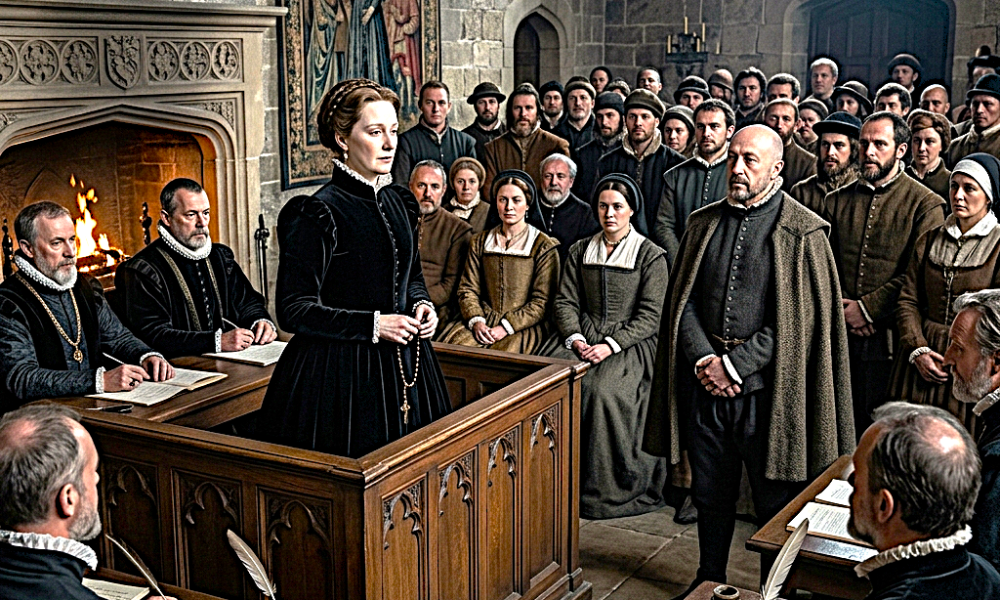
Cajun Dead et le Talkin’ Stick, the Acadian songwriter project that has been quietly building one of the most ambitious triptychs in French Canadian popular music, has completed its three-part Benchmark Canadian Song Trilogy with a cinematic song cycle dedicated to Marie Stuart, Queen of Scots. Produced through AI-driven LLM cinematic generation on FocalML, the trilogy — Vol. 1: Marie Stuart, Vol. 2: Départ Marie Stuart, and Vol. 3: Inspire, Expire, Marie Stuart — represents a seismic departure from the folk revival aesthetic that has long defined Acadian music. These are not heritage songs. They are epic songs about heritage. There is a critical difference, and Cajun Dead et le Talkin’ Stick knows exactly what it is doing as it creates a benchmark Canadian song trilogy.
The trilogy spans from 1548 to 1587: from a five-year-old girl with extraordinary copper-red hair playing with a pony in the gardens of the Château de Saint-Germain-en-Laye to a forty-four-year-old queen removing her black outer robe to reveal a bright orange martyrdom gown before stepping forward to her executioner at Fotheringhay Castle on the cold, clear morning of February 8, 1587. Between those two images lies an entire life—and one of the most devastating political betrayals in the history of the Catholic francophone world.
What anchors all three videos is a single recurring character who appears in no history book: a strikingly handsome Arabic deaf-mute monk, twenty-five years old in Vol. 1 and weathered and grey-bearded by Vol. 3, who lives in a small monastery directly across the river from the château. He first sees Marie as a child running in the royal gardens. He gazes into the river—his divination mirror, in the tradition of Nostradamus—and sees everything that is coming. The betrayal. The trial. The axe. He cannot speak. His lips never move. Not once across three full music videos and four years and fifty minutes of storytelling. His face carries the entire weight of the narrative. It is an astonishing creative constraint that produces the most emotionally devastating performance in the trilogy.
How a French Canadian Songwriter Is Redefining the Scope of Acadian Musical Storytelling by creating a new paradigm with his Benchmark Canadian Song Trilogy
The Acadian musical tradition is one of the richest oral heritage cultures in the North American francophone world. From the ancient ballads of Beausoleil-Broussard to the contemporary poetry of Zachary Richard, Acadian music has always known that song is memory, and memory is survival. But it has also — by necessity, by geography, and by the deep wound of the Grand Dérangement of 1755 — tended to look inward. Kitchen parties. Festival reels. Nostalgic ballads that keep the flame alive but rarely take it anywhere new.
Cajun Dead et le Talkin’ Stick has taken the Benchmark Canadian Song Trilogy flame somewhere new and innovative for quite some time now.
By setting three original Acadian French songs against the life of Marie Stuart—a Scottish Catholic queen betrayed by her own son, condemned by her Protestant cousin Elizabeth, and executed by an establishment that needed her permanently silenced—the project locates the Acadian experience inside a larger Francophone Catholic history of dispossession, betrayal, and survival. Marie Stuart is not a Scottish story borrowed for novelty. She is one of us. Her son James VI signed papers she never saw. Walsingham built the trap. Elizabeth signed the warrant. The powerful wrote the history. The dispossessed sang it afterward. This is a pattern every Acadian knows in their bones from childhood.
The lyrics name names without flinching. James. Elizabeth. Darnley. Walsingham. In Vol. 3, the court spokesman delivers the sentence in lip-sync precision—a devastating directorial choice that makes the music itself briefly complicit in the condemnation before redeeming everything through the monk’s silent tears at the river’s edge hundreds of miles away. The line Tout ce qui reste, c’est moi, le sourd-muet voyeur savant dans le clos des moines—a deaf-mute witness who has followed a queen from her childhood gardens to her execution block, who has seen it all reflected in the water, and who can tell absolutely no one—is one of the finest lines in contemporary French Canadian songwriting. That is not merely a character. That is a living metaphor for every francophone community that watched their world be methodically dismantled while having no institution powerful enough to stop it.
Why Cajun Dead and le Talkin’ Stick Belong in the Canon of French Canadian Arts with the new Benchmark Canadian Song Trilogy
French Canadian and Acadian cultural institutions have long struggled with a defining tension: how do you preserve a fragile linguistic heritage without calcifying it into a museum exhibit of itself? How do you keep a living culture alive without reducing it to costume and nostalgia? Cajun Dead et le Talkin’ Stick answers this question not with a manifesto but with three music videos that are genuinely indistinguishable in visual ambition from major European period cinema.
The production approach is itself a cultural argument. Shot through AI cinematic generation, the trilogy deploys natural light cinematography inspired by Terrence Malick—slow push shots across Loire Valley gold at dawn, cold Atlantic grey-blue at the Scottish coast, and sinister candlelit stone in the execution room at Fotheringhay Castle. The technology has collapsed the financial barrier between a francophone independent artist in Atlantic Canada and the visual language of Cannes. That collapse matters enormously for a culture whose stories have historically been told by others, on other people’s budgets, in other people’s languages, to other people’s audiences. While Theriault builds a new Benchmark Canadian Song Trilogy
The Marie Stuart trilogy is the first Acadian chanson-histoire to sustain a single fictional narrator across three music videos as a cohesive character arc. The first to use AI cinematic generation at this level of photorealistic period production. And the first to position Acadian French songwriting explicitly within the broader history of Catholic francophone dispossession—from the Loire Valley to Leith Harbour to Fotheringhay to Grand Pré, Nova Scotia.
Marie Stuart was French. She was Catholic. She was silenced by the most powerful Protestant establishment in sixteenth-century Europe. So were the Acadians. The monk who watches her from across the river and can never speak is all of us.
La trilogie est complète. La reine est chantée. Le moine a tout vu.