
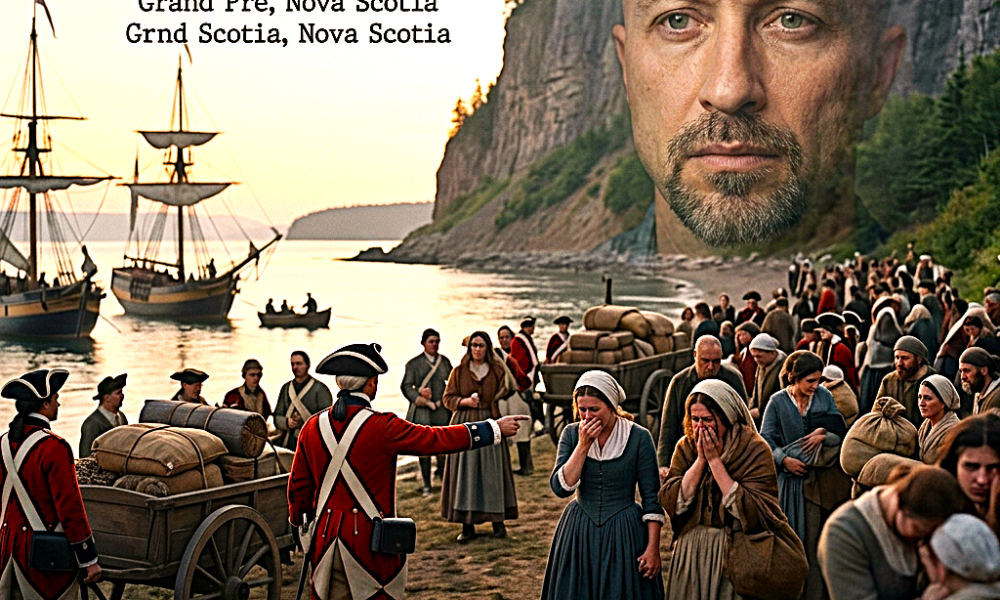
Here it is—select all and copy:
FOR IMMEDIATE RELEASE: April 2026
One artist. No Budget. A Humanitarian Refugee Film Our Globalized, Indifferent World Needs to See on the Topic of the Global Refugee Crisis.
Contemporary Acadian artist Theriault launches a self-funded, AI-produced trilogy on the 1755 Grand Pré deportation—a humanitarian refugee film that uses history as a mirror for the world’s most urgent ongoing crises.
NOVA SCOTIA, CANADA — For as long as human beings have organized themselves into nations and empires, they have also organized the displacement of other human beings. It is, by conservative archaeological and historical estimate, a practice at least 400,000 years old. Wars are fought, borders are drawn, and ordinary people—families, children, the old, and the very young—are swept from everything they have ever known and deposited somewhere they were never meant to be. The delivery mechanisms change. The human suffering does not.
A Parable tale from 1755 for an indifferent World That Still Hasn’t learned to change the story now
Contemporary Acadian artist and creative Theriault has watched this cycle repeat with the weary, mounting outrage of someone who recognizes in the evening news the same faces, the same reaching hands, and the same bewildered children that his own ancestors wore in 1755. He is tired. He is tired of the globalized indifference that meets each new refugee crisis with a brief flicker of media attention before the next news cycle absorbs it. He is tired of the way industrial-scale human suffering has become, for much of the world, a background condition—acknowledged, sighed at, and scrolled past.
His response is not a petition. It is not a social media campaign. It is a humanitarian refugee film that proves the global refugee crisis is as old as war itself.
A Global Refugee Crisis Film Set in 1755 — Because Nothing Has Changed
Theriault is currently in production on “Cajun Dead: The Merkabah Trilogy,” a three-part cinematic epic rooted in one of North America’s most historically documented and emotionally underexplored catastrophes: the forced deportation of the Acadian people from Grand Pré, Nova Scotia, in 1755. Known in French as Le Grand Dérangement — The Great Upheaval — the British Crown’s systematic expulsion of over ten thousand French-speaking Acadian settlers remains one of the most complete erasures of a civilian population in colonial North American history. Villages were burned. Families were separated at gunpoint and loaded onto transport ships. Thousands died. Those who survived were scattered across a continent, from the Carolinas to Louisiana to the cold islands of the North Atlantic, searching for each other for years.
Volume One of the trilogy, subtitled “Blomidon to Bayou Teche,” follows Eva Lynn Thériault and Gabby Dev Dugas—two five-year-old Acadian neighbours swept apart from their parents in the chaos of the Grand Pré burning—as they make their way from the smoking marshlands of Nova Scotia through the hostile colonial streets of South Carolina and down the Mississippi to the bayou country of Louisiana, guided by the mysterious figure of Cajun Dead, a tall, dark privateer and shamanic shapeshifter with a lignum vitae walking stick carved by a Creole shaman in Port Royal, Jamaica, and a past that ties him inextricably to the fate of the children in his care.
They Called It Le Grand Dérangement. Today We Call It Breaking News. Same Global Refugee Crisis Thing.
The visual world of the film is scrupulously, authentically 1755. The war powers are France and England. The language is Le Cajun Patois. The costumes, vessels, architecture, and landscapes are period-precise. But the emotional register of every frame is drawn directly from the visual language of the 21st-century global refugee crisis. The faces of Acadian families watching their homes burn are composed with the formal documentary weight of the most indelible photographs of Aleppo, of the Rohingya coast, and of the Texas border. The children holding hands in the crowd are every child who has ever held another child’s hand because there was no adult hand left to hold. This is a global refugee crisis film that does not require its audience to travel anywhere to recognize what they are seeing. They have seen it. It is happening now. Theriault has set it in 1755 as a parable—because the parable, he argues, is the only form that can hold a truth this old without the audience looking away.
The two war powers in the film — France and England — are not presented as historical curiosities. They are presented as the eternal architecture of empire: large institutional forces prosecuting geopolitical strategies whose human costs are borne entirely by people who had no voice in the decisions that destroyed their world. The children do not understand geopolitics. They understand that the soldiers came and their parents are gone. That, Theriault insists, is the only geopolitical analysis a film of this kind needs.
A Humanitarian Refugee Film Built Without Permission — And Why That Matters
What makes this Global Refugee Crisis film project historically significant extends well beyond its subject matter. Theriault is producing this humanitarian refugee film entirely without the support, funding, endorsement, or involvement of any government, cultural organization, film body, heritage institution, or community group. No grants. No co-production agreements. No institutional backing of any kind. In a creative landscape where projects of this scale and ambition typically require years of applications, committee approvals, editorial oversight by funding bodies, and the slow bureaucratic dilution of original vision, Theriault has simply decided to make the film himself and is doing so.
His primary production tool is artificial intelligence. Using a combination of Higgsfield Cinema Studio, Kling AI, and HeyGen for character generation and video production, Suno for original musical score, and CapCut for final assembly and sound design, Theriault is constructing a 100-minute cinematic epic across 20 segments with the production architecture of a professional studio and the budget of an individual creator. The film’s complete master character bible, director’s vision statement, segment-by-segment clip prompts, and music cue library have been developed with painstaking creative rigour—every character described with documentary precision, every humanitarian visual parallel consciously embedded, and every frame of the opening bagpipe fade-in and closing dobro fade-out deliberately designed.
The Oldest Crime in the World Is Still Happening. It Just Changes Its Uniform.
This represents something the mainstream creative industry has been slow to acknowledge and quick to fear: the genuine democratization of cinematic storytelling. The narrative that artificial intelligence is a threat to creativity—a villain, as Theriault describes the mainstream’s framing—is, he argues, the anxiety of institutions whose monopoly on the means of production is ending. The real threat AI poses is not to creativity. It is for the gatekeepers of creativity: the funding bodies, the distribution platforms, the studio development processes, and the editorial committees who have historically decided which stories get told and, more significantly, which stories do not. The story of the Acadian deportation as a mirror for the global refugee crisis is precisely the kind of story those gatekeepers have not told—too regional, too French, too inconveniently parallel to present political realities that powerful institutions prefer not to illuminate.
Theriault is telling it anyway. Without asking. Without waiting. Without the dull, uninspired, committee-approved aesthetic of mainstream heritage media that has spent decades making the Acadian story—when it has been told at all—safe, nostalgic, and politically inoffensive. His film will not be safe. It will not be nostalgic. It will be a 1755 period epic that makes audiences think of a photograph they saw last week. That is the intention. That is the point.
The Global Refugee Crisis Has a New Voice: A Humanitarian Refugee Film From Grand Pré.
In doing so, Theriault is setting a precedent that reaches far beyond the Acadian community. He is demonstrating what becomes possible when a marginalized artist with a story the mainstream will not tell picks up the most powerful creative tool of the current era and uses it with full creative sovereignty. The story of Eva Lynn Thériault and Gabby DevDugas—two five-year-olds holding hands in a crowd, walking toward a dark ship, looking back at a burning home—will be seen. Not because an institution decided it should be. Because one artist decided it must be.