
Press Release: The Space-Based AI Data Centres Orbital AI Race Just Went…
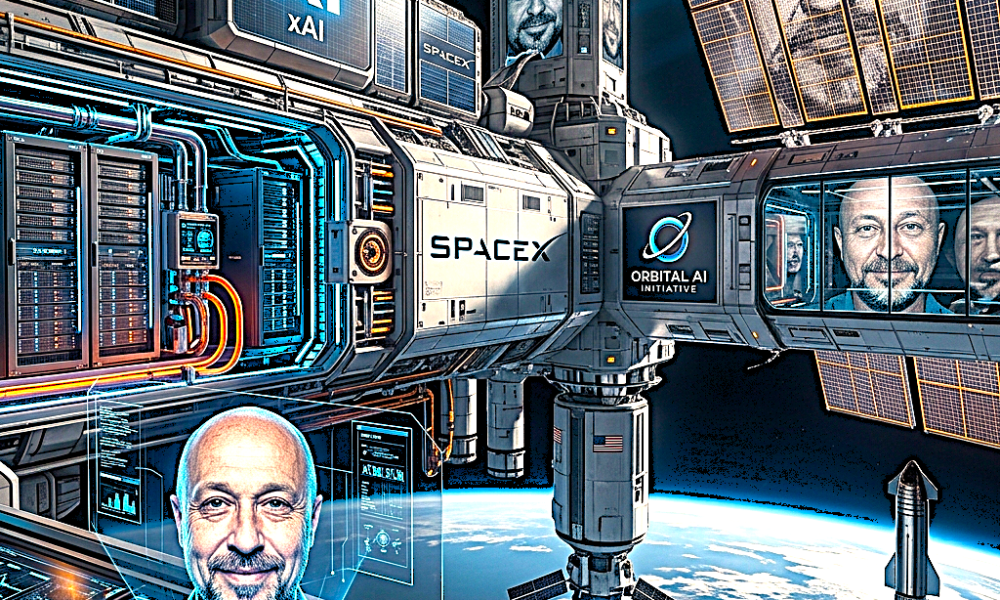
Artificial intelligence has officially outgrown Earth. As of early 2026, SpaceX’s acquisition of xAI has kicked off one of the most audacious infrastructure pivots in tech history: the creation of a constellation of orbital AI data centres designed to move the future of compute off the planet entirely and why it matters from an investor’s point of view.
If that sentence feels like science fiction, buckle up. The next decade of AI won’t be defined by who has the best model — it’ll be defined by who controls the compute, the energy, and the orbital real estate to run it.
And right now, SpaceX is trying to claim the high ground. Literally.
🚀 The New Space Race Isn’t About Rockets — It’s About Orbital AI Compute
The merger between SpaceX and xAI, valued at roughly $1.25 trillion, isn’t just a corporate reshuffle. It’s a vertical integration play that fuses rockets, satellites, and AI into a single industrial machine.
The goal: launch up to 1 million orbital AI data centres—what SpaceX calls “orbital data-centre systems”—using Starship’s projected ability to loft a million tons of hardware per year.
This isn’t just scaling. It’s rethinking the physical location of intelligence.
Why AI Data Centres in Space?
Because Earth is running out of power, cooling, and patience.
- Energy: AI compute demand is doubling every few months. Terrestrial grids can’t keep up. Space offers uninterrupted solar energy — no clouds, no nights, no NIMBYs.
- Cooling: On Earth, data centres drink water like a small city. In orbit, radiative cooling becomes the default. No evaporative towers, no water rights battles, no overheated rivers.
- Launch economics: Starship’s cost-per-kilogram is dropping fast. When you can throw 150 tons into orbit for less than the price of a mid-sized data hall, the math starts to tilt.
If those numbers hold, orbital compute could outpace Earth-based data centres within 2–3 years—not in performance, but in cost per watt of usable AI output.
That’s the part that makes strategists sit up straight.
🌑 The Long Game: Lunar Manufacturing and Deep-Space AI
The near-term plan is wild enough, but the long-term vision is where things get cosmic.
SpaceX has floated the idea of using the Moon as a manufacturing hub, mining lunar resources to build satellites off-world. From there, electromagnetic mass drivers could fling finished AI nodes into deeper space, creating a distributed intelligence network that spans the inner solar system.
Think of it as the first draft of a Dyson Swarm—not built to harvest energy but to run models.
This is the kind of idea that makes AI futurists grin and engineers sweat.
⚠️ The Skeptics Aren’t Wrong — The AI Data Centre Challenges Are Brutal
For all the hype, the technical obstacles are enormous. And critics are loud for a reason.
Radiation
High-performance AI chips degrade fast under solar radiation. Shielding them adds weight, which adds cost, which breaks the economics.
Heat Dissipation
Space is cold, but it’s also a vacuum. Heat doesn’t “escape”—it must be radiated. That means giant radiators, which again add mass.
Hardware Obsolescence
AI hardware cycles every 12–18 months. Replacing a server on Earth is trivial. Replacing one in orbit is… not.
Orbital Debris and AI Data Centers
Launching a million satellites increases orbital object count by a factor of 100. Debris experts are already sounding alarms about collision cascades.
These aren’t footnotes. They’re existential risks to the entire plan.
But Musk’s argument is simple:
Earth cannot scale AI compute fast enough. Space must pick up the slack.
Agree or disagree, it’s hard to ignore the logic.
🌍 Why This Matters for the Future of AI Data Centers
Whether or not SpaceX hits its numbers, the shift in mindset is the real story. AI is no longer just a software problem. It’s an energy problem, a physics problem, a logistics problem, and now an orbital mechanics problem.
This is the first time a major player has said out loud what many in the industry have whispered for years:
“AI will eventually require infrastructure that Earth alone cannot provide.”
If that’s true, then the companies that master off-world compute will shape the next century of intelligence.
This isn’t about models. It’s about territory.
🛰️ The Strategic AI Data Centres View: What Comes Next
From a strategist’s perspective, here’s what to watch:
- Launch cadence: If Starship hits weekly or daily launches, the orbital compute plan becomes plausible.
- Chip radiation hardening: Whoever cracks this unlocks the entire space-AI economy.
- Orbital debris mitigation: Expect new treaties, new tech, and new regulatory battles.
- Energy economics: If orbital solar becomes cheaper than terrestrial power, everything changes.
- Model architecture shifts: AI designed for space constraints will look different — more efficient, more modular, more resilient.
This is the part where the industry quietly pivots. Not with a press release, but with procurement orders.
🌌 The Big Picture: Orbital AI Leaves the Planet
We’re witnessing the beginning of a new infrastructure layer—one that sits above clouds, above fibre, above geopolitics.
If SpaceX succeeds like they say they will, AI won’t just run in the cloud. It will run in orbit. It will run on the Moon. It will run wherever sunlight and vacuum give it an advantage.
And that means the future of intelligence won’t be bound to Earth’s limits.
It will be built in space.