
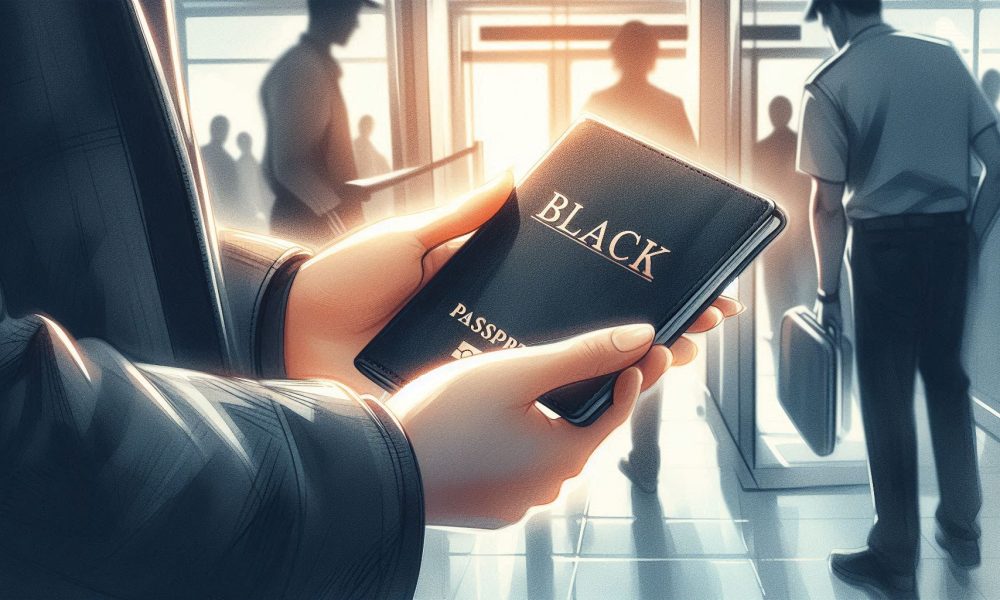
A harder-edged explainer on the myths of unrestricted travel, diplomatic courtesy, and the legal limits that make a black passport far less powerful than internet mythology suggests.
WASHINGTON, DC, April 17, 2026.
When people hear the phrase black passport, they often imagine a near-magical document that opens borders, shortens lines, softens scrutiny, and places the holder above ordinary travel friction. That fantasy is one of the most durable myths in the passport world, and it survives because diplomatic documents look rare, official, and politically charged. The real answer is much narrower. A diplomatic passport can matter a great deal in the right context, but it does not create unrestricted travel, it does not suspend border control, and it does not turn every official trip into a private freedom pass.
The most important correction comes straight from the State Department’s guidance on special issuance passports, which makes clear that these passports are for official or diplomatic duties, are not for personal travel except in limited assignment-related circumstances, remain government property, and do not by themselves provide diplomatic immunity or protection from arrest. That is not a small detail. It is the whole foundation of the issue.
The black passport is not a stronger consumer passport.
This is where public imagination usually goes wrong. Many people think of a diplomatic passport as a premium version of an ordinary passport, almost like a global upgrade that comes with fewer rules and more freedom. In law and practice, it is not that at all. A diplomatic passport is a state instrument tied to role, mission, and recognized official status. It exists because a government needs a particular person to travel abroad in an official capacity, not because that person deserves a more powerful travel experience than everyone else.
That difference changes everything. An ordinary passport follows the private life of a citizen through vacations, business trips, family visits, school, and relocation. A diplomatic passport follows the official life of an assignment. It is narrower, more conditional, and much more dependent on the government’s purpose behind the trip. The public sees power. Governments see a category.
The myth of unrestricted travel collapses as soon as host-state rules enter the picture.
A black passport can place a traveler into a more official administrative lane, but that does not mean the host country stops asking questions or waives its own immigration rules. Diplomatic courtesy exists, and official travelers may be processed differently, but courtesy is not the same thing as unrestricted movement. Host governments still decide visa treatment, inspection procedures, and whether the claimed diplomatic function is recognized in the first place.
That is why the fantasy of free movement with a diplomatic passport is so misleading. The document may help identify the bearer as someone traveling on official business, but it does not erase the receiving state’s authority to require visas, impose restrictions, or challenge the claimed status. The passport can open a different conversation at the border, but it does not end that conversation.
Diplomatic courtesy is real, but it is not the same thing as legal freedom.
A diplomatic traveler may encounter more formal handling, more protocol awareness, and a more structured process than an ordinary tourist or business passenger. Yet that should never be confused with an automatic right to move without scrutiny. Courtesy is contextual. It depends on the traveler’s role, the state relationship involved, and the host government’s willingness to extend that courtesy under current political conditions.
That means a black passport can produce smoother handling in some situations while still offering no protection at all against a host state that wants closer control, stricter processing, or clearer proof that the trip is genuinely official. Courtesy is not immunity. And neither courtesy nor immunity equals unrestricted travel.
Visa treatment can be tightened even for diplomatic passport holders.
One of the clearest recent reminders came when, as Reuters reported in January 2025, the European Union approved the suspension of visa-free travel for Georgian officials holding diplomatic passports. That move did not target the entire population. It targeted a specific official category. The lesson could not be clearer. Diplomatic passports do not float above politics. They live inside politics.
That example matters because it shatters the common assumption that diplomatic documents always travel more freely than ordinary passports. In some cases, they do. In others, they become the exact category a host state chooses to restrict when it wants to send a political message without punishing the wider public. A diplomatic passport can therefore become a marker of tighter control, not broader freedom.
Immunity is not the same thing as mobility.
Another major source of confusion is the tendency to merge travel freedom with diplomatic immunity, as though the two concepts were basically the same. They are not. Immunity is a legal doctrine tied to accredited status, official function, and recognized diplomatic standing. Travel freedom is a practical question about entry, inspection, visa rules, and what the host country is willing to permit on a given day.
A diplomatic passport may support a claim to official status, but it does not itself create immunity, and it certainly does not create a right to ignore customs law, immigration law, or border screening. That is one reason the black passport is so often misunderstood. It looks like a shortcut to legal insulation, but the actual protections depend on the role behind the holder, not on the cover color of the booklet.
Readers looking for a broader background on that gap between symbolism and law can see the same issue in Amicus coverage of diplomatic passports and immunity, where the central point is that document appearance and legal effect are never identical in practice.
Host-country recognition matters more than the booklet itself.
A government may issue a diplomatic passport, but its practical force abroad depends on whether another government recognizes the status behind it. That is why black-passport power is always conditional. The sending state can certify a traveler as official, but the receiving state still decides how that traveler will be handled under its visa rules, diplomatic framework, and broader political relationship with the issuing country.
This is the part mythmakers usually skip. They speak as though the passport contains the power within itself. Real diplomacy does not work that way. The power lies in the state-to-state relationship behind the document. If that relationship weakens, sours, or becomes politically strained, the practical advantages associated with the passport can shrink very quickly.
Politics can narrow movement even when the passport remains valid.
A diplomatic passport can be genuine, current, and officially issued, and the holder can still find that movement is politically contested. That was visible again when Reuters reported in May 2025 that Cuba issued a formal warning to the top U.S. diplomat in Havana and criticized his movement across the island for meetings with dissidents. The point here is not to relitigate the politics of the case. It is to show how limited the black passport can be when a host state decides the traveler’s conduct is politically unacceptable.
That is one of the most important practical truths about diplomatic travel. A black passport may place a person inside a protected framework, but it does not force a host state to welcome every movement, every meeting, or every political signal attached to that traveler. The passport can identify the status. It cannot dissolve political reality.
The document follows the job, not the private desires of the holder.
This is another reason the myth of free travel falls apart. A diplomatic passport is not a lifetime trophy or a deluxe version of personal identity. It follows office, assignment, and official need. That means it is tied to the mission and to the legal basis for the mission, not to the private wishes of the traveler carrying it.
Once that is understood, the black passport looks less like a freedom machine and more like what it really is, namely a controlled state document issued for a narrow official purpose. It may be highly useful for that purpose, but outside of it, the magic disappears quickly. That is also why so many public misunderstandings begin with the cover and end in disappointment when the law enters the picture.
For readers who want a broader sense of how these myths spread, Amicus has also published a separate explainer on what diplomatic passports really do in practice, which tracks the same recurring gap between public symbolism and legal limits.
The clean answer is that a diplomatic passport can smooth official travel, but it does not create unrestricted travel.
It may identify the holder as someone moving under official authority. It may help place the traveler inside a more formal protocol process. It may support access to diplomatic or official channels in the right circumstances. But it does not erase immigration law, it does not guarantee visa-free entry, it does not override host-state politics, and it does not transform the holder into someone beyond questioning, screening, or consequence.
That is the real limit of black passport power. The document can matter a great deal, but only inside the official framework that gives it meaning. Outside that framework, the fantasy of traveling freely with a diplomatic passport collapses fast. The booklet may look like unrestricted movement in physical form, but in law it is a narrow instrument whose force depends on recognition, assignment, reciprocity, and the willingness of another government to play along.




