
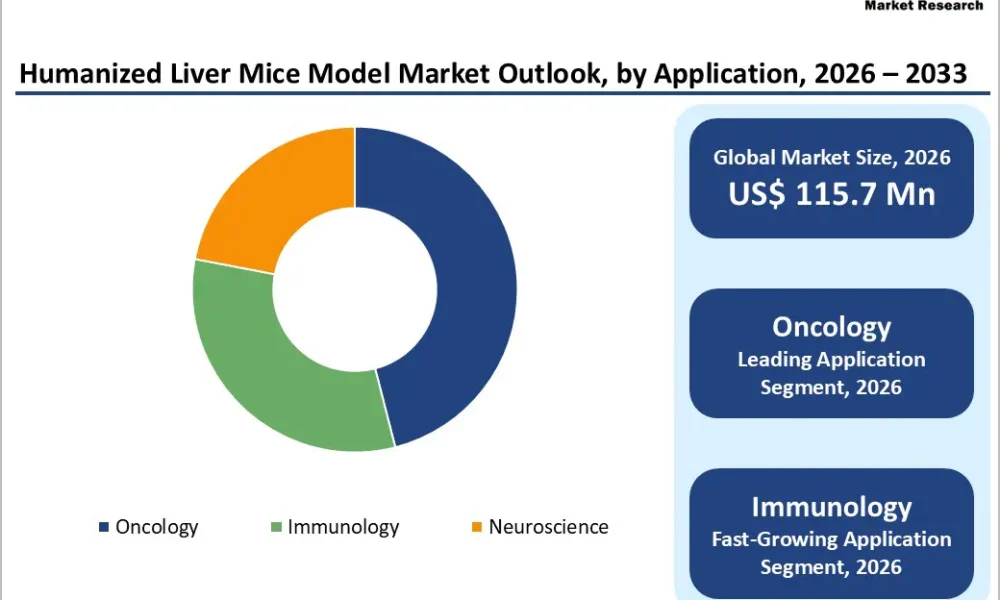
The global Humanized Liver Mice Model Market is projected to reach a valuation of US$ 115.7 million in 2026 and is expected to grow to US$ 169.4 million by 2033, representing a compound annual growth rate (CAGR) of 5.6% from 2026 to 2033. The market is experiencing significant growth due to the increasing demand for human-relevant preclinical testing models that bridge interspecies differences in drug metabolism and toxicity studies. Humanized liver mice models, which achieve 70–90% human hepatocyte chimerism, replicate human liver structure and functionality, allowing for more accurate pharmacokinetics and safety evaluations during early-stage drug development. The growing prevalence of liver diseases, including hepatitis, liver cirrhosis, and hepatocellular carcinoma, is driving research activities globally. Furthermore, rising FDA approvals for liver-targeted therapies are encouraging pharmaceutical R&D investments, bolstering the adoption of these models in preclinical pipelines.
Download Your Free Sample & Explore Key Insights: https://www.persistencemarketresearch.com/samples/25417
Key Market Highlights
North America remains the largest market, driven by robust biomedical research funding, advanced infrastructure, and widespread adoption of humanized liver models in drug development studies. The Asia Pacific region is projected to be the fastest-growing market, fueled by a rising liver disease burden, expanding research facilities, and increased pharmaceutical investments. Genetic humanized liver mice models currently hold the largest market share due to their superior physiological relevance, reproducibility, and extensive use in preclinical drug testing. CRISPR-based humanized models are the fastest-growing segment, owing to demand for precision modeling, accelerated development timelines, and improved translational outcomes.
Key Insights
- Humanized Liver Mice Model Market Size (2026E): US$ 115.7 Mn
- Market Value Forecast (2033F): US$ 169.4 Mn
- Projected Growth (CAGR 2026–2033): 5.6%
- Historical Market Growth (CAGR 2020–2025): 4.7%
Market Dynamics
Drivers: Technological Advancements and Rising Liver Disease Burden
Technological advancements are key drivers in the humanized liver mice model market, allowing for highly sophisticated and reliable preclinical models. Advanced models such as PPARα- and AFC8-based mice replicate human liver physiology more closely, offering improved stability, functional consistency, and predictive accuracy. The shift from basic immunodeficient mice implanted with human hepatocytes to chimeric models with humanized liver tissue has enhanced translational research outcomes significantly. These models allow precise studies of drug metabolism, toxicity, and liver-specific disease mechanisms, improving confidence in preclinical data and accelerating drug development timelines.
The increasing global prevalence of liver diseases is also boosting market growth. Hepatitis B and C, liver cirrhosis, and hepatocellular carcinoma are major public health concerns, particularly in Asia and Africa. Humanized liver mice models provide biologically relevant platforms to study disease progression and evaluate therapeutic candidates. As pharmaceutical companies and research institutions increase investments in liver disease research and antiviral drug development, demand for these advanced preclinical models is expected to rise steadily.
Restraints: High Model Costs and Regulatory Challenges
Despite their benefits, the high cost of humanized liver mice models poses a challenge for market growth. These models require complex genetic engineering, human cell engraftment, and specialized animal care, making them significantly more expensive than conventional laboratory mice. While standard immunodeficient mice may cost between USD 140 and USD 500, advanced chimeric humanized liver mice models range from USD 2,500 to USD 3,500 per animal. Additional costs for specialized housing, skilled personnel, and temperature-controlled shipping further limit accessibility, particularly for smaller research organizations and academic institutions.
Regulatory and ethical requirements also constrain market expansion. Strict frameworks govern the use of animal models, emphasizing humane treatment and ethical justification under principles such as replacement, reduction, and refinement (3Rs). Compliance necessitates extensive documentation, ethical approvals, and ongoing monitoring, which can delay study initiation and increase operational costs. Together, high costs and regulatory hurdles limit broader adoption of humanized liver mice models.
Opportunities: Genetic Editing Innovations and Emerging Markets
The integration of advanced genetic editing technologies, particularly CRISPR-Cas9, presents a significant growth opportunity. CRISPR enables precise genome editing to develop models with specific human gene expression and liver functions, closely mimicking human physiology. This precision enhances model reliability for studying complex liver diseases and drug responses. Additionally, CRISPR reduces the time and cost associated with generating customized models, increasing accessibility to a wider research community. As genetic engineering evolves, model performance and application areas in toxicology, virology, and personalized medicine are expected to expand.
Emerging markets, especially in Asia Pacific and Latin America, also offer significant opportunities. These regions are investing in healthcare infrastructure, biomedical research, and pharmaceutical manufacturing. High hepatitis B and C prevalence further drives the need for advanced liver models to support drug discovery. Establishing regional facilities, forming partnerships with local research institutions, and supporting government-led research initiatives can unlock new revenue streams and strengthen the global footprint of market players.
Get Custom Insights Designed for Your Businecss: https://www.persistencemarketresearch.com/request-customization/25417
Category-wise Insights
Model Type Analysis
Genetic humanized mouse models dominate the market due to their critical role in drug discovery and preclinical research. Engineered to express human genes or develop functional human liver tissue, these models enable accurate evaluation of human-specific drug metabolism, toxicity, and disease pathways. Pharmaceutical and biotechnology companies rely heavily on these models for translational data, reducing late-stage drug failures and providing regulatory confidence. Academic and contract research institutions also increasingly adopt these models for experimental analysis. Continuous improvements in genetic engineering techniques enhance model stability and reproducibility, cementing the dominance of genetic humanized models.
Application Analysis
Oncology is the leading application segment, driven by the global cancer burden and the need for advanced preclinical research tools. Humanized mouse models facilitate studies of tumor biology, cancer progression, and tumor–host interactions in a human-relevant environment. They enable precise evaluation of anticancer drugs, immunotherapies, and targeted treatments, improving predictive accuracy. By replicating human tumor complexity, these models allow researchers to assess treatment efficacy and safety more effectively. Continued investment in oncology research ensures sustained demand, reinforcing the segment’s leadership and growth potential.
Regional Insights
North America
The North American market is poised for substantial growth due to the increasing demand for personalized and precision medicine. Pharmaceutical and biotechnology companies adopt humanized models for preclinical studies to better predict human-specific drug metabolism, toxicity, and therapeutic response. Advancements in genetic engineering and CRISPR-based tools have improved model accuracy and stability. Academic institutions and contract research organizations utilize these models to study complex liver diseases and evaluate novel drug candidates. A strong healthcare ecosystem, robust regulatory frameworks, and significant R&D investments support sustained market growth, making North America the leading revenue-generating region.
Asia Pacific
Asia Pacific is emerging as a high-growth region, driven by expanding pharmaceutical research, rising liver disease prevalence, and an increasing focus on translational medicine. Countries including China, Japan, South Korea, and India are investing heavily in biotechnology infrastructure and preclinical research. The high burden of hepatitis B and C accelerates demand for advanced liver disease models. Government and private organizations are promoting collaborations and funding initiatives to strengthen life sciences research. Contract research organizations and academic institutions improve access to advanced animal models, while cost-effective research environments and growing adoption of genetic engineering support market expansion. As regulatory standards mature and align with global practices, Asia Pacific is expected to witness strong adoption of humanized liver mice models.
Checkout Now & Download Complete Market Report: https://www.persistencemarketresearch.com/checkout/25417
Competitive Landscape
Market Structure Analysis
The humanized liver mice model market is highly competitive, with leading players focusing on innovation and expansion of product offerings. Companies are investing heavily in R&D to deliver reliable and functionally efficient humanized models. Strategic collaborations, mergers, and acquisitions are commonly pursued to enhance technological capabilities and expand market reach. Competition is further intensified by rapid advancements in genetic engineering tools, particularly CRISPR-Cas9, which facilitate the development of physiologically relevant models. Rising demand for preclinical drug testing and the growing global liver disease burden drive competitive dynamics.
Key Market Developments
- January 2022: Taconic Biosciences, Inc. (US) launched the huNOG-EXL EA (early access) humanized immune system (HIS) mouse model
- October 2021: The Jackson Laboratory (US) acquired the Research Models & Services (RMS) business of Charles River Laboratories Japan, Inc., making it a wholly owned subsidiary
Companies Covered in the Market
- Ingenious Targeting Laboratory
- Axenis S.A.S
- Trans Genic Inc.
- Horizon Discovery Group PLC
- HuMurine Technologies
- Champions Oncology Inc.
- Genoway S.A.
- Crown Bioscience Inc.
- Taconic Biosciences Inc.
- The Jackson Laboratory
- Vitalstar Biotechnology Co. Ltd
Conclusion
The Humanized Liver Mice Model Market is poised for steady growth, driven by technological advancements, rising liver disease prevalence, and increasing pharmaceutical R&D investments. Genetic humanized models dominate the market, while CRISPR-based models are expanding rapidly due to precision and cost-effectiveness. North America leads the market, supported by advanced infrastructure and research funding, while Asia Pacific offers high-growth opportunities due to rising liver disease burden and emerging research capabilities. Despite challenges from high costs and regulatory constraints, innovations in genetic engineering and expansion into emerging markets are expected to sustain long-term growth, making humanized liver mice models an essential component of preclinical drug development and translational research.




