
The global X-ray crystallography market is poised for substantial growth, with a projected market value of US$ 1.8 billion in 2025, set to reach US$ 3.0 billion by 2032. This represents a compound annual growth rate (CAGR) of 7.6% from 2025 to 2032. The market’s expansion is largely driven by the growing demand for advanced molecular and structural analysis across sectors like pharmaceuticals, biotechnology, and materials science. As research methodologies evolve and new technologies enhance the accuracy of data collection and analysis, the adoption of X-ray crystallography is gaining widespread traction. Notably, innovations in automation and artificial intelligence (AI) are revolutionizing crystallographic workflows, further fueling this market’s growth.
Key Growth Drivers and Leading Market Segments
The primary growth drivers of the X-ray crystallography market include the increasing emphasis on drug discovery and the expanding application of structural biology to understand disease mechanisms. As the need for precise molecular data intensifies, the pharmaceutical and biotechnology sectors are increasingly relying on X-ray crystallography to expedite research and accelerate the development of new drugs. Moreover, advances in imaging technologies, automation, and data analysis software are improving the precision and efficiency of crystallography, making it a more attractive option for researchers.
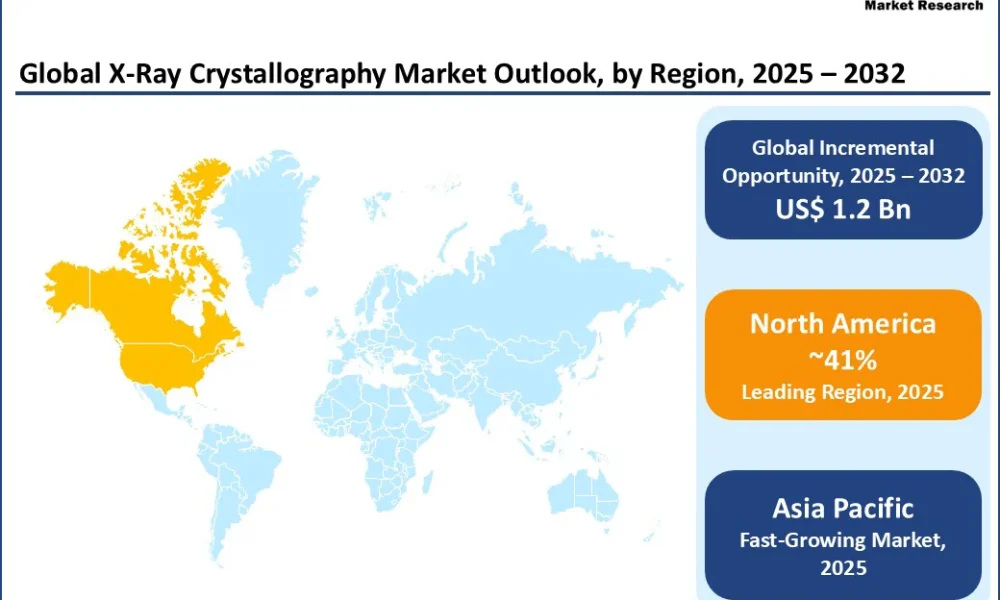
The pharmaceutical sector remains the dominant application area, contributing over 45% of the market revenue in 2025. As drug development becomes more intricate and tailored, the need for high-resolution structural insights grows, further solidifying X-ray crystallography’s pivotal role. Geographically, North America is the leading region, expected to capture 41% of the market share by 2025. The region’s dominance is attributed to its world-class research infrastructure, heavy investments in pharmaceutical R&D, and the presence of industry leaders such as Bruker Corporation and Thermo Fisher Scientific.
Download Your Free Sample & Explore Key Insights: https://www.persistencemarketresearch.com/samples/8818
Key Highlights from the Report
• The global X-ray crystallography market size in 2025 is expected to be US$ 1.8 billion.
• The market is forecast to grow at a CAGR of 7.6% between 2025 and 2032.
• North America is the leading market, anticipated to account for 41% of the global share in 2025.
• The pharmaceutical sector is expected to hold the largest revenue share, contributing over 45%.
• Instruments dominate the market, with a share of 55% in 2025.
• The fastest-growing segment is the services sector, driven by the increasing outsourcing of crystallographic analysis.
Market Segmentation
The global X-ray crystallography market can be segmented into product types, end-users, and applications, with distinct trends emerging in each category.
Product Type
The instruments segment leads the market, expected to account for around 55% of the market share by 2025. The prominence of instruments is due to their crucial role in providing high-precision structural analysis. These advanced tools, such as X-ray diffractometers and high-resolution detectors, are used extensively in academic research, pharmaceutical development, and materials science. Additionally, the growing integration of AI and automated workflows in X-ray crystallography instruments enhances their appeal, making them indispensable in both industrial and research settings.
The services segment is experiencing rapid growth, particularly in the context of contract research organizations (CROs) and specialized service providers. These services, including crystal structure determination and data analysis, are becoming more popular due to their cost-effectiveness and ability to support institutions lacking advanced equipment or in-house expertise.
End-User
The pharmaceutical industry holds the largest market share, driven by the industry’s need for precise structural data to support drug discovery, biologics development, and the approval processes for new therapies. Crystallographic data is essential for understanding protein-ligand interactions, a key component of designing effective drugs.
The biotechnology and life sciences sector is also witnessing significant growth, fueled by the increasing need for X-ray crystallography in protein engineering, enzyme studies, and the development of personalized medicines. The rise in biologics and biopharmaceuticals has further accelerated the demand for high-resolution structural data.
Application
In terms of applications, the pharmaceuticals segment remains dominant, contributing over 45% of the market revenue. This dominance is linked to the essential role of X-ray crystallography in drug discovery and the development of biologics. The academic research segment is the fastest-growing application area, particularly in regions with expanding research infrastructures like Asia Pacific.
Get Custom Insights Designed for Your Business: https://www.persistencemarketresearch.com/request-customization/8818
Regional Insights
The X-ray crystallography market exhibits varied trends across regions, with North America and Asia Pacific standing out as key players.
North America
North America dominates the global X-ray crystallography market, accounting for an estimated 41% of the market share by 2025. The region’s leadership is due to its sophisticated research facilities, strong pharmaceutical and biotechnology sectors, and substantial investments in life sciences research. The presence of leading companies like Bruker Corporation, Thermo Fisher Scientific, and Agilent Technologies further strengthens the region’s market position. Additionally, the U.S. and Canada have world-renowned academic institutions and healthcare centers that are integral to the growth of the crystallography market.
Asia Pacific
Asia Pacific is the fastest-growing region, driven by robust government support for research and rapid advancements in the biotechnology and pharmaceutical sectors. Countries like China, India, and Japan are investing heavily in healthcare infrastructure and research facilities, making the region a key hub for X-ray crystallography. China, in particular, has invested significantly in state-of-the-art crystallography centers to support its burgeoning pharmaceutical industry, while India’s expanding biotech ecosystem is adopting crystallographic tools for both academic and industrial applications.
Europe
Europe remains a critical player in the global X-ray crystallography market, supported by strong research frameworks and collaborative initiatives. Leading countries such as Germany, United Kingdom, and France continue to drive market growth through extensive investments in scientific research and biotechnology. Europe’s focus on advancing drug discovery and materials characterization, particularly with AI-driven systems, ensures its place as a major contributor to the global crystallography market.
Market Drivers
The X-ray crystallography market is benefiting from several key drivers. One of the foremost drivers is the increasing demand for drug discovery and development. The rise in chronic diseases and infectious disorders globally has prompted pharmaceutical companies to ramp up their research and development efforts. X-ray crystallography plays a crucial role in this context, enabling scientists to determine the 3D structures of biomolecules, such as proteins and enzymes, which is essential for understanding disease mechanisms and designing drugs that interact effectively with specific biological targets. As the focus on precision medicine intensifies, the demand for X-ray crystallography in drug discovery is set to grow.
Additionally, the integration of automation and AI is enhancing the efficiency and scalability of X-ray crystallography workflows, further driving adoption. These technological advancements are allowing laboratories to handle larger volumes of samples and accelerate the pace of discovery. As a result, the market is seeing increased investment from pharmaceutical companies, research institutions, and biotechnology firms eager to leverage these innovations.
Market Restraints
Despite its growth, the X-ray crystallography market faces significant restraints, primarily in the form of high costs associated with both instruments and maintenance. Advanced X-ray crystallography systems, including X-ray diffractometers and high-resolution detectors, require significant capital investment. For smaller research labs or academic institutions, the upfront costs, coupled with ongoing expenses like calibration and maintenance, can be a major barrier to adoption. Furthermore, maintaining these sophisticated systems requires skilled technicians and adherence to strict operational standards, adding to the overall cost burden.
For many smaller players or companies in developing regions with limited resources, the high costs associated with crystallography instruments can deter investment. This financial challenge restricts broader market penetration, especially in resource-constrained environments.
Market Opportunities
The integration of automation and AI into X-ray crystallography workflows presents significant opportunities for growth. These technological innovations are not only improving the speed and accuracy of crystallographic analysis but also making the technology more accessible to a broader range of users. AI and machine learning algorithms can automate complex data analysis, reduce errors, and predict molecular structures, which significantly enhances the value of X-ray crystallography in drug discovery and materials science.
Moreover, the growing emphasis on biologics and personalized medicine provides further opportunities for X-ray crystallography to play a crucial role in understanding disease mechanisms and designing targeted therapies. The growing demand for these advanced treatments, coupled with improvements in data processing and automation, is expected to drive the market forward.
Checkout Now & Download Complete Market Report: https://www.persistencemarketresearch.com/checkout/8818
Company Insights
The X-ray crystallography market is home to a mix of global giants and specialized players, including:
• Rigaku Corporation
• Bruker Corporation
• Thermo Fisher Scientific
• Agilent Technologies
• PerkinElmer Inc.
• Malvern Panalytical
• JEOL Ltd.
• Anton Paar GmbH
• Oxford Instruments plc
• Dectris Ltd.
Recent Developments:
In April 2023, Rigaku and JEOL launched the XtaLAB Synergy-ED, a fully integrated electron diffraction platform designed for molecular structure determination of nanocrystals.
In July 2024, Bruker made a strategic minority investment in NovAliX to enhance structure-guided drug discovery workflows.
Conclusion
The X-ray crystallography market is set for impressive growth, driven by advancements in automation, AI integration, and an increasing demand for precise molecular analysis. North America remains the market leader, while Asia Pacific emerges as the fastest-growing region due to significant investments in research and biotechnology. However, challenges such as high instrument costs and maintenance requirements must be addressed to ensure broader adoption. With opportunities emerging in the fields of biologics and personalized medicine, the market for X-ray crystallography is well-positioned to continue its growth trajectory in the coming years.




