
The global solvent recovery systems market is experiencing steady growth as industries increasingly focus on environmental compliance, cost reduction, and sustainable manufacturing practices. Solvent recovery systems are designed to reclaim and purify solvents from industrial waste streams, enabling companies to reuse them instead of disposing of them as hazardous waste. This approach helps reduce operational costs, minimize environmental impact, and comply with strict emission regulations.
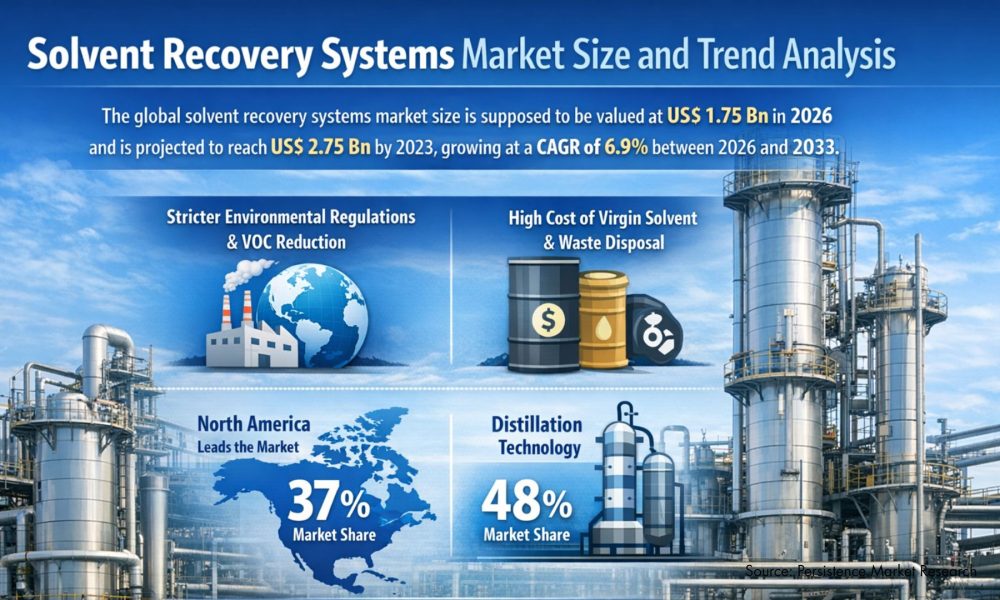
According to industry analysis, the global solvent recovery systems market is expected to reach US$ 1.75 billion in 2026 and is projected to grow to US$ 2.75 billion by 2033, expanding at a CAGR of 6.9% during the forecast period from 2026 to 2033. The increasing need to reduce volatile organic compound (VOC) emissions and the rising cost of purchasing virgin solvents are major factors driving the adoption of solvent recovery technologies across various industries.
Get Your FREE Sample Report Instantly – Click Now: https://www.persistencemarketresearch.com/samples/33890
Rising Environmental Regulations Accelerating Market Growth
Environmental regulations are one of the most significant drivers influencing the adoption of solvent recovery systems. Governments and regulatory bodies across the world have introduced strict rules aimed at reducing industrial emissions, particularly volatile organic compounds (VOCs) released from chemical processing, paints and coatings, and pharmaceutical manufacturing.
Regulatory frameworks such as the U.S. Environmental Protection Agency (EPA) Clean Air Act and the European Union Industrial Emissions Directive require industries to implement technologies that reduce harmful emissions and improve waste management practices. As a result, companies are increasingly investing in solvent recovery systems to comply with these environmental regulations while minimizing operational risks.
By recovering and reusing solvents, companies can significantly reduce the volume of hazardous waste generated during production processes. This not only helps meet environmental standards but also improves corporate sustainability performance. Many organizations are now integrating solvent recovery systems into their environmental, social, and governance (ESG) strategies to demonstrate responsible manufacturing practices.
The combination of regulatory pressure and sustainability goals is therefore expected to drive strong demand for solvent recovery systems across industries including pharmaceuticals, chemicals, electronics, and coatings.
Cost Savings and Operational Efficiency Driving Adoption
Another key factor supporting the growth of the solvent recovery systems market is the economic advantage associated with solvent recycling. Industrial solvents are widely used in manufacturing processes such as cleaning, extraction, and chemical synthesis. However, the continuous purchase of fresh solvents and disposal of waste solvents can significantly increase operational costs.
Solvent recovery systems enable companies to reclaim a large portion of used solvents and reuse them in production processes. Modern recovery technologies can achieve recovery rates of up to 95%, allowing companies to reduce their reliance on virgin solvents while minimizing waste disposal expenses.
In many cases, the cost savings generated by solvent recycling allow companies to recover their investment in solvent recovery equipment within a relatively short period. Industry case studies have shown that solvent recovery systems can generate substantial annual savings by reducing raw material procurement and hazardous waste treatment costs.
Additionally, recovered solvents often achieve very high purity levels, sometimes exceeding 99.9% purity, making them suitable for reuse in high-precision industries such as pharmaceuticals and electronics manufacturing. This economic advantage is encouraging more companies to adopt solvent recovery technologies as part of their operational efficiency strategies.
Distillation Technology Leading the Market
Among the various technologies used in solvent recovery systems, distillation technology dominates the market due to its reliability, efficiency, and versatility. Distillation systems separate solvents based on differences in boiling points, allowing them to effectively recover solvents from complex mixtures.
Distillation systems account for approximately 48% of the solvent recovery systems market, making them the leading technology segment.
One of the key reasons for the popularity of distillation systems is their ability to handle a wide variety of solvent mixtures, including complex industrial waste streams. Advanced distillation systems incorporate multi-stage columns and specialized separation techniques that allow manufacturers to recover solvents with high purity levels.
Distillation technology is widely used in industries such as pharmaceuticals, paints and coatings, petrochemicals, and specialty chemicals. These industries generate large volumes of solvent waste that can be efficiently processed through distillation systems.
Although alternative technologies such as membrane filtration and adsorption systems are gaining traction, distillation remains the preferred choice for large-scale industrial solvent recovery due to its proven performance and scalability.
Pharmaceutical Industry Emerging as a Key Growth Segment
The pharmaceutical industry is becoming one of the fastest-growing end-use sectors in the solvent recovery systems market. Pharmaceutical manufacturing processes often involve the use of large quantities of organic solvents during drug synthesis, purification, and formulation.
These solvents are essential for producing active pharmaceutical ingredients (APIs) and ensuring product quality. However, the extensive use of solvents also generates significant amounts of waste that must be managed carefully to comply with environmental and safety regulations.
Solvent recovery systems allow pharmaceutical companies to reclaim solvents from production processes and reuse them in future manufacturing cycles. This helps reduce raw material costs while maintaining high production standards.
The pharmaceutical industry is also subject to strict regulatory requirements such as Good Manufacturing Practice (GMP) guidelines, which emphasize process efficiency, waste reduction, and product purity. Advanced solvent recovery systems can achieve high purification levels, making them suitable for pharmaceutical applications.
As global demand for pharmaceuticals continues to rise, particularly in emerging markets across Asia-Pacific, the adoption of solvent recovery systems within the pharmaceutical sector is expected to increase significantly.
Paints and Coatings Industry Dominating End-Use Applications
The paints and coatings industry represents the largest end-use segment in the solvent recovery systems market, accounting for approximately 32% of total market share.
Solvents are widely used in the paints and coatings industry as carriers, thinners, and cleaning agents during production and application processes. These solvents are essential for controlling viscosity, improving coating performance, and facilitating application.
However, paint manufacturing and coating operations generate large quantities of solvent waste that must be properly managed to comply with environmental regulations. Solvent recovery systems allow manufacturers to reclaim solvents from waste streams and reuse them in production processes.
By implementing solvent recovery technologies, paint manufacturers can reduce solvent consumption, lower production costs, and minimize environmental impact. Additionally, recovered solvents can often be reused in non-critical applications, further improving resource efficiency.
The growing demand for paints and coatings in construction, automotive, and industrial applications is therefore expected to drive continued growth in the solvent recovery systems market.
Asia Pacific Emerging as the Fastest Growing Regional Market
While North America currently holds the largest share of the solvent recovery systems market, Asia Pacific is emerging as the fastest-growing regional market. North America accounts for around 37% of the global market, largely due to strong environmental regulations and advanced industrial infrastructure.
In contrast, Asia Pacific is experiencing rapid growth due to expanding industrial activity in countries such as China and India. Manufacturing industries in these countries are increasing their use of solvents for chemical processing, pharmaceuticals, textiles, and electronics production.
At the same time, governments across the region are strengthening environmental regulations to reduce industrial pollution and promote sustainable manufacturing practices. This regulatory shift is encouraging companies to invest in solvent recovery technologies.
Additionally, the availability of cost-effective manufacturing infrastructure and technical expertise is supporting the adoption of solvent recovery systems in Asia Pacific. As industrialization continues to accelerate in the region, demand for solvent recovery technologies is expected to increase significantly.
Circular Economy and Sustainable Manufacturing Trends
The concept of a circular economy is gaining traction across industries as companies seek to minimize waste and maximize resource efficiency. Solvent recovery systems play a crucial role in this transition by enabling the reuse of valuable solvents instead of disposing of them as hazardous waste.
In a circular economy framework, industrial waste streams are treated as valuable resources that can be recycled and reintroduced into production processes. Solvent recovery technologies support this approach by converting waste solvents into reusable materials.
Companies are increasingly integrating solvent recovery systems into their sustainability initiatives to reduce carbon emissions and improve resource efficiency. Some industrial facilities have demonstrated significant environmental benefits by implementing large-scale solvent recovery programs.
These initiatives align with corporate ESG goals and help organizations meet sustainability reporting requirements. As businesses continue to prioritize sustainable manufacturing practices, solvent recovery systems are expected to become an essential component of modern industrial operations.
Get a Customized Market View in One Click: https://www.persistencemarketresearch.com/request-customization/33890
Competitive Landscape
The solvent recovery systems market features a moderately consolidated competitive landscape with several global companies specializing in environmental technologies, process engineering, and waste management solutions. These companies focus on technological innovation, modular system design, and integrated service offerings to strengthen their market positions.
Leading companies operating in the solvent recovery systems market include:
- Veolia
- Sulzer
- Spooner AMCEC
- HongYi Environmental Equipment
- Praj Industries
- CBG Technologies
- Koch Modular Process Systems
- EPIC Modular Process Systems
- KIMURA Chemical Plants
- CycleSolv
- Clean Planet Chemical
- Maratek Environmental
These companies are investing in advanced solvent recovery technologies that improve efficiency, reduce energy consumption, and enable high-purity solvent recovery for industrial applications.
Future Outlook
The future of the solvent recovery systems market appears highly promising as industries continue to prioritize sustainability, regulatory compliance, and operational efficiency. Increasing environmental regulations, rising solvent costs, and the global shift toward circular economy practices are expected to drive strong demand for solvent recovery technologies.
Technological advancements in distillation, membrane filtration, and adsorption systems will further improve the efficiency and cost-effectiveness of solvent recovery processes. At the same time, growing industrial activity in emerging economies will create new opportunities for market expansion.
As companies strive to reduce waste and optimize resource utilization, solvent recovery systems will play an increasingly important role in sustainable industrial operations. The market is therefore expected to witness steady growth over the coming years, supported by innovation, regulatory support, and rising environmental awareness.
About Persistence Market Research:
Persistence Market Research delivers strategic research solutions that drive business growth. Founded in 2012 and registered in England and Wales in 2023 as Persistence Research & Consultancy Services Ltd., we have completed 3,600+ custom and syndicated studies and supported 2,700+ projects for leading research firms. Combining traditional methodologies with modern tools, we provide actionable insights to multinational corporations, consultants, investors, and government bodies, earning strong trust through long-term client relationships.
Contact Us:
Persistence Market Research
Second Floor, 150 Fleet Street,
London, EC4A 2DQ, United Kingdom
USA Phone: +1 646-878-6329
UK Phone: +44 203-837-5656
Email: [email protected]
Web: https://www.persistencemarketresearch.com




