
The semiconductor industry is entering an era of unprecedented technological advancement. As chips become more complex and power the next generation of artificial intelligence (AI), electric vehicles, high-performance computing, and 5G communications, the need for advanced semiconductor testing solutions is increasing rapidly. Semiconductor test equipment plays a critical role in ensuring that integrated circuits perform reliably before reaching end-use applications.
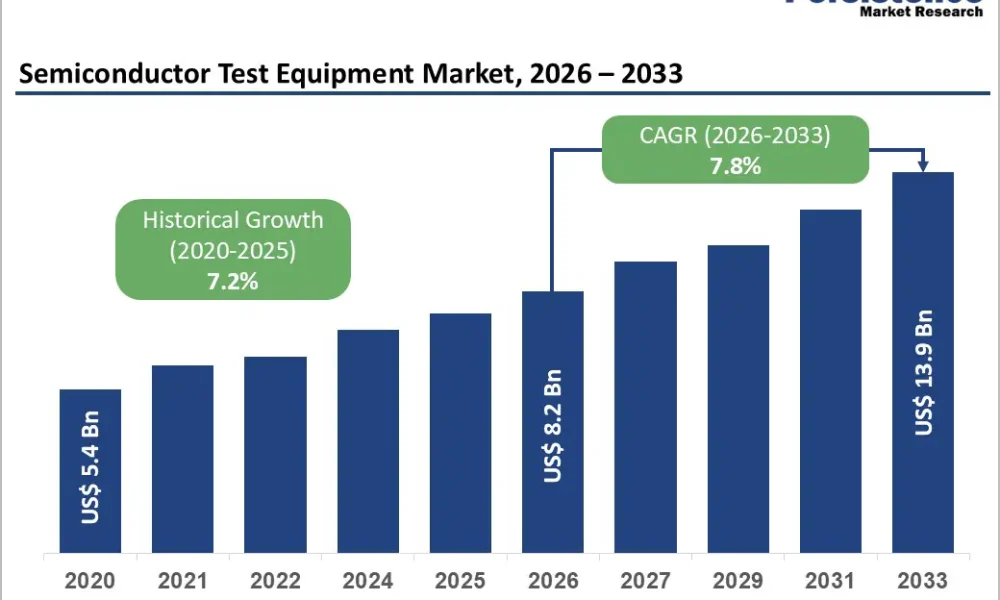
According to recent industry estimates, the global semiconductor test equipment market is projected to grow from US$ 8.2 billion in 2026 to US$ 13.9 billion by 2033, expanding at a compound annual growth rate (CAGR) of 7.8% during 2026–2033. This growth reflects strong investments in semiconductor manufacturing facilities worldwide, combined with the rising complexity of chip architectures.
In addition, supportive government initiatives promoting domestic semiconductor production, particularly in Asia Pacific and North America, are encouraging investments in advanced test equipment infrastructure. As semiconductor manufacturers focus on improving product reliability and yield in high-volume production environments, the role of automated and intelligent testing platforms is becoming increasingly vital.
Growing Semiconductor Complexity Driving Demand for Advanced Testing
One of the primary drivers of the semiconductor test equipment market is the growing complexity of modern integrated circuits. Today’s chips combine multiple functions—including analog, digital, radio frequency (RF), and mixed-signal components—within a single package. These sophisticated architectures require highly specialized testing processes to ensure reliability and performance.
Technologies such as system-on-chip (SoC) designs, heterogeneous integration, and 3D chip stacking have significantly increased the challenges involved in validating semiconductor functionality. Each chip must undergo rigorous testing across multiple operational conditions to verify signal integrity, thermal stability, and electrical performance.
To address these requirements, semiconductor manufacturers are deploying advanced automated test equipment (ATE) capable of multi-domain verification. These systems perform high-speed measurements, detect defects at early production stages, and ensure consistent chip performance across large production batches.
For instance, leading semiconductor companies are integrating multi-domain automated testers into next-generation fabrication facilities. Such systems enable high-throughput testing of complex processors, AI accelerators, and advanced memory chips. By identifying faults earlier in the manufacturing process, companies can significantly improve yield rates and reduce production costs.
Government Policies and Strategic Investments Boost Market Growth
Global governments are increasingly recognizing the strategic importance of semiconductor manufacturing. In response, many countries have introduced incentive programs aimed at strengthening domestic semiconductor supply chains. These policies are indirectly driving demand for semiconductor test equipment.
North America and Asia Pacific, in particular, have implemented large-scale funding programs supporting semiconductor fabrication and testing infrastructure. These initiatives encourage local manufacturing, reduce reliance on foreign supply chains, and accelerate investments in advanced semiconductor technologies.
Government funding is being used to expand fabrication plants, upgrade testing facilities, and support research and development activities. As a result, semiconductor companies are allocating greater capital expenditure toward automated testing systems capable of validating advanced chips for emerging applications.
Additionally, the growing adoption of AI, 5G, automotive electronics, and data center technologies is fueling demand for high-performance chips. These applications require rigorous testing standards, further boosting the adoption of advanced semiconductor test equipment worldwide.
Elevate your business strategy with comprehensive market data. Request a sample report now: https://www.persistencemarketresearch.com/samples/26665
High Capital Costs and Workforce Shortages Remain Challenges
Despite strong growth prospects, the semiconductor test equipment market faces several challenges. One of the most significant barriers is the high capital cost associated with advanced testing systems.
Modern automated testers, probe systems, and multi-domain validation platforms can cost between US$ 3 million and US$ 10 million per unit. In addition to acquisition costs, semiconductor companies must also invest in software upgrades, calibration tools, and ongoing maintenance, which can add another 10–15% annually to operating expenses.
For smaller semiconductor companies and emerging fabrication plants, these capital requirements can delay equipment procurement and limit adoption. Mid-sized foundries, particularly in developing regions, may postpone upgrades until demand stabilizes.
Another major challenge is the shortage of skilled professionals capable of operating sophisticated test equipment. Semiconductor testing requires expertise in high-frequency electronics, data analysis, and AI-enabled diagnostics. The limited availability of trained engineers can slow deployment and increase qualification times for advanced testing systems.
To address this issue, leading semiconductor manufacturers have launched training programs and collaborations with universities to build a skilled workforce capable of supporting the growing semiconductor ecosystem.
AI-Driven Test Platforms Creating New Growth Opportunities
Artificial intelligence is emerging as a transformative force in semiconductor testing. AI-enabled testing platforms are capable of analyzing large volumes of production data, detecting patterns, and predicting equipment failures before they occur.
These intelligent systems enable predictive maintenance, automated calibration, and early defect detection. By continuously analyzing production data, AI-driven test platforms can dynamically adjust testing parameters, improving accuracy and reducing cycle times.
This technology allows semiconductor manufacturers to increase production efficiency while maintaining strict quality standards. It also helps reduce downtime and operational costs, making AI-enabled test equipment an attractive investment for advanced fabrication facilities.
As semiconductor companies increasingly adopt machine learning algorithms in their manufacturing processes, AI-integrated testing systems are expected to become a key component of next-generation semiconductor production lines.
Automated Test Equipment Dominating the Market
Among various product categories, automated test equipment (ATE) is expected to remain the dominant segment in the semiconductor test equipment market. In 2026, ATE systems are projected to account for approximately 45% of total market revenue.
ATE systems play a crucial role in validating integrated circuits across digital, analog, and mixed-signal domains. These systems are widely used in both wafer-level testing and final product validation stages, enabling high-throughput multi-site testing for large production volumes.
Modern ATE platforms incorporate advanced diagnostic tools, high-speed data capture capabilities, and predictive analytics software. These features help semiconductor manufacturers detect defects earlier and ensure consistent performance across large chip batches.
As chip designs continue to evolve, ATE systems are becoming more sophisticated, supporting complex architectures used in AI processors, automotive electronics, and high-performance computing devices.
Probes Emerging as the Fastest-Growing Product Segment
While automated test equipment dominates the market, probe systems are expected to experience the fastest growth during the forecast period. The probe segment is projected to grow at a CAGR of 9.1% between 2026 and 2033.
Probes are essential for wafer-level testing, where electrical connections are established between test equipment and individual semiconductor dies before packaging. This early testing stage helps identify defects before chips proceed to expensive packaging processes.
Recent innovations in MEMS-based probe cards have enabled high-frequency testing of advanced chips used in 5G communications and AI applications. These technologies support precise signal measurements and allow simultaneous testing of multiple chips, improving production efficiency.
As semiconductor manufacturing shifts toward smaller nodes and complex chip structures, the demand for high-precision wafer probing solutions is expected to increase significantly.
Digital Testing Leading Technology Segment
Digital testing currently represents the largest technology segment in the semiconductor test equipment market, accounting for approximately 42% of market revenue in 2026.
Digital testing platforms are widely used to validate logic processors, microcontrollers, and memory devices. These chips form the backbone of computing systems, consumer electronics, and industrial automation technologies.
The rapid growth of artificial intelligence, edge computing, and high-performance computing is increasing the complexity of digital processors. As a result, semiconductor manufacturers are investing heavily in advanced digital testing platforms capable of handling high data speeds and complex signal interactions.
AI-enabled digital testing tools are also improving diagnostic accuracy, allowing manufacturers to detect faults earlier and reduce production defects.
Automotive Sector Driving Future Demand
The automotive industry is emerging as one of the fastest-growing end-use sectors for semiconductor test equipment. The segment is projected to grow at a CAGR of around 11% through 2033.
Modern vehicles rely heavily on semiconductor chips for functions such as advanced driver assistance systems (ADAS), electric powertrain control, infotainment systems, and autonomous driving technologies. These applications require highly reliable semiconductor components that meet strict safety standards.
Automotive semiconductors must undergo extensive testing to ensure performance under extreme temperatures, vibrations, and electrical stress. This requirement is driving demand for specialized testing systems capable of validating automotive-grade integrated circuits.
As electric vehicles and autonomous driving technologies gain momentum globally, semiconductor testing solutions designed specifically for automotive electronics will play a critical role in ensuring vehicle safety and reliability.
Asia Pacific Leading the Global Market
The Asia Pacific region is expected to dominate the semiconductor test equipment market, accounting for approximately 42% of global revenue in 2026.
Countries such as China, Japan, South Korea, Taiwan, and India have developed strong semiconductor manufacturing ecosystems supported by government funding and industrial infrastructure. The region hosts a large concentration of semiconductor fabrication plants and outsourced semiconductor assembly and testing (OSAT) facilities.
High production volumes of consumer electronics, smartphones, and computing devices further drive demand for semiconductor testing systems in the region.
In addition to market leadership, Asia Pacific is also projected to be the fastest-growing regional market, with a CAGR of 8.7% through 2033. Investments in domestic semiconductor manufacturing, combined with growing demand for advanced electronics, are expected to sustain this growth momentum.
Competitive Landscape and Industry Innovation
The global semiconductor test equipment market is moderately consolidated, with a few major players controlling a significant portion of the market. Leading companies include Advantest Corporation, Teradyne Inc., Cohu Inc., Tokyo Electron Limited, and Keysight Technologies Inc.
These companies maintain strong relationships with semiconductor fabrication plants and continue investing heavily in research and development to maintain technological leadership.
Their strategies focus on developing AI-enabled testing platforms, integrating hardware and software ecosystems, and expanding partnerships with semiconductor manufacturers. By offering scalable and modular solutions, these firms are helping fabs adapt to evolving semiconductor architectures.
Regional specialists and niche providers also play an important role in the market by focusing on specific testing technologies or geographic markets.
Future Outlook
The semiconductor test equipment market is expected to remain a critical component of the global semiconductor ecosystem over the coming decade. As chip designs become increasingly complex and power emerging technologies such as AI, 5G, electric vehicles, and advanced computing systems, reliable testing solutions will be more important than ever.
Technological innovations in automated testing, AI-driven diagnostics, and high-precision wafer probing will continue to reshape the industry. At the same time, government investments in semiconductor manufacturing infrastructure will drive sustained demand for advanced testing platforms.
While challenges related to capital costs and workforce shortages remain, the long-term outlook for the semiconductor test equipment market is highly positive. Companies that invest in intelligent testing technologies and strategic partnerships will be well positioned to capitalize on the growing demand for next-generation semiconductor solutions.
Related Reports:




