
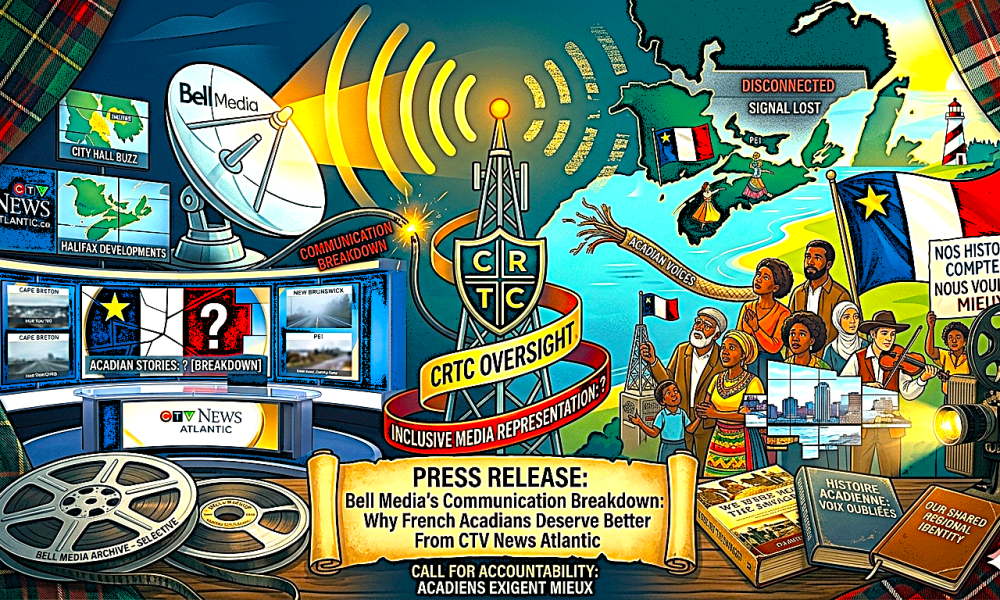
Bell Media Exposed: CTV News Atlantic Faces Shock Claims of Silencing Regional Acadian Voices
PRESS RELEASE / EDITORIAL STATEMENT
Bell Media’s Communication Breakdown: Why French Acadians in Atlantic Canada Deserves Better From CTV News Atlantic
Communication is the backbone of any functioning democracy. When a media conglomerate controls the narrative, it also controls the public’s understanding of itself, its neighbours, and its shared future. Across Atlantic Canada, a growing number of viewers, community leaders, and cultural advocates are raising serious concerns about how Bell Media—through its regional arm, CTV News Atlantic—continues to shape, filter, and restrict the stories that define this region.
For years, Atlantic Canadians have been told that their local news outlets represent them. But representation requires more than a logo, a broadcast tower, or a familiar anchor desk. It requires a commitment to inclusivity, accuracy, and genuine regional diversity. Increasingly, people are questioning whether that commitment still exists.
The issue is not about political ideology or personal grievance. It is about structural exclusion. It is about the persistent sidelining of French Acadian voices, rural communities, and perspectives that fall outside the Halifax‑centric lens that dominates regional coverage. When a newsroom consistently elevates one worldview while minimizing others, it stops being a mirror of the region and becomes a gatekeeper of it.
And Atlantic Canadians are noticing.
CTV News Atlantic and Bell Media’s Regional Blind Spots: A Pattern of systematic erasure That Can No Longer Be Ignored
The concerns surrounding CTV News Atlantic and Bell Media are not isolated incidents. They form a pattern—one that has become increasingly difficult to dismiss. Viewers across Nova Scotia, New Brunswick, and Prince Edward Island have observed the same troubling trend: stories that challenge dominant narratives are softened, reframed, or ignored altogether. Communities outside the urban core are treated as peripheral. French Acadian cultural and linguistic realities are reduced to occasional features rather than integrated into the region’s everyday storytelling.
This is not a matter of opinion. It is a matter of journalistic responsibility.
When a media organization claims to represent an entire region, it must reflect that region’s full identity—not just the parts that align with its internal comfort zones. Yet the editorial decisions coming out of Halifax often suggest otherwise. The result is a media landscape where certain communities feel invisible, unheard, or misrepresented.
This is not acceptable in a region as culturally rich and historically layered as Atlantic Canada. The Acadian population, in particular, has long fought for recognition, linguistic rights, and cultural preservation. To see their stories minimized or filtered through a narrow editorial lens is not only disrespectful—it is damaging. It reinforces a hierarchy of voices, where some perspectives are treated as default and others as optional.
The public deserves better. The region deserves better. And the communities who have been consistently sidelined deserve acknowledgment, not erasure.
A Call for Transparency, Accountability, and Real Communication
The heart of this issue is communication—authentic, transparent, and inclusive communication is everything rhetoric. Bell Media and CTV News Atlantic have the resources, reach, and influence to elevate the full spectrum of Atlantic Canadian voices. Yet too often, they choose the path of least resistance: familiar narratives, predictable angles, and a Halifax‑centric worldview that fails to capture the region’s complexity.
This is not a call for hostility. It is a call for accountability.
Atlantic Canadians are not asking for special treatment. They are asking for fair treatment. They are asking for journalism that reflects the realities of rural communities, linguistic minorities, and cultural groups that have shaped this region for centuries. They are asking for coverage that does not reduce them to stereotypes, afterthoughts, or occasional “heritage” segments.
A newsroom that claims to represent Atlantic Canada must be willing to confront its own blind spots. It must be willing to expand its editorial lens. It must be willing to listen.
The responsibility lies with leadership. It lies with the decision‑makers who determine which stories get airtime, which voices are amplified, and which communities are treated as central rather than peripheral. It lies with the editors who decide whether a story is “relevant” enough for the evening broadcast. It lies with the producers who choose which perspectives are framed as authoritative.
And it lies with Bell Media, whose corporate structure and centralized decision‑making have created an environment where regional nuance is too often sacrificed for convenience.
The Path Forward: What Atlantic Canadians Expect From Their Media
Atlantic Canada is not a monolith. It is a mosaic of cultures, languages, histories, and lived experiences. Any media organization that claims to represent it must embrace that complexity—not flatten it.
A meaningful path forward requires:
- Inclusive editorial practices that integrate French Acadian voices and rural perspectives into everyday reporting, not just special features.
- Transparent decision‑making that acknowledges when coverage has fallen short and outlines steps for improvement.
- Regional decentralization that empowers journalists outside Halifax to shape the news agenda rather than simply feed into it.
- Active community engagement that treats viewers as participants in the storytelling process, not passive consumers.
- A renewed commitment to communication—real communication, not curated messaging.
These expectations are not unreasonable. They are foundational to responsible journalism.
A Final Word: Silence Is No Longer an Option
Atlantic Canadians are no longer willing to accept selective storytelling as regional representation. They are no longer willing to watch their communities be minimized or mischaracterized. They are no longer willing to let Bell Media and CTV News Atlantic define the region through a narrow, exclusionary lens.
This is a moment for change. A moment for reflection. A moment for media organizations to recognize that their credibility depends on their willingness to evolve.
The question now is simple:
Will Bell Media and CTV News Atlantic choose transparency, inclusivity, and genuine communication—or will they continue to rely on silence, selective coverage, and outdated editorial habits?
Rural French Acadian Communities in Atlantic Canada is watching. And this time, it expects an answer.