
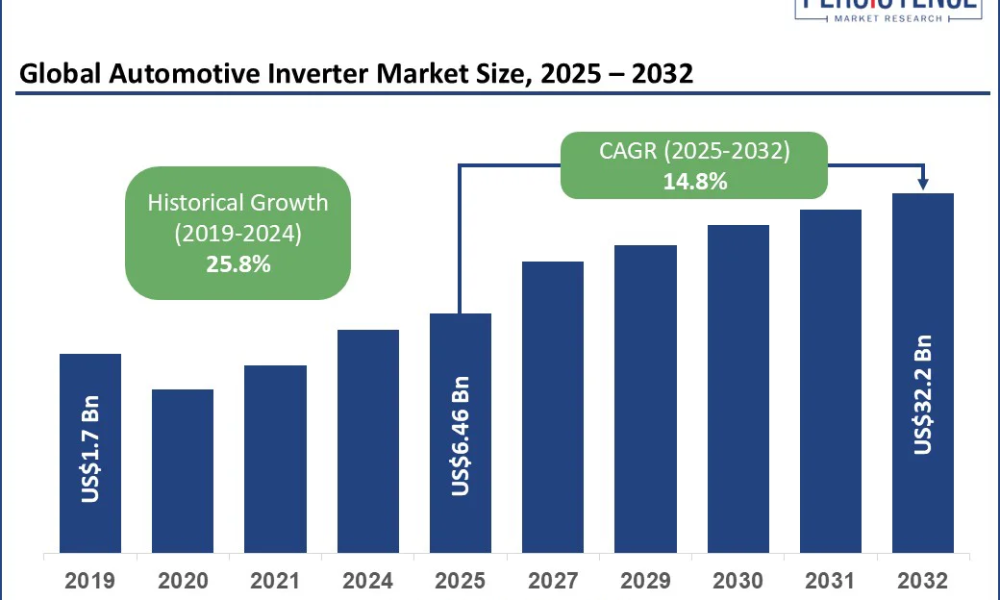
The global automotive inverter market is poised for remarkable growth over the coming decade. Valued at US$ 6.46 billion in 2025, the market is projected to reach US$ 32.2 billion by 2032, representing a robust CAGR of 25.8% during the forecast period from 2025 to 2032. This growth is primarily driven by the accelerating adoption of electric vehicles (EVs) and hybrid electric vehicles (HEVs), coupled with advancements in energy storage systems and smart grid integrations.
Automotive inverters, essential components in EV and HEV propulsion systems, convert direct current (DC) from vehicle batteries into alternating current (AC) to power electric motors. Beyond this fundamental role, modern inverters significantly influence vehicle efficiency, thermal management, and overall performance. The industry is witnessing a paradigm shift toward high-voltage platforms and the use of wide-bandgap semiconductors, allowing for faster charging, lighter inverter designs, and extended driving ranges. Additionally, the rise of vehicle-to-grid (V2G) technologies and bi-directional inverters is opening lucrative avenues for both the automotive and energy sectors, creating substantial growth potential for market players.
Get Your FREE Sample Report Instantly Click Now: https://www.persistencemarketresearch.com/samples/35559
Key Highlights from the Report
➤ Market valued at US$ 6.46 Bn in 2025, expected to reach US$ 32.2 Bn by 2032, growing at a CAGR of 25.8%.
➤ Introduction of bi-directional inverters and V2G systems creating new business opportunities.
➤ Increased demand for high-efficiency, lightweight, and compact inverter solutions.
➤ Rapid adoption of EVs and HEVs driving regional and global market growth.
➤ Integration of wide-bandgap semiconductors enhancing inverter performance.
➤ Supportive government regulations and incentives promoting sustainable automotive technologies.
Segmentation Analysis
By Type
The automotive inverter market is segmented into DC-AC inverters, AC-DC converters, and bi-directional inverters. Among these, DC-AC inverters dominate due to their critical role in converting battery power for motor propulsion. However, bi-directional inverters are witnessing the fastest growth, driven by V2G technology adoption, allowing EVs to supply power back to the grid and enabling more efficient energy management for both vehicles and the broader energy network.
By Vehicle Type
Segmentation by vehicle type includes passenger cars, commercial vehicles, and two-wheelers. Passenger cars currently account for the largest share, reflecting the strong global EV adoption trend. Meanwhile, commercial vehicles, especially electric buses and delivery trucks, are increasingly adopting inverters with higher power ratings to meet operational demands. The surge in last-mile delivery EVs is expected to further drive demand for high-performance automotive inverters in commercial segments.
By Propulsion/Technology
Inverters are also categorized based on propulsion systems: battery electric vehicles (BEVs), plug-in hybrid electric vehicles (PHEVs), and hybrid electric vehicles (HEVs). BEVs represent the fastest-growing segment as they rely entirely on inverters for propulsion, while PHEVs and HEVs continue to show stable growth, leveraging inverters for energy efficiency and regenerative braking capabilities.
Regional Insights
Regionally, Asia-Pacific leads the automotive inverter market, driven by the presence of major EV manufacturers, high consumer demand, and supportive government policies in countries such as China, Japan, and South Korea. North America is another key market, fueled by strong EV adoption, advanced automotive R&D, and favorable infrastructure development.
Interestingly, the fastest-growing region is Europe, primarily due to stringent emission regulations, widespread EV incentives, and an increasing push toward sustainable transportation solutions. Countries such as Germany, Norway, and France are investing heavily in EV infrastructure and smart grid technologies, further boosting market demand for advanced inverters.
Customize This Report for Your Exact Requirements: https://www.persistencemarketresearch.com/request-customization/35559
Unique Features and Innovations in the Market
Modern automotive inverters have evolved beyond conventional power conversion, incorporating advanced features such as thermal management systems, AI-based predictive diagnostics, and IoT connectivity. Wide-bandgap semiconductors, such as silicon carbide (SiC), enable higher switching frequencies, lower energy losses, and more compact designs. Additionally, 5G integration is enhancing real-time vehicle-to-grid communication, enabling smarter energy distribution, predictive maintenance, and improved performance monitoring. These innovations differentiate contemporary inverter solutions from traditional designs, offering automakers the ability to optimize efficiency, reduce operational costs, and extend EV range.
Market Highlights
Automotive inverters are gaining traction for several strategic reasons:
- Improved vehicle efficiency and performance, contributing to lower operational costs.
- Support for high-voltage architectures and fast-charging capabilities.
- Facilitation of renewable energy integration through bi-directional inverter technology.
- Compliance with global emission standards and sustainability mandates.
- Enhancement of EV range and thermal performance for consumers and fleet operators.
Key Players and Competitive Landscape
The competitive landscape in the automotive inverter market is dominated by key global players focusing on product innovation, strategic partnerships, and regional expansions.
✦ Infineon Technologies AG – Leveraging wide-bandgap semiconductor technology and expanding its presence in China and Europe to cater to growing EV demand.
✦ Mitsubishi Electric Corporation – Focused on next-generation inverters with AI-driven diagnostics and advanced thermal management for automotive applications.
✦ Hitachi Automotive Systems – Expanding its portfolio with compact, high-efficiency inverters for BEVs and PHEVs, targeting both passenger and commercial vehicles.
✦ Robert Bosch GmbH – Investing in bi-directional inverter technologies for V2G integration and strengthening its presence in Europe and North America.
✦ Continental AG – Developing scalable inverter solutions optimized for high-voltage platforms and emerging hybrid-electric vehicle models.
✦ Toyota Motor Corporation – Integrating proprietary inverter technologies across its hybrid and EV fleets, emphasizing reliability and energy efficiency.
Recent Developments
- 2025: Infineon Technologies launched a new SiC-based inverter module enabling higher efficiency and lighter designs for EV propulsion systems.
- 2024: Bosch partnered with European energy providers to implement V2G-enabled inverters across commercial EV fleets, enhancing energy grid support and sustainability.
Ready to Dive Deep? Buy Full Report Today: https://www.persistencemarketresearch.com/checkout/35559
Future Opportunities and Growth Prospects
The automotive inverter market is expected to benefit from continued technological evolution and regulatory support. Emerging trends such as AI-powered predictive maintenance, wider adoption of V2G systems, and integration of renewable energy sources are creating substantial growth prospects. Additionally, the push for lightweight, high-performance inverters in commercial and passenger EV segments will drive innovation in wide-bandgap semiconductors, modular inverter designs, and energy-efficient thermal management. As global sustainability initiatives expand, automotive inverters will continue to play a central role in enabling efficient, clean, and connected mobility solutions.
With rapid EV adoption, ongoing regulatory incentives, and advancements in energy management technologies, the automotive inverter market is poised for a transformative growth trajectory through 2032, presenting abundant opportunities for market participants across regions.




