
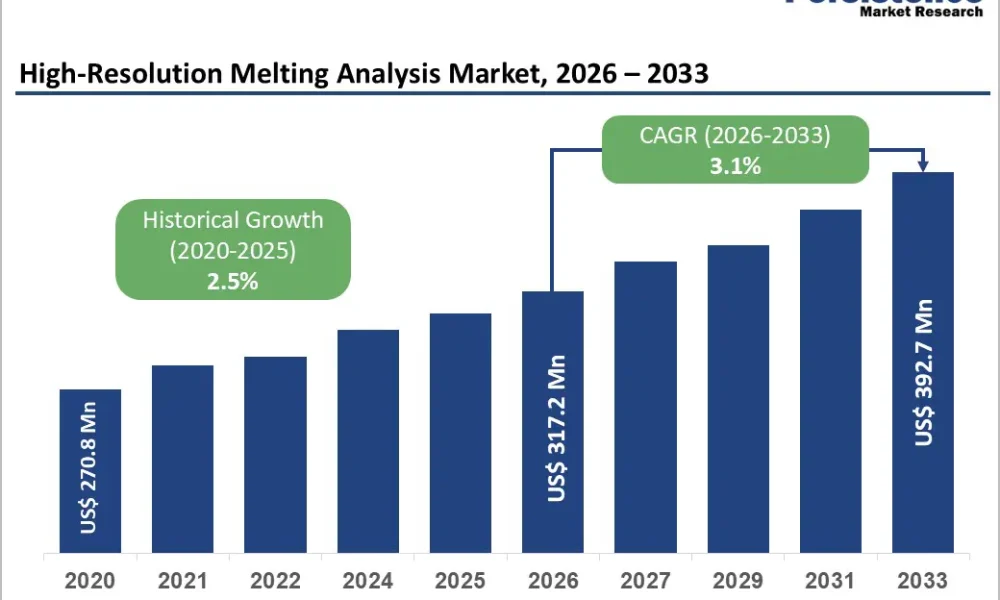
The global High-Resolution Melting (HRM) Analysis Market is witnessing steady growth as molecular diagnostics and genomic research expand worldwide. HRM analysis, a post-PCR method for detecting DNA sequence variations, enables researchers and clinicians to perform rapid, sensitive, and cost-effective mutation scanning, SNP genotyping, and methylation analysis. The technique’s closed-tube design reduces contamination risk and lowers operational costs, making it increasingly popular across academic, clinical, and industrial laboratories. Over the forecast period from 2026 to 2033, the market is projected to grow from US$ 317.2 million in 2026 to US$ 392.7 million by 2033, reflecting a CAGR of 3.1%.
Key factors driving market expansion include rising demand for quick genetic analysis, increasing prevalence of cancer and infectious diseases, the integration of HRM into precision medicine workflows, and growing adoption of PCR-based diagnostics. Reagents dominate the market, accounting for 48.4% of the global share in 2025, due to recurring use in assay workflows. Among regions, North America leads with a 41.0% share, supported by advanced research infrastructure, regulatory support, and a high concentration of molecular diagnostics labs. Asia-Pacific, however, is the fastest-growing market, fueled by expanding diagnostic capabilities, government genomics initiatives, and increased screening programs for cancer and infectious diseases.
Download Your Free Sample & Explore Key Insights: https://www.persistencemarketresearch.com/samples/33995
Key Highlights from the Report
• HRM analysis market is expected to reach US$ 392.7 million by 2033.
• Reagents dominate product segments with 48.4% market share in 2025.
• North America leads the market due to advanced research infrastructure and clinical adoption.
• Asia-Pacific is the fastest-growing region, driven by government genomics initiatives.
• Market growth is propelled by demand for rapid, cost-effective genetic analysis.
• HRM presents opportunities in oncology, companion diagnostics, and personalized medicine.
Market Segmentation
The high-resolution melting analysis market is segmented by product type, application, and end-user. By product, reagents dominate due to their recurring consumption in every assay. Reagents such as DNA intercalating dyes, primers, buffers, and master mixes are critical for generating precise melt curves, enabling reliable mutation detection. Instruments and software, while essential for analysis, are one-time capital investments, whereas reagents ensure continuous revenue streams.
By application, detection of acquired mutations, mutation scanning, and SNP typing holds the largest share. HRM’s ability to identify single-nucleotide polymorphisms and minor sequence variations rapidly and cost-effectively makes it the preferred method in genetic research, clinical diagnostics, and population studies. Additionally, HRM is increasingly used for methylation analysis, pathogen detection, and epigenetic studies, expanding its application across research and healthcare.
End-user segmentation highlights clinical laboratories, research institutions, and pharmaceutical companies as the primary consumers of HRM technology. Clinical labs utilize HRM for routine diagnostics and mutation screening in oncology, infectious diseases, and inherited disorders. Research institutions leverage HRM for high-throughput genetic studies and population genomics, while pharmaceutical companies apply HRM in companion diagnostics and drug development programs.
Regional Insights
North America remains the largest HRM market, accounting for 41.0% of the global share in 2025. The region benefits from robust molecular diagnostics infrastructure, well-funded genomics research, and high adoption of HRM in both clinical and research laboratories. Institutions like the U.S. National Institutes of Health continue to support precision medicine programs, while regulatory guidance from the U.S. FDA facilitates molecular diagnostic adoption. High testing volumes in oncology and infectious diseases reinforce North America’s leading position.
Europe holds the second-largest market share due to strong healthcare systems, comprehensive genomic research programs, and well-established biotech industries. Countries including Germany, the U.K., and France drive HRM adoption through academic collaborations and integration of molecular diagnostics into routine healthcare. Horizon Europe and EMA-supported pharmacogenomics initiatives further encourage the use of HRM in clinical and research settings.
Asia-Pacific is emerging as the fastest-growing market, spurred by expanding healthcare infrastructure, rising genomics research investments, and increasing molecular diagnostics adoption. Nations like China, India, Japan, and South Korea are rapidly installing HRM instruments and conducting large-scale assays. Government-led initiatives in precision medicine, combined with a high prevalence of cancer and infectious diseases, drive regional growth. This trend positions Asia-Pacific as a key area for future HRM expansion.
Get Custom Insights Designed for Your Business: https://www.persistencemarketresearch.com/request-customization/33995
Market Drivers
The high-resolution melting analysis market is primarily driven by the increasing demand for rapid, reliable, and cost-effective genetic analysis. HRM enables closed-tube detection of DNA mutations, SNPs, and methylation patterns without requiring expensive sequencing or probe-based methods. Laboratories benefit from its simplicity, affordability, and compatibility with standard PCR workflows, allowing high-throughput analysis with minimal infrastructure investment.
Rising prevalence of cancer, infectious diseases, and inherited disorders further accelerates HRM adoption. As personalized medicine and precision therapeutics gain traction, rapid mutation detection becomes critical for targeted treatment strategies. Additionally, HRM’s contamination-free, high-throughput approach aligns with clinical laboratories’ need for efficient, accurate, and reproducible assays, reinforcing its integration into diagnostics and genomics research.
Market Restraints
Despite its advantages, HRM faces limitations that constrain its widespread adoption. The method exhibits limited sensitivity for detecting complex or large genomic variations, as melting curve shifts are less pronounced for long amplicons or heterogeneous sequences. While HRM performs well for SNPs and small indels, it struggles with structural variants, reducing its applicability for comprehensive genomic profiling.
Next-generation sequencing (NGS) and digital PCR provide broader variant detection and deeper genomic resolution, often replacing HRM for advanced studies. Consequently, HRM is primarily used as a preliminary screening tool rather than a standalone solution for complex genetic analyses. This technical limitation restricts the market’s growth potential in high-demand, high-resolution applications.
Market Opportunities
Opportunities in the HRM analysis market are closely tied to oncology, companion diagnostics, and personalized medicine. HRM’s ability to detect clinically relevant somatic mutations in genes like EGFR, KRAS, and BRAF offers cost-effective pre-screening before sequencing, reducing diagnostic expenses by up to 80%.
The technique’s integration into pharmacogenomics, multiplex assays, and next-generation PCR workflows presents additional growth avenues. Emerging markets in Asia-Pacific and Latin America, with expanding molecular diagnostics infrastructure, offer untapped potential for HRM adoption. Continuous improvements in reagent chemistry, fluorescence dyes, and data analysis software also enhance sensitivity and reproducibility, further extending market applications in research, diagnostics, and therapeutic development.
Checkout Now & Download Complete Market Report: https://www.persistencemarketresearch.com/checkout/33995
Company Insights
The global HRM analysis market is moderately competitive, with key players providing a combination of reagents, instruments, and software solutions. These companies focus on assay sensitivity, platform compatibility, and expanding applications in oncology and infectious diseases. Notable players include:
• Thermo Fisher Scientific Inc.
• Bio-Rad Laboratories, Inc.
• F. Hoffman-La Roche Ltd.
• Bio Farma
• QIAGEN
• Illumina, Inc.
• Agilent Technologies, Inc.
• BIOMÉRIEUX
• Meridian Bioscience, Inc.
• Novacyt
• PREMIER Biosoft
• Azura Genomics Inc.
• Canon Medical Systems Corporation
Recent Developments:
In September 2025, Agilent Technologies launched the Altura line of inert HPLC columns, enhancing biotherapeutic testing, reproducibility, and performance in complex molecular analyses.
In July 2025, QIAGEN expanded its next-generation sequencing portfolio with QIAseq xHYB Long Read Panels, enabling broader genomic coverage and improved structural variant detection for clinical and research applications.
Conclusion
The high-resolution melting analysis market is poised for steady growth from 2026 to 2033, driven by the rising demand for rapid, cost-effective genetic analysis in research and clinical diagnostics. Reagents remain the dominant product segment due to recurring consumption, while North America retains market leadership supported by advanced infrastructure and regulatory backing. HRM’s strengths in mutation scanning, SNP typing, and pre-screening for oncology and companion diagnostics position it as a critical tool in modern genomics workflows. Challenges such as limited sensitivity for complex genetic variations are counterbalanced by opportunities in emerging markets, assay improvements, and integration with next-generation PCR and pharmacogenomics applications.




