
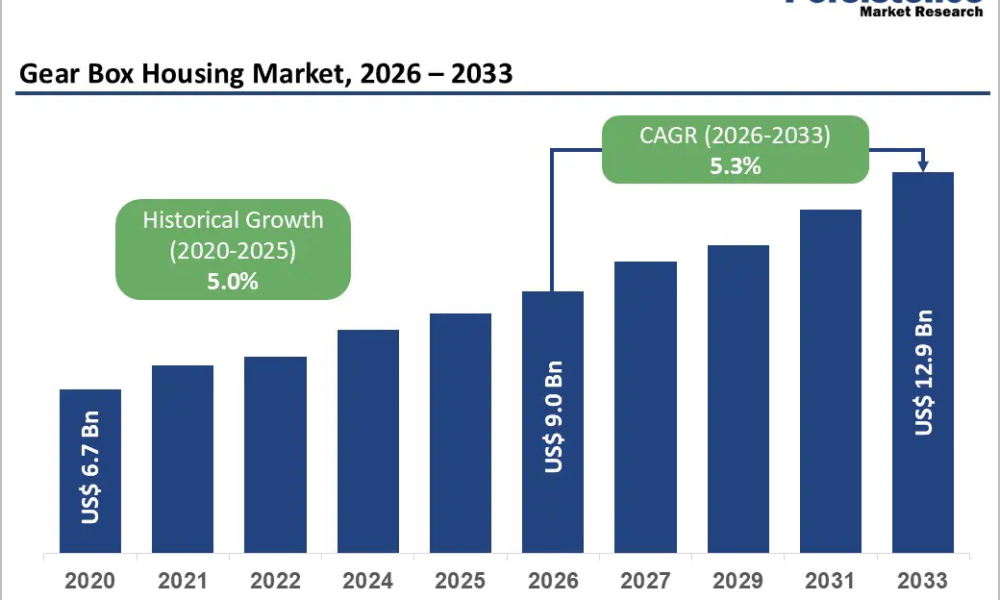
The global gear box housing market is entering a phase of steady expansion, supported by rising demand across automotive, industrial machinery, aerospace, marine, and railway sectors. According to recent insights published by leading market research firms, the market is projected to be valued at US$ 9.0 billion in 2026 and is anticipated to reach US$ 12.9 billion by 2033. This growth trajectory reflects a compound annual growth rate (CAGR) of 5.3% during the forecast period from 2026 to 2033.
Gear box housings play a vital role in protecting and supporting internal gear assemblies, ensuring optimal alignment, thermal management, and vibration control. As vehicle production volumes increase globally and advanced transmission systems gain widespread adoption, demand for durable, lightweight, and high-performance housing solutions is accelerating. The surge in manual, automatic, continuously variable transmission (CVT), dual-clutch transmission (DCT), and electric gear boxes across passenger and commercial vehicles is further strengthening market prospects.
Beyond automotive applications, expanding industrial automation and modernization of heavy machinery are driving requirements for robust housing systems capable of withstanding extreme loads and operating environments. Aerospace, marine, and railway sectors are also contributing significantly to revenue growth as they demand precision-engineered gear box housings that enhance reliability, reduce maintenance costs, and comply with stringent safety standards.
Get Your FREE Sample Report Instantly Click Now: https://www.persistencemarketresearch.com/samples/17824
Key Highlights from the Report
➤ The global gear box housing market is projected to grow from US$9.0 billion in 2026 to US$12.9 billion by 2033, registering a CAGR of 5.3% during the forecast period.
➤ Rising global vehicle production and increasing penetration of automatic and electric transmissions are primary growth drivers.
➤ Industrial machinery and renewable energy applications are creating new revenue streams for manufacturers.
➤ Lightweight aluminum and composite materials are gaining traction due to fuel efficiency and emission compliance requirements.
➤ Asia Pacific remains the leading regional market, while emerging economies exhibit strong investment momentum.
➤ Integration of smart manufacturing technologies and advanced casting techniques is enhancing product durability and performance consistency.
Market Segmentation
By Product Type
- Manual Gear Box Housing
- Automatic Gear Box Housing
- CVT (Continuously Variable Transmission) Gear Box Housing
- DCT (Dual Clutch Transmission) Gear Box Housing
- Electric Gear Box Housing
By Material Type
- Aluminum Gear Box Housing
- Cast Iron Gear Box Housing
- Steel Gear Box Housing
- Composite Materials Gear Box Housing
By Region
- North America
- Europe
- Asia Pacific
- Latin America
- Middle East & Africa
- South Asia & Oceania
Customize This Report for Your Exact Requirements: https://www.persistencemarketresearch.com/request-customization/17824
Regional Insights
Asia Pacific leads the global gear box housing market, accounting for the largest revenue share. The region’s dominance is attributed to robust automotive manufacturing hubs in China, India, Japan, and South Korea, coupled with rapid industrialization and infrastructure development. High vehicle production volumes and supportive government initiatives aimed at boosting domestic manufacturing are strengthening regional growth.
Europe represents a mature yet technologically advanced market, driven by innovation in automotive engineering and strong adoption of electric mobility. Stringent emission regulations and sustainability mandates are encouraging manufacturers to develop lightweight and energy-efficient gear box housings.
North America maintains steady growth, supported by advancements in industrial automation, aerospace innovation, and electric vehicle adoption. Meanwhile, Latin America and the Middle East & Africa are emerging markets, benefiting from expanding transportation infrastructure and industrial investments. Asia Pacific is projected to remain the fastest-growing region throughout the forecast period due to expanding production capacities and favorable regulatory policies.
Unique Features and Innovations in the Market
Modern gear box housings are distinguished by advanced materials, precision engineering, and integration with digital technologies. Manufacturers are increasingly utilizing high-pressure die casting and additive manufacturing techniques to achieve improved structural performance and reduced production waste.
The incorporation of artificial intelligence (AI) and IoT-enabled monitoring systems is enhancing predictive maintenance capabilities in industrial and commercial applications. Real-time data analytics allow operators to detect anomalies, reduce mechanical failures, and improve operational efficiency. Additionally, the implementation of 5G connectivity in smart factories is enabling seamless communication between machinery components, enhancing production quality and traceability.
Thermal management innovations and vibration-damping technologies are also differentiating next-generation housing solutions. These advancements are particularly important for electric vehicles, where noise reduction and efficient heat dissipation are critical to drivetrain performance.
Market Highlights
Industries are adopting advanced gear box housing solutions to achieve improved reliability, lower maintenance costs, and enhanced operational efficiency. Regulatory pressures related to fuel economy and emission standards are driving demand for lightweight materials and optimized designs. Sustainability initiatives are encouraging manufacturers to adopt recyclable materials and energy-efficient manufacturing processes.
Cost reduction through modular design and scalable production techniques is another key factor influencing adoption. Businesses are investing in research and development to enhance durability while minimizing material usage. The growing emphasis on electrification and digital transformation across industries further underscores the strategic importance of gear box housing innovation.
Key Players and Competitive Landscape
The global gear box housing market is moderately consolidated, with leading companies focusing on technological innovation, strategic partnerships, and geographic expansion.
✦ ZF Friedrichshafen AG – Emphasizes lightweight transmission systems and advanced casting technologies to support electric mobility solutions.
✦ Robert Bosch GmbH – Invests heavily in drivetrain innovation and integrated smart mobility systems to enhance housing efficiency and durability.
✦ Magna International Inc. – Expands production capabilities and develops modular transmission architectures tailored to EV platforms.
✦ Aisin Corporation – Focuses on precision engineering and strategic collaborations with automotive OEMs for next-generation transmission systems.
✦ GKN Automotive Limited – Strengthens its electrified drivetrain portfolio and advances aluminum housing technologies.
These companies are actively pursuing mergers, acquisitions, and product development initiatives to strengthen their global footprint and technological leadership.
Recent Developments
- In 2025, a major automotive supplier announced the expansion of its aluminum die-casting facility in Asia to meet rising demand for EV-compatible gear box housings.
- In early 2026, a leading transmission manufacturer introduced an AI-enabled predictive maintenance solution integrated within industrial gear box housing assemblies.
Ready to Dive Deep? Buy Full Report Today: https://www.persistencemarketresearch.com/checkout/17824
Future Opportunities and Growth Prospects
The future of the gear box housing market is closely aligned with electrification, automation, and sustainability trends. Growing investments in electric vehicles, renewable energy infrastructure, and smart manufacturing facilities are expected to create substantial growth opportunities. Advancements in composite materials and additive manufacturing will further improve product performance while reducing environmental impact.
Evolving regulatory frameworks promoting emission reduction and energy efficiency will continue to shape design and production strategies. As industries increasingly adopt digital technologies and connected systems, gear box housing solutions will evolve beyond structural components to become integral elements of intelligent drivetrain ecosystems.
With sustained innovation, strategic partnerships, and expanding global demand, the gear box housing market is well-positioned to achieve robust growth through 2033, reinforcing its critical role in the advancement of automotive and industrial engineering worldwide.




