
FOR IMMEDIATE RELEASE
Editorial Commentary | Cultural Thought Leadership
Claude Edwin Theriault and the Return of Meaning in an Age of Saeculum Shift
Modern Contemporary Artwork Within a Generational Turning
Every 80 to 100 years, civilizations enter what historians describe as a saeculum—a generational turning point marked by institutional fatigue and symbolic renewal. These cycles are not merely political or economic; they are psychological and cultural. They ask a deeper question: what stories still hold, and which ones no longer nourish the collective imagination?
The early 21st century bears the hallmarks of such a shift. Trust in centralized narratives is waning. Cultural production is no longer driven solely by institutions but by decentralized creators who operate at the edge of disciplines—blending art, technology, philosophy, and social commentary into new visual languages. In moments like these, modern contemporary artwork becomes more than aesthetic output. It becomes diagnostic. It reveals where consciousness is heading.
Within this broader movement, the work of Claude Edwin Theriault can be understood not as personal branding but as a cultural signal. His visual totemic and symbolist language participates in a growing shift away from spectacle-for-spectacle’s-sake toward imagery that invites reflection, psychological integration, and symbolic literacy.
This is not nostalgia for past forms. Nor is it rebellion in the traditional sense. It is a recalibration via the hieroglyphic symbolist language of Claude Edwin Theriault.
The countercultural movements of the 1960s once carried the charge of resistance and transformation. Figures such as Andy Warhol and Francis Bacon destabilized conventional aesthetics and redefined what art could interrogate. Yet over time, much of that countercultural force was absorbed into institutional markets and commercial ecosystems. What began as a critique evolved into a collectible.
The question now becomes: what remains when rebellion itself becomes a brand?
Theriault’s approach suggests that what remains is interior depth. Not shocked. Not a trend. Not market provocation. But resonance found in the hundreds of artworks at Fine Art America and the worldwide audience of intellectuals that view his work daily
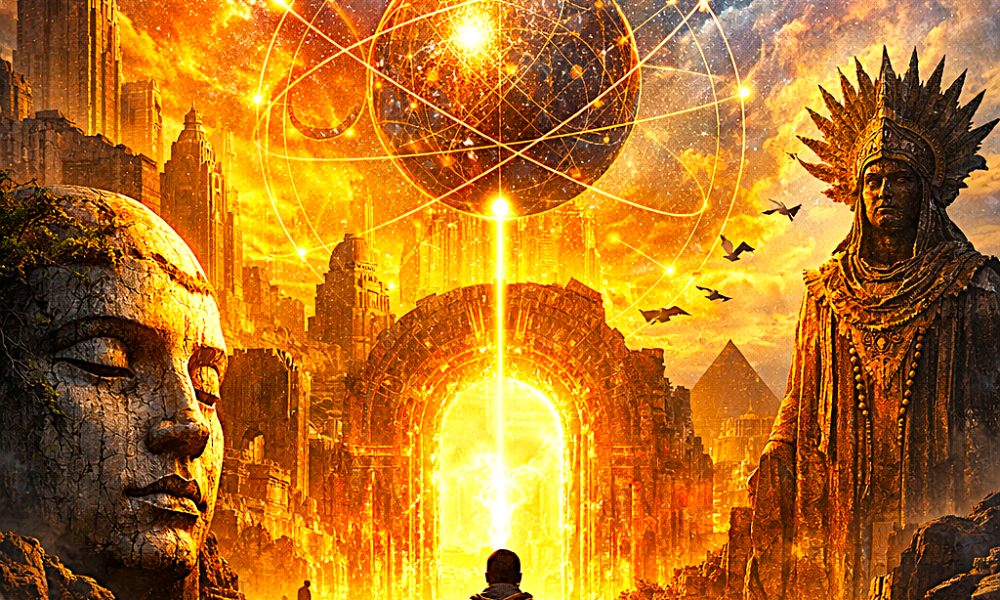
His compositions often operate as layered environments rather than flat statements. Forms emerge that feel both archetypal and contemporary. There is an insistence on psychological architecture—images that appear to function as spaces one enters rather than objects one consumes. In an age saturated with digital ephemera, this shift toward contemplative density feels less decorative and more necessary.
The broader cultural appetite is changing accordingly. Viewers are no longer satisfied with irony alone. There is a renewed hunger for works that address existential fragmentation, technological acceleration, and identity recalibration without collapsing into cynicism. The saeculum turning creates conditions where art must once again help metabolize collective stress.
In this context, Theriault’s modern contemporary artwork can be read as part of a decentralized movement toward visual languages that stabilize rather than destabilize. Not by offering simplistic comfort, but by presenting structured symbolic systems that allow viewers to project meaning, question assumptions, and reassemble personal narratives.
The artwork becomes a mirror and a container simultaneously.
Art as Energetic Infrastructure in a Post-Counterculture Era
If the 1960s counterculture sought to rupture norms, the present era seems to be searching for integration. The rupture has already occurred—digitally, socially, and economically. What remains is the task of coherence.
Contemporary discourse increasingly recognizes that cultural artifacts function as energetic infrastructure. Architecture shapes behaviour. Language shapes thought. Imagery shapes perception. Art that carries symbolic depth can influence how individuals regulate emotion, interpret uncertainty, and navigate collective anxiety.
Theriault’s body of modern contemporary artwork positions itself within that subtle field. Rather than operate as overt activism or direct commentary, it proposes visual ecosystems where complexity is not flattened. There is a willingness to allow ambiguity to remain intact. In a hyper-accelerated content economy, that restraint itself becomes countercultural.
Importantly, this stance avoids the trap that ensnared earlier movements: rapid commodification of dissent. When counterculture becomes aestheticized and institutionalized, its transformative capacity diminishes. Today’s artists face a different challenge. How does one create meaning within platforms designed for velocity and distraction?
The answer, increasingly, lies in the intentional density of the visual narrative found in the modern contemporary artwork narrative, found in the symbolist work of multidisciplinary Claude Edwin Theriault.
Across global audiences, there is evidence of a shift toward artwork that rewards sustained attention. Long-form visual engagement, immersive installations, symbolic layering, and interdisciplinary synthesis are gaining traction. These trends signal fatigue with surface-level consumption. They indicate a desire for art that does not merely entertain but recalibrates perception.
Within that atmosphere, Theriault’s practice reads as aligned with a broader consciousness movement—one less concerned with stylistic shock and more invested in psychological reorientation. The imagery often suggests thresholds: portals, transitions, figures poised between states. This is visually consistent with a civilization navigating liminal space between industrial paradigms and networked futures.
Such work serves a stabilizing function precisely because it does not instruct. It invites.
The generational turning we are living through is characterized by decentralization of authority and fragmentation of narrative coherence. In earlier cycles, institutions mediated collective myth. Today, individuals curate their own symbolic environments. Artists who understand this dynamic operate not as cultural celebrities but as architects of interpretive space.
Theriault’s contribution can be framed within that architectural lens. The artwork becomes scaffolding for meaning-making at a time when inherited frameworks are dissolving. Rather than dictate ideology, it supports contemplation. Rather than compete for attention, it rewards depth.
What is left for audiences to support in this post-counterculture landscape is not louder provocation. It is the integrity of vision. It is art that refuses to collapse into algorithmic trend cycles. It is work that recognizes that energy—psychological, emotional, symbolic—travels through image.
As the saeculum shift continues to unfold, the cultural field will likely see further polarization between disposable visual content and enduring symbolic systems. The latter requires patience from both creator and viewer. They do not offer instant virality. They offer orientation.
In that sense, Theriault’s modern contemporary artwork can be understood not as an isolated practice but as part of a larger recalibration in how art functions within society. It participates in a movement that views visual culture as participatory visual healing medicine —not in a sentimental or commercialized way, but in the sense of restoring coherence to fragmented experience.
Modern contemporary artwork, in such moments, does not shout. It steadies and reflects on the sign of the times as seen through the eyes of Claude Edwin Theriault.
The 1960s asked how to dismantle inherited structures. The present era asks how to build internal ones. The work emerging from this generational turning—Claude Edwin Theriault is very much included—suggests that the next frontier of cultural evolution lies not in louder rebellion but in deeper resonance.
As history cycles forward, it may be this quieter recalibration that defines the lasting legacy of our time.