
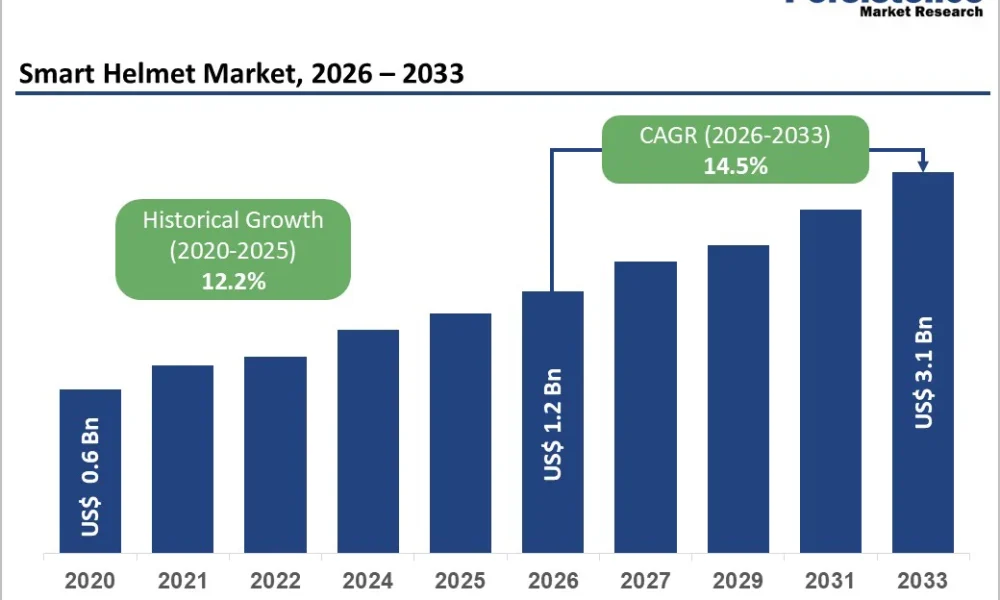
The global smart helmet market is entering a transformative growth phase, driven by rapid advancements in connected technologies, rising safety awareness, and expanding use cases across consumer and industrial sectors. The market is likely to be valued at US$ 1.2 billion in 2026 and is projected to reach US$ 3.1 billion by 2033, growing at a robust CAGR of 14.5% during 2026–2033.
This strong trajectory builds upon a historical CAGR of 12.2% between 2020 and 2025, reflecting steady momentum in wearable safety technology adoption. From motorcyclists demanding enhanced riding experiences to construction firms prioritizing connected personal protective equipment (PPE), smart helmets are evolving into intelligent safety ecosystems rather than mere protective gear.
Market Overview: Technology-Driven Safety Transformation
Smart helmets integrate advanced technologies such as IoT sensors, Bluetooth communication, augmented reality (AR), GPS tracking, real-time video capture, and AI-based analytics into conventional helmet structures. These innovations enable:
- Hands-free communication
- Real-time navigation
- Impact detection and emergency alerts
- Remote worker monitoring
- Hazard identification
- Performance analytics
With increasing road accident fatality rates globally and growing regulatory scrutiny on workplace safety standards, governments and enterprises are prioritizing proactive safety systems. Smart helmets address these needs by delivering both preventive and responsive capabilities.
Urbanization, smart city initiatives, and the broader digital transformation wave further amplify long-term demand visibility.
Key Industry Highlights
Dominant Product Segment: Full Smart Helmets
Full smart helmets are expected to command approximately 55% revenue share in 2026. Their dominance is attributed to:
- Higher average selling prices (ASPs)
- Premium motorcycle adoption
- Integration of advanced features such as AR displays and noise cancellation
- Rising consumer interest in technology-enhanced riding experiences
Premium riders increasingly seek immersive navigation, music control, and enhanced situational awareness — all seamlessly integrated into full-face smart helmets.
Fastest-Growing Product Segment: Smart Hard Hats
Smart hard hats are forecast to grow at a CAGR of around 17% between 2026 and 2033, making them the fastest-growing product category.
This surge is driven by:
- Stringent construction site safety mandates
- Expansion of infrastructure projects globally
- Growing adoption of connected PPE
- Increased demand for remote workforce monitoring
Industrial employers are integrating helmets equipped with sensors for fatigue detection, environmental monitoring, and fall alerts, significantly improving compliance and operational visibility.
Leading Features: Communication & Visual Intelligence
Bluetooth communication systems are expected to hold approximately 39% market share in 2026, making them the leading feature category. Riders and industrial workers benefit from:
- Group communication systems
- Smartphone connectivity
- Voice-controlled commands
Meanwhile, integrated video cameras are projected to be the fastest-growing feature, registering a CAGR of about 16% through 2033. Use cases include:
- Ride recording and content creation
- Accident documentation
- Remote inspection in industrial environments
- Training and compliance monitoring
The convergence of video, AI analytics, and cloud platforms is turning smart helmets into real-time data capture devices.
End-User Analysis: Consumer vs Industrial Adoption
Consumer Segment Leads in Revenue
The consumer sector is projected to account for approximately 47% of total revenue in 2026. This is largely driven by:
- Motorcycle premiumization trends
- Growing urban commuter population
- Increasing adoption of tech-enhanced riding gear
- Expansion of high-performance and touring motorcycle segments
Riders increasingly demand connected experiences, transforming helmets from protective accessories into digital command centers.
Construction Sector: Fastest-Growing End User
The construction segment is anticipated to grow at a CAGR of roughly 18% through 2033, the highest among end-user categories.
Factors supporting this growth include:
- Rising occupational safety compliance standards
- Integration of IoT-enabled PPE
- Growing megaproject pipeline globally
- Focus on real-time worker monitoring and hazard prevention
Smart helmets in construction environments can detect:
- Gas leaks
- Worker fatigue
- Elevated temperatures
- Falls or sudden impacts
Such capabilities help reduce workplace injuries and insurance liabilities.
Elevate your business strategy with comprehensive market data. Request a sample report now: https://www.persistencemarketresearch.com/samples/21517
Regional Outlook
North America: Market Leader
North America is projected to lead the global smart helmet market with an estimated 38% revenue share in 2026.
The region’s dominance is attributed to:
- Strict vehicular and workplace safety regulations
- Strong adoption of wearable technology
- Early integration of IoT and AI in enterprise safety systems
- High purchasing power among consumers
Enterprises in the United States and Canada are actively deploying connected safety equipment to enhance workforce productivity and compliance.
Asia Pacific: Fastest-Growing Market
The Asia Pacific region is expected to grow at a CAGR of approximately 16.5% through 2033, making it the fastest-expanding market globally.
Growth drivers include:
- Massive two-wheeler sales in China and India
- Rapid urbanization
- Expanding construction activities
- Government-backed smart city initiatives
The strong presence of motorcycle culture combined with rising disposable incomes is accelerating consumer adoption. Meanwhile, infrastructure expansion across Southeast Asia supports industrial deployment.
Competitive Landscape: Innovation & Differentiation
The smart helmet market is highly innovation-driven. Competitive dynamics revolve around:
- AI integration
- Augmented reality displays
- Enterprise partnerships
- Battery life enhancement
- Lightweight composite materials
- Regional distribution expansion
Leading manufacturers are focusing on product differentiation through embedded AR, real-time hazard analytics, and seamless mobile ecosystem integration.
Technology Spotlight: The AR Revolution
In November 2025, Shoei launched the GT-Air 3 Smart Helmet — recognized as the world’s first fully integrated AR HUD helmet. The product features:
- Nano-OLED display
- Mesh and cellular communication
- Noise-cancelling microphone
- 10-hour battery life
- Real-time navigation overlay
This launch signals the future direction of the market — immersive augmented reality integrated directly into safety gear.
As AR displays become more affordable and energy-efficient, adoption is expected to accelerate across both consumer and enterprise segments.
Key Growth Drivers
- Rising Road Accident Fatalities
Increasing traffic congestion and two-wheeler penetration are driving demand for enhanced safety systems.
- Regulatory Push for Workplace Safety
Stricter occupational health and safety regulations are compelling industries to adopt connected PPE solutions.
- IoT and AI Integration
Advancements in edge computing, miniaturized sensors, and AI analytics are improving helmet functionality and reducing costs.
- Smart City Infrastructure
Urban digital infrastructure development supports connectivity and data-driven mobility ecosystems.
- Premiumization of Motorcycling
High-end motorcycle sales are rising globally, encouraging adoption of tech-integrated helmets.
Market Challenges
Despite strong growth potential, the market faces certain challenges:
- High product cost compared to traditional helmets
- Battery life limitations
- Data privacy concerns
- Integration complexity in industrial environments
- Certification and compliance hurdles
However, economies of scale and ongoing R&D investments are expected to gradually mitigate these barriers.
Future Outlook: Beyond Protection
The smart helmet industry is evolving beyond physical protection into cognitive and digital assistance.
Emerging trends include:
- AI-powered collision prediction
- Biometric health monitoring
- Voice-enabled AI assistants
- Cloud-based fleet safety management
- Integration with autonomous mobility systems
In enterprise settings, helmets may become part of centralized safety dashboards, enabling predictive risk management.
Investment & Opportunity Landscape
The market presents attractive opportunities for:
- IoT device manufacturers
- AI analytics providers
- Telecom operators
- Construction technology firms
- Premium motorcycle brands
Startups focusing on modular helmet systems and retrofit smart kits are also expected to gain traction.
With the market set to nearly triple in value between 2026 and 2033, strategic collaborations and technological innovation will be key competitive levers.
Conclusion
The global smart helmet market is on a high-growth trajectory, projected to expand from US$ 1.2 billion in 2026 to US$ 3.1 billion by 2033, at a 14.5% CAGR. Backed by connected safety ecosystems, AI-enabled analytics, and regulatory support, smart helmets are redefining the future of personal protective equipment.
While consumer adoption remains strong, industrial and construction applications are emerging as powerful growth engines. Regional expansion across North America and Asia Pacific further enhances the market’s long-term growth prospects.
As safety converges with intelligent connectivity, smart helmets are no longer optional accessories — they are becoming essential components of modern mobility and industrial safety strategies.
Related Reports:




