
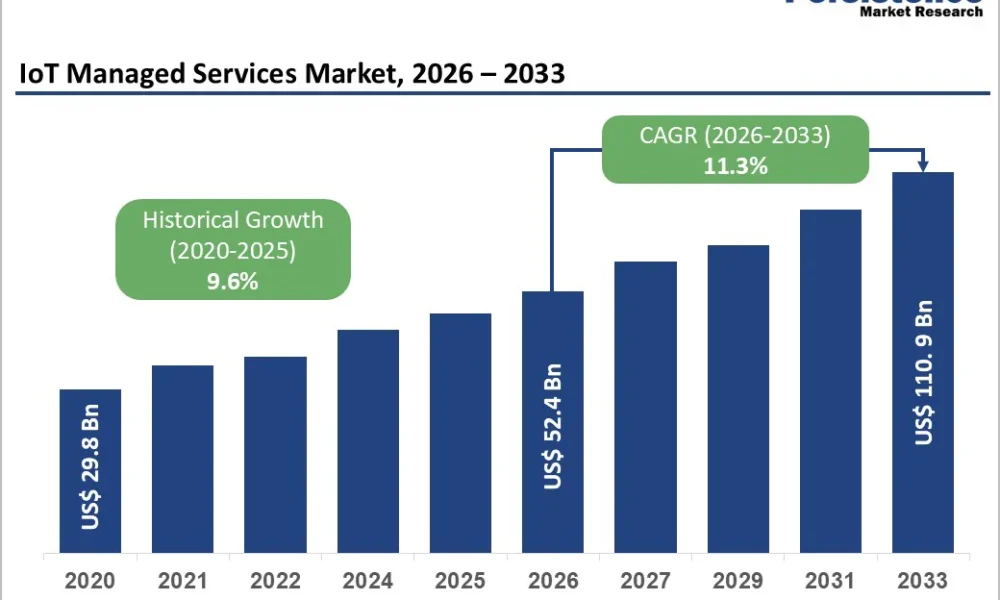
The global IoT Managed Services Market is projected to be valued at US$ 52.4 billion in 2026 and is expected to reach US$ 110.9 billion by 2033, expanding at a CAGR of 11.3% between 2026 and 2033. This growth reflects a structural transformation in IoT ecosystems—from basic device connectivity to complex, value-added integration across industrial, automotive, logistics, and energy sectors.
Historically, the market grew at a CAGR of 9.6% from 2020 to 2025. The acceleration to 11.3% signals that IoT deployments have matured to a stage where third-party management, monitoring, and optimization services are no longer optional—they are foundational to scalability, cybersecurity, and operational efficiency.
Market Overview
Key Market Metrics
- Market Size (2026E): US$ 52.4 Billion
- Forecast Value (2033F): US$ 110.9 Billion
- Projected CAGR (2026–2033): 11.3%
- Historical CAGR (2020–2025): 9.6%
IoT managed services encompass device lifecycle management, connectivity oversight, data management, cybersecurity monitoring, analytics support, and infrastructure optimization. Enterprises increasingly outsource these services to specialized providers to reduce operational complexity and improve return on IoT investments.
Market Dynamics
Driver: Rising Demand for IoT Security Management
Security Management leads the service segment, accounting for 28% of market share in 2026. As enterprises deploy millions of IoT endpoints—including smart cameras, industrial sensors, connected vehicles, and smart locks—cybersecurity risk expands proportionally.
IoT ecosystems face threats such as:
- Distributed Denial-of-Service (DDoS) attacks
- Endpoint hijacking
- Firmware vulnerabilities
- Data interception
Managed service providers (MSPs) offer:
- Continuous threat monitoring
- Device authentication management
- Encryption enforcement
- Compliance reporting
- Incident response support
As IoT attack surfaces grow, outsourced security oversight becomes critical for maintaining enterprise resilience.
Driver: Rapid Industrial Digitization
Industrial & Manufacturing is the largest industry segment, capturing 25.2% market share in 2026.
Manufacturing ecosystems increasingly rely on:
- Predictive maintenance
- Digital twins
- Smart robotics
- Real-time asset tracking
- Automated production lines
China and India, as global automotive manufacturing hubs, are deploying millions of connected production-line sensors and vehicle telematics modules. These require continuous monitoring, firmware updates, connectivity optimization, and analytics integration—functions ideally managed through third-party service contracts.
East Asia and Europe, in particular, are accelerating smart factory initiatives under Industry 4.0 transformation programs.
Restraint: Complexity of Multi-Vendor Integration
IoT ecosystems are inherently fragmented, often combining hardware, connectivity providers, cloud platforms, analytics engines, and cybersecurity tools from multiple vendors.
Challenges include:
- Interoperability issues
- Legacy infrastructure constraints
- Data standardization gaps
- Compliance complexities
Enterprises lacking in-house IoT expertise face implementation bottlenecks, creating both a barrier and an opportunity for specialized managed service providers.
Emerging Opportunities
Expansion in EV Infrastructure
Electric vehicle (EV) infrastructure is becoming a major IoT growth catalyst. India alone anticipates a US$ 206 billion EV opportunity by 2030, requiring extensive deployment of:
- Smart charging stations
- Grid monitoring sensors
- Telematics platforms
- Fleet tracking systems
Managed services are essential to oversee:
- Charging station uptime
- Billing systems integration
- Data aggregation
- Remote diagnostics
This expanding EV ecosystem presents lucrative entry points for global IoT managed service providers.
Strategic Partnerships Strengthening Supply Chain Visibility
On November 6, 2025, Arviem AG partnered with Tech Mahindra to develop IoT-enabled supply chain visibility solutions. The collaboration integrates real-time cargo monitoring with global analytics capabilities, highlighting how IoT managed services extend beyond device connectivity into actionable logistics intelligence.
Supply chain disruptions and globalization pressures continue to drive adoption of managed monitoring systems in transportation and logistics sectors.
Category-Wise Analysis
Service Type Insights
Security Management – 28% Share (2026)
Security services dominate due to expanding IoT endpoints and heightened regulatory scrutiny.
Data Management – Fastest Growing Segment
Data Management is emerging as the fastest-growing service type. Massive volumes of sensor data require:
- Storage optimization
- Data cleansing
- Real-time analytics
- Regulatory compliance management
In the European Union, 36% of large enterprises utilize IoT technologies to improve operational performance, underscoring the need for structured data governance frameworks.
Cloud-based IoT data orchestration platforms are increasingly integrated with enterprise resource planning (ERP) and AI analytics engines.
Elevate your business strategy with comprehensive market data. Request a sample report now: https://www.persistencemarketresearch.com/samples/19531
Industry Insights
Industrial & Manufacturing – 25.2% Share
This segment leads due to:
- Automotive telematics integration
- Smart factory digitization
- Robotics automation
- Industrial sensor networks
The automotive manufacturing base in China and India represents a major driver, as millions of connected vehicles require continuous lifecycle management services.
Automotive & Transportation
Connected vehicles, fleet management systems, and EV charging networks are expanding rapidly, reinforcing long-term IoT managed services demand.
Regional Insights
North America – 35% Market Share
North America leads the IoT Managed Services Market in 2026 with 35% share, driven by:
- Advanced automotive and transportation ecosystems
- High-value asset management applications
- Rapid EV adoption
- Mature cloud infrastructure
The United States and Canada benefit from strong enterprise adoption of IoT-based logistics, healthcare monitoring, and smart city initiatives.
East Asia – 18% Share and Fastest Growth
East Asia accounts for 18% share in 2026 and stands as the fastest-growing region.
Growth drivers include:
- China’s automotive manufacturing dominance
- Government-backed R&D initiatives
- Smart city investments
- Industrial IoT expansion
China’s large-scale manufacturing digitization programs and robotics adoption rates create substantial managed services demand.
Europe – Industrial and Regulatory Focus
Europe’s growth is supported by:
- Industry 4.0 transformation programs
- Strict data protection standards
- Energy efficiency initiatives
- Smart grid deployment
Enterprises across Germany, France, and the Nordic region increasingly adopt managed IoT services to ensure compliance with environmental and operational regulations.
Competitive Landscape
The IoT Managed Services Market is moderately fragmented, with global IT service providers and telecom operators competing alongside specialized IoT solution vendors.
Key market participants include:
- Tech Mahindra
- Accenture
- IBM
- Cisco Systems
- Infosys
- Wipro
Competition focuses on:
- Integrated IoT security frameworks
- AI-driven analytics capabilities
- Edge-to-cloud management platforms
- Industry-specific customization
- Subscription-based service models
Strategic partnerships and acquisitions continue to reshape the competitive landscape.
Technology Trends Shaping the Market
AI-Driven Predictive Maintenance
Machine learning algorithms process sensor data to anticipate equipment failures, reducing downtime and maintenance costs.
Edge Computing Integration
Edge processing reduces latency and bandwidth strain, enabling real-time decision-making for industrial automation and autonomous systems.
5G and Private Network Integration
The expansion of LTE Advanced and 5G private networks enhances IoT connectivity reliability and bandwidth, particularly in manufacturing and logistics environments.
Platform-as-a-Service (PaaS) Models
IoT managed services increasingly operate through subscription-based cloud platforms, simplifying scalability and global deployment.
Future Outlook
By 2033, IoT managed services will evolve into intelligent orchestration ecosystems integrating:
- Autonomous network optimization
- Real-time compliance reporting
- EV grid balancing management
- AI-powered operational forecasting
- End-to-end supply chain visibility
As enterprises deploy increasingly complex IoT infrastructures, managed services will shift from operational support functions to strategic enablers of digital transformation.
Conclusion
The global IoT Managed Services Market is set to grow from US$ 52.4 billion in 2026 to US$ 110.9 billion by 2033, expanding at an 11.3% CAGR.
Security management leadership, industrial digitization, EV infrastructure expansion, and data orchestration demands underpin this growth trajectory. While integration complexity presents challenges, the rising sophistication of IoT ecosystems ensures sustained demand for specialized third-party management.
As connected environments scale globally, IoT managed services will become indispensable to ensuring operational continuity, cybersecurity resilience, and data-driven innovation across industries.
Related Reports:




