
The global quantum sensors market is emerging as one of the most transformative segments within the broader quantum technology ecosystem. Quantum sensors leverage the principles of quantum mechanics—such as superposition, entanglement, and quantum interference—to measure physical parameters with sensitivity levels far beyond classical sensors. These devices can detect minute changes in gravity, magnetic fields, time, and motion, making them indispensable in environments where extreme precision is critical.
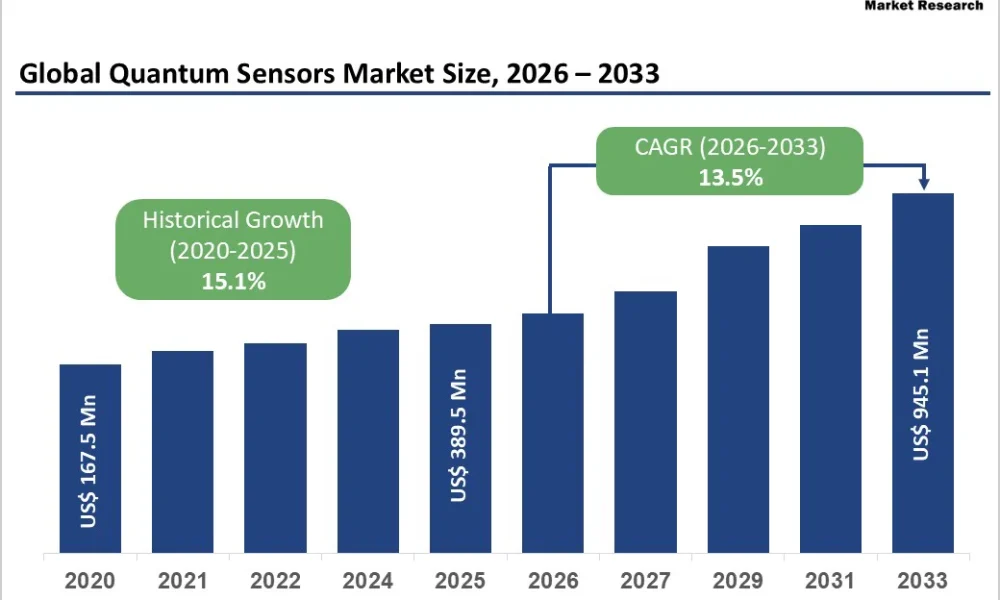
In 2026, the quantum sensors market is projected to be valued at approximately US$ 389.5 million, reflecting rapid commercialization across defense, aerospace, healthcare, and industrial sectors. The market is forecast to reach US$ 945.1 million by 2033, expanding at a robust CAGR of 13.5% during the forecast period. This growth trajectory is supported by increasing investments in national quantum programs, rising defense modernization budgets, and growing demand for GPS-independent navigation and ultra-accurate sensing technologies.
Market Statistics, Growth Drivers, and Leading Segments
Quantum sensors are transitioning from laboratory prototypes to real-world deployments at an accelerating pace. One of the strongest growth drivers is the defense and aerospace sector, where quantum inertial sensors and atomic clocks enable navigation and timing in GPS-denied or contested environments. Healthcare is another high-impact area, with quantum-enhanced imaging systems improving early disease detection and diagnostic accuracy.
From a segmentation perspective, atomic clocks dominate the market, accounting for nearly 42% market share in 2025 due to their long-standing use in defense, satellite navigation, and telecom synchronization systems. Geographically, North America leads the market with around 40% share, driven by strong U.S. defense funding, early technology adoption, and a mature quantum research ecosystem. Meanwhile, Asia Pacific is emerging as the fastest-growing region, fueled by aggressive government-backed quantum missions and expanding semiconductor manufacturing capabilities.
Key Highlights from the Quantum Sensors Market Report
- The global quantum sensors market is projected to grow from US$ 389.5 million in 2026 to US$ 945.1 million by 2033.
- Defense and aerospace applications remain the largest revenue contributors due to demand for GPS-independent navigation systems.
- Atomic clocks represent the dominant sensor type segment owing to technological maturity and consistent procurement cycles.
- Imaging and LiDAR quantum sensors are the fastest-growing segment, expanding at nearly 20% CAGR through 2032.
- North America leads the market, while Asia Pacific is expected to register the highest growth rate during the forecast period.
- AI-enabled and edge-integrated quantum sensing solutions are opening new commercial and industrial opportunities globally.
Quantum Sensors Market Segmentation Analysis
The quantum sensors market is segmented based on sensor type, application, and end-user industry, each playing a distinct role in shaping overall demand. By sensor type, the market includes atomic clocks, magnetometers, gravimeters, interferometers, imaging sensors, and quantum LiDAR systems. Atomic clocks continue to dominate due to their widespread deployment in defense, satellite systems, and telecommunications, while quantum magnetometers and gravimeters are gaining traction in geophysical exploration and medical diagnostics.
From an application and end-user perspective, defense and aerospace account for the largest share of market revenues, driven by modernization of navigation, surveillance, and timing infrastructure. Healthcare, oil and gas, mining, automotive, and autonomous systems represent fast-growing segments as industries seek higher measurement accuracy than conventional sensors can provide. Industrial adoption is accelerating as quantum sensors demonstrate clear advantages in predictive maintenance, subsurface mapping, and precision manufacturing.
Regional Insights and Market Dynamics
North America remains the most established regional market for quantum sensors, supported by strong federal funding, advanced defense programs, and close collaboration between universities, startups, and large technology firms. The United States, in particular, benefits from early commercialization efforts and large-scale procurement contracts for quantum timing and navigation systems.
Asia Pacific is expected to witness the fastest growth through 2032, driven by national quantum initiatives in China, Japan, and India. These countries are investing heavily in semiconductor fabrication, rare-earth materials, and indigenous quantum research, positioning the region as a future manufacturing and innovation hub for quantum sensing technologies.
Elevate your business strategy with comprehensive market data. Request a sample report now: https://www.persistencemarketresearch.com/samples/18508
Market Drivers Fueling Industry Expansion
The primary driver of the quantum sensors market is the growing need for ultra-precise measurement in defense and security applications. As electronic warfare and GPS jamming threats increase, governments are investing in quantum-based inertial navigation and timing systems that operate independently of satellite signals. This shift is creating sustained demand for atomic clocks and quantum gyroscopes.
Another major driver is the expansion of quantum sensing in healthcare and life sciences. Quantum imaging technologies enable earlier disease detection, higher-resolution scans, and improved patient outcomes. Industrial demand is also rising as sectors such as oil and gas, mining, and autonomous mobility require sensors capable of operating reliably in extreme and complex environments.
Market Restraints Limiting Adoption
Despite strong growth potential, the quantum sensors market faces several challenges that could slow adoption. High development and manufacturing costs remain a significant barrier, particularly for smaller enterprises and cost-sensitive commercial applications. Many quantum sensors require specialized materials, cryogenic environments, or complex calibration processes, which increase total ownership costs.
Additionally, the market faces a shortage of skilled professionals with expertise in quantum physics, materials science, and system integration. Limited standardization and interoperability across quantum sensing platforms further complicate large-scale deployment, especially in industrial and commercial settings where ease of integration is critical.
Market Opportunities and Future Outlook
The integration of artificial intelligence and edge computing with quantum sensors represents one of the most promising opportunities in the market. AI-enabled quantum sensing systems can process data in real time, enabling predictive maintenance, anomaly detection, and autonomous decision-making across industries. These hybrid quantum-classical architectures are expected to significantly expand commercial viability.
Another major opportunity lies in miniaturization and cost reduction through advances in photonics, semiconductor manufacturing, and materials engineering. As quantum sensors become more compact and affordable, adoption is expected to expand beyond defense and research into mass-market applications such as smart infrastructure, autonomous vehicles, and environmental monitoring.
Reasons to Buy the Quantum Sensors Market Report
✔ Gain detailed insights into current and future market size, growth trends, and revenue forecasts through 2033
✔ Understand key growth drivers, restraints, and opportunities shaping the global quantum sensors industry
✔ Analyze market segmentation by sensor type, application, and end-user for strategic decision-making
✔ Identify leading regions and emerging markets with high growth potential
✔ Access competitive intelligence and recent developments from major industry players
Company Insights: Key Players in the Quantum Sensors Market
- Honeywell International Inc.
- Thales Group
- Lockheed Martin Corporation
- Northrop Grumman Corporation
- Raytheon Technologies
- Bosch Quantum Sensing
- AOSense Inc.
- Muquans (iXblue Group)
- ColdQuanta
- Qnami AG
Recent Developments:
- Several defense contractors have expanded partnerships with national laboratories to accelerate the deployment of quantum inertial navigation systems for military platforms.
- Leading technology firms are investing in photonic-based quantum sensors to improve scalability and reduce operational complexity for commercial applications.
Conclusion
The quantum sensors market is rapidly evolving from a niche research domain into a commercially viable and strategically critical industry. With applications spanning defense, healthcare, industrial automation, and autonomous systems, quantum sensors are redefining the limits of precision measurement. Strong government support, technological breakthroughs, and growing cross-industry adoption position the market for sustained double-digit growth through 2033.
As costs decline and integration challenges are addressed, quantum sensors are expected to play a foundational role in next-generation navigation, imaging, and sensing systems worldwide. For stakeholders seeking long-term technological and commercial advantage, the quantum sensors market represents one of the most compelling opportunities within the global quantum technology landscape.
Related Reports:




