
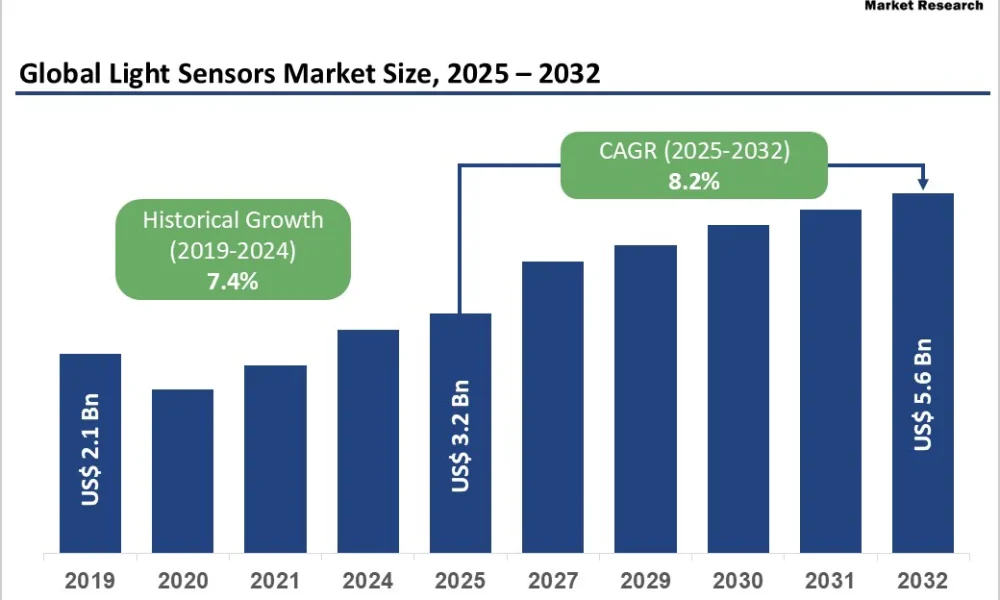
The global light sensor market is undergoing a transformative phase, driven by the rapid integration of sensing technologies across consumer electronics, automotive systems, industrial automation, and smart infrastructure. In 2025, the market is valued at US$ 3.2 billion and is projected to reach US$ 5.6 billion by 2032, expanding at a CAGR of 8.2% during the forecast period. This growth reflects the rising importance of light-sensing solutions in enabling energy efficiency, automation, and user-centric device performance across industries.
Light sensors play a critical role in detecting and measuring light intensity, color, and proximity, enabling systems to respond intelligently to environmental changes. From adjusting smartphone screen brightness to activating automotive headlights and optimizing smart lighting systems, these sensors have become indispensable. Continuous innovation in sensor accuracy, power efficiency, and miniaturization is further accelerating adoption across both established and emerging applications.
Market Dynamics, Growth Drivers, and Leadership Landscape
One of the key growth drivers behind the light sensor market is the accelerating adoption of smart devices and IoT-enabled systems. Smartphones, wearables, laptops, and smart home devices increasingly rely on ambient and proximity light sensors to enhance user experience and reduce power consumption. In parallel, stringent automotive safety regulations are compelling manufacturers to integrate advanced sensing solutions for adaptive lighting, driver assistance systems, and autonomous driving functions.
From a leadership standpoint, ambient light sensing dominates the functional segment with approximately 32% market share, owing to its widespread use in consumer electronics for automatic brightness control. On the regional front, North America leads the market, accounting for nearly 35% share in 2025, supported by strong automotive manufacturing, smart city initiatives, and early adoption of advanced sensing technologies. Meanwhile, Asia Pacific stands out as the fastest-growing region, driven by large-scale smartphone production, rapid urbanization, and Industry 4.0 adoption.
Key Highlights from the Light Sensor Market Report
- The global light sensor market is projected to grow from US$ 3.2 billion in 2025 to US$ 5.6 billion by 2032.
- Ambient light sensors dominate functional applications due to extensive use in consumer electronics.
- Consumer electronics represent the leading end-use segment, accounting for nearly 38% of total demand.
- North America leads the market owing to advanced automotive safety standards and smart infrastructure projects.
- Asia Pacific is the fastest-growing region, with a CAGR exceeding 14% through 2032.
- Healthcare wearables and biometric monitoring represent a high-potential growth opportunity.
Light Sensor Market Segmentation Analysis
The light sensor market is segmented based on product type, including ambient light sensors, proximity sensors, color sensors, infrared sensors, and ultraviolet sensors. Among these, ambient and proximity sensors account for the largest revenue share due to their extensive integration in smartphones, tablets, laptops, and smart home devices. Color sensors are gaining traction in display calibration and industrial quality control, while infrared and UV sensors are increasingly used in automotive and healthcare applications.
From an end-user perspective, the market spans consumer electronics, automotive, industrial, healthcare, and smart infrastructure sectors. Consumer electronics dominate demand, driven by high-volume production of smartphones and wearables. The automotive segment is witnessing strong growth as vehicles increasingly adopt adaptive lighting, automatic headlamp control, and advanced driver assistance systems. Industrial automation and healthcare applications are emerging as high-growth segments, supported by digital transformation and remote monitoring trends.
Elevate your business strategy with comprehensive market data. Request a sample report now: https://www.persistencemarketresearch.com/samples/33410
Regional Insights and Market Performance
North America continues to hold a leading position in the global light sensor market, supported by strong R&D capabilities, early adoption of smart technologies, and strict automotive safety regulations. The region’s focus on smart cities and energy-efficient building solutions further fuels demand for advanced light sensing systems across commercial and residential applications.
Asia Pacific is the fastest-growing regional market, driven by massive smartphone penetration, expanding electronics manufacturing in China, South Korea, and Taiwan, and rapid adoption of industrial automation. Government-led smart city initiatives and increasing investments in healthcare technology are also contributing to sustained market expansion across the region.
Market Drivers Fueling Industry Growth
The primary driver of the light sensor market is the surging demand for smart consumer electronics that prioritize energy efficiency and enhanced user experience. Automatic brightness adjustment, gesture recognition, and proximity detection have become standard features, making light sensors essential components. Additionally, the proliferation of IoT devices across homes and industries is creating new avenues for sensor integration.
Another significant driver is the automotive industry’s shift toward intelligent and autonomous systems. Adaptive lighting, night vision enhancement, and environmental sensing rely heavily on advanced light sensor technologies. Regulatory mandates for vehicle safety and energy efficiency further strengthen the case for widespread adoption.
Market Restraints Impacting Adoption
Despite strong growth prospects, the light sensor market faces challenges related to price sensitivity and integration complexity. In cost-competitive consumer electronics markets, manufacturers often face pressure to balance performance with affordability, which can limit the adoption of advanced sensor variants. Additionally, integrating sensors into compact devices requires sophisticated design and calibration, increasing development costs.
Another restraint is the susceptibility of sensors to environmental interference, such as temperature fluctuations and electromagnetic noise. These factors can affect accuracy and reliability, particularly in industrial and automotive environments, necessitating additional protective measures and increasing overall system costs.
Emerging Market Opportunities and Future Potential
The light sensor market presents significant opportunities in healthcare and wearable biometric monitoring. As wearable devices evolve to support continuous health tracking, light sensors are increasingly used in pulse oximetry, sleep monitoring, and physiological data collection. Advances in sensor miniaturization and AI-driven analytics are enhancing accuracy and expanding clinical acceptance.
Smart infrastructure and energy-efficient lighting systems also represent lucrative opportunities. Governments and urban planners are investing heavily in smart city projects that rely on adaptive lighting and environmental sensing to reduce energy consumption and improve public safety. These initiatives are expected to create sustained demand for advanced light sensing solutions over the coming decade.
Company Insights: Key Players in the Light Sensor Market
- ams-OSRAM AG
- STMicroelectronics
- Texas Instruments Incorporated
- Broadcom Inc.
- ROHM Semiconductor
- Vishay Intertechnology, Inc.
- Panasonic Corporation
- ON Semiconductor
- Analog Devices, Inc.
- Everlight Electronics Co., Ltd.
Recent Developments:
Leading semiconductor manufacturers are investing in next-generation light sensors with enhanced sensitivity and ultra-low power consumption to support wearable and IoT applications. Additionally, several key players have expanded their automotive-grade sensor portfolios to meet growing demand for advanced driver assistance and autonomous vehicle systems.
Reasons to Buy the Light Sensor Market Report
✔ Gain in-depth insights into market size, growth trends, and future forecasts through 2032.
✔ Understand key growth drivers, restraints, and opportunities shaping the global light sensor industry.
✔ Analyze detailed segmentation by product type, end-user, and region for strategic decision-making.
✔ Identify leading players, competitive strategies, and recent technological developments.
✔ Support investment, expansion, and partnership decisions with data-driven market intelligence.
Frequently Asked Questions (FAQs)
How Big is the Light Sensor Market and how fast is it growing?
Who are the Key Players in the Global Market for Light Sensors?
What is the Projected Growth Rate of the Light Sensor Market during the forecast period?
What is the Market Forecast for the Light Sensor Market for 2032?
Which Region is Estimated to Dominate the Light Sensor Industry through the Forecast Period?
Conclusion: The Future of Light Sensing Technology
The light sensor market is positioned for sustained growth as industries increasingly prioritize automation, energy efficiency, and intelligent system design. With strong demand from consumer electronics, automotive safety systems, and emerging healthcare applications, light sensors are becoming foundational components of modern technology ecosystems. As innovation continues to improve performance, reduce power consumption, and expand application scope, the market is set to illuminate new opportunities well beyond 2032.
Related Reports:




