
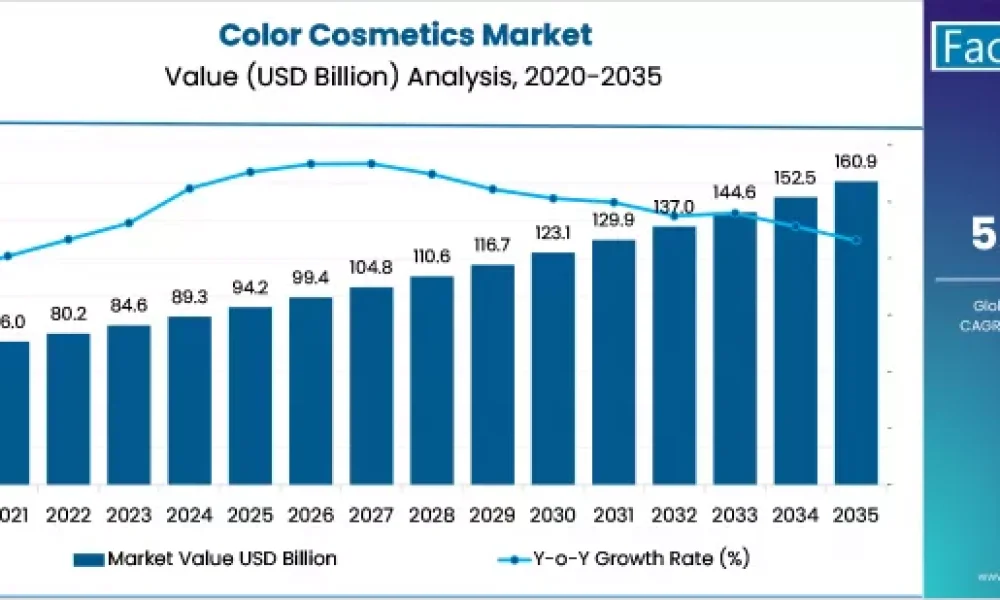
The global color cosmetics market has reached a definitive milestone in early 2026, with its total valuation climbing to $91.81 billion. Driven by a profound consumer shift toward “skin-first” makeup and the integration of advanced digital diagnostics, the industry is transitioning from simple aesthetic enhancement to a high-performance wellness category.
As of February 2026, industry giants—including L’Oréal, The Estée Lauder Companies, Shiseido, and LVMH—are reporting a structural pivot toward hybrid products that blend pigment with clinical-grade skincare. The current market momentum is fueled by the “clean beauty” imperative, with 68% of global consumers now actively seeking formulations free from parabens, synthetic dyes, and silicones.
Request for Sample Report | Customize Report |purchase Full Report – https://www.factmr.com/connectus/sample?flag=S&rep_id=64
The 2026 Market Landscape: Who, What, and Why
The sector’s expansion is being spearheaded by Gen Z and Millennial demographics, whose purchasing habits are dictated by social media “viral cycles” and a demand for radical brand transparency. This shift has moved color cosmetics from a discretionary luxury to an essential tool for digital self-expression.
Key growth drivers for 2026 include:
- The “Skinification” of Makeup: Foundations and concealers are no longer judged solely on coverage, but on their inclusion of active ingredients like niacinamide, hyaluronic acid, and probiotics.
- AI & AR Integration: Virtual try-on tools and AI-powered skin tone analysis have reduced purchase hesitation in the e-commerce sector, which now accounts for over 30% of global beauty sales.
- Adaptive Technology: A surge in “adaptive” cosmetics that react to a user’s unique skin pH or environmental humidity levels to provide a customized finish.
Strategic Market Insights: Paragraph Analysis
Market intelligence for 2026 indicates a robust growth trajectory, with the global color cosmetics sector projected to reach $143.15 billion by 2034, maintaining a steady CAGR of 5.7%. Within this landscape, the Face Products segment remains the dominant force, capturing a 36.6% market share as consumers prioritize “no-makeup” makeup looks that emphasize a healthy, glowing complexion. Geographically, the Asia-Pacific region has solidified its position as the global engine of growth, commanding a 43.3% share of the market. This dominance is supported by the massive influence of K-Beauty and J-Beauty trends, alongside a burgeoning middle class in India and China with rising disposable incomes. Conversely, the North American and European markets are witnessing a “premiumization” surge, where the prestige segment is outperforming mass-market offerings as consumers trade up for dermatologically tested and ethically sourced products.
The Rise of Inclusive and Gender-Neutral Beauty
A pivotal development in 2026 is the mainstreaming of inclusive shade ranges and gender-neutral collections. Following the blueprint set by pioneering brands, the industry has adopted a “universal-first” approach to product development. Manufacturers are now utilizing micro-millimeter pigment technology to ensure superior color payoff across the widest possible spectrum of skin tones, particularly in the rapidly growing markets of Southeast Asia and Africa.
Furthermore, the men’s color cosmetics segment is experiencing an unprecedented CAGR of nearly 7%. This growth is driven by a societal shift toward male grooming, with concealers, tinted moisturizers, and “beard fillers” becoming staple items in the modern man’s daily routine.
“The 2026 consumer is no longer buying just a lipstick or a foundation; they are investing in a brand’s values and its scientific credibility,” says a senior beauty market analyst. “Success in this decade is defined by the intersection of high-pigment performance and measurable skin health benefits.”
Regional Performance & 2026 Projections
- China & India: Emerging as strategic hubs for domestic innovation, with local brands like Kay Beauty and Perfect Diary leveraging deep regional insights to challenge the market share of established Western conglomerates.
- Europe: Continues to lead in regulatory excellence, with new bans on microplastics and specific fragrance allergens forcing a global wave of “clean-label” reformulations.
- North Asia: Represents the largest regional hub for R&D, with Japan and South Korea serving as the primary testing grounds for biotech-derived cosmetic ingredients.
Future Outlook: 2026 and Beyond
The road ahead for the color cosmetics market is characterized by a push toward circular economy packaging and waterless formulations. As environmental transparency becomes a non-negotiable requirement for Gen Alpha consumers, brands are pivoting toward refillable luxury components and concentrated “solid” makeup formats. For investors and analysts, the highest value lies in the “Indie-Prestige” sector—nimble, digital-first brands that can adapt to viral trends in real-time while maintaining the rigorous safety standards of legacy houses.
About the Industry Research & Data Bureau This press release synthesizes current 2026 market data, industrial filings, and consumer sentiment analysis to provide an authoritative overview of the global color cosmetics landscape. It is intended for executive decision-makers, market analysts, and stakeholders in the global beauty supply chain.
About Fact.MR
Fact.MR is a global market research and consulting firm, trusted by Fortune 500 companies and emerging businesses for reliable insights and strategic intelligence. With a presence across the U.S., UK, India, and Dubai, we deliver data-driven research and tailored consulting solutions across 30+ industries and 1,000+ markets. Backed by deep expertise and advanced analytics, Fact.MR helps organizations uncover opportunities, reduce risks, and make informed decisions for sustainable growth.



