
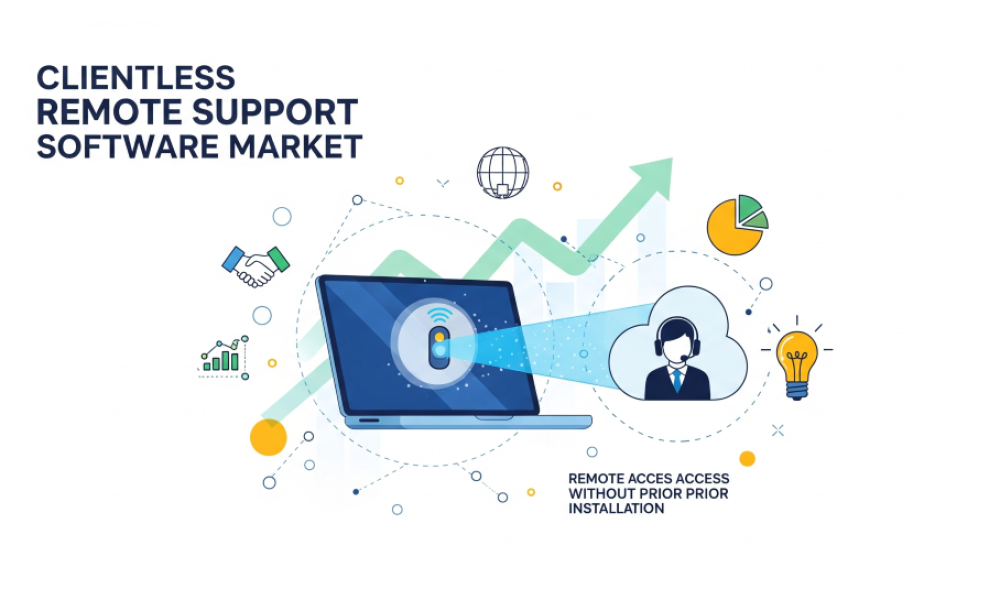
The global clientless remote support software market has reached a definitive milestone in early 2026, with its valuation climbing to approximately $2.14 billion. Driven by the urgent need for secure, frictionless technical assistance and the continued expansion of hybrid work models, the industry is witnessing a structural transition toward “zero-footprint” architectures that allow IT technicians to resolve issues without installing permanent software on end-user devices.
As of February 2026, industry leaders—including TeamViewer, LogMeIn (GoTo), ConnectWise, and BeyondTrust—are reporting a surge in demand from sectors where data privacy and deployment speed are paramount. By leveraging web-based protocols and temporary browser-based sessions, clientless solutions are effectively eliminating the traditional “installation hurdle,” allowing for immediate support across diverse hardware ecosystems.
Request for Sample Report | Customize Report |purchase Full Report – https://www.factmr.com/connectus/sample?flag=S&rep_id=345
The 2026 Market Landscape: Who, What, and Why
The market’s current momentum is spearheaded by enterprise IT departments and third-party managed service providers (MSPs), who are tasked with supporting a global workforce that is increasingly mobile and hardware-agnostic.
Key growth drivers for 2026 include:
- Frictionless Troubleshooting: Clientless tools enable instant screen sharing and remote control via a simple URL or session code, reducing “Time-to-Resolution” (TTR) by bypassing the administrative permissions often required for standard software installs.
- The Security Imperative: In an era of escalating malware, clientless solutions offer a reduced attack surface. Because no permanent agent remains on the device post-session, the risk of “dormant” vulnerabilities or unauthorized backdoor access is significantly mitigated.
- IoT and Mobile Proliferation: With the explosion of connected devices in healthcare and manufacturing, technicians require versatile tools that can jump between a desktop, a ruggedized tablet, or a smartphone without device-specific configurations.
Strategic Market Insights: Data-Backed Analysis
The global clientless remote support software market is projected to maintain a high-velocity CAGR of 14.1%, with estimates suggesting it will reach $7.03 billion by 2035. Currently, North America remains the dominant force, holding roughly 45% of the global market share, fueled by a high concentration of tech-heavy enterprises and rigorous cybersecurity standards. However, the Asia-Pacific region is emerging as the fastest-growing geography, driven by rapid digital transformation in India and China. From a deployment perspective, cloud-based solutions now account for the majority of new revenue, as organizations prioritize the low maintenance and high scalability of SaaS models over traditional on-premise installations. Within the industry verticals, the BFSI (Banking, Financial Services, and Insurance) segment remains the largest revenue contributor, representing approximately 38% of the market, as financial institutions leverage “zero-install” tools to provide secure support to remote agents without risking sensitive data exposure.
Technological Innovation: AI and Browser-Native Support
A pivotal trend in 2026 is the integration of AI-driven diagnostics within the clientless environment. Modern platforms now utilize machine learning to analyze system telemetry in the background during a session, providing technicians with “predictive fixes” before the user even finishes describing the problem.
Furthermore, the rise of WebRTC (Web Real-Time Communication) has allowed these tools to achieve near-zero latency. This technical evolution ensures that remote control sessions are as responsive as a local interaction, even when the technician and the end-user are on different continents.
“We are seeing the end of the ‘install-heavy’ era of IT support,” notes a senior market analyst at a leading research firm. “In 2026, the value is in the session, not the software. The ability to enter and exit a device cleanly, leaving no digital footprint behind, is now the baseline requirement for enterprise-grade security.”
The Role of the SME and Hybrid Work
While large enterprises were the early adopters, Small and Medium Enterprises (SMEs) are now the fastest-growing customer segment. For smaller businesses with limited IT budgets, clientless software offers a cost-effective way to provide “big-firm” support levels without the overhead of managing a complex software deployment infrastructure. This is particularly vital in the Gig Economy, where support teams must assist freelancers and contractors who use personal, non-managed devices (BYOD).
Future Outlook: 2026 and Beyond
The road ahead for the clientless remote support market is characterized by a push toward multi-factor session authentication and automated compliance logging. As global data protection laws (such as GDPR and CCPA) become more stringent, the “clean exit” provided by clientless technology will become a legal necessity for many industries. For investors and analysts, the most significant opportunities lie in platforms that can offer cross-platform parity—ensuring that the support experience on a Linux server is as seamless as it is on an iOS tablet.
About the Industry Research Group This press release synthesizes current 2026 market data, industrial filings, and technological trends to provide an authoritative overview of the remote access sector. It is intended for industry leaders, analysts, and investors tracking the evolution of digital workspace solutions.
About Fact.MR
Fact.MR is a global market research and consulting firm, trusted by Fortune 500 companies and emerging businesses for reliable insights and strategic intelligence. With a presence across the U.S., UK, India, and Dubai, we deliver data-driven research and tailored consulting solutions across 30+ industries and 1,000+ markets. Backed by deep expertise and advanced analytics, Fact.MR helps organizations uncover opportunities, reduce risks, and make informed decisions for sustainable growth.



