
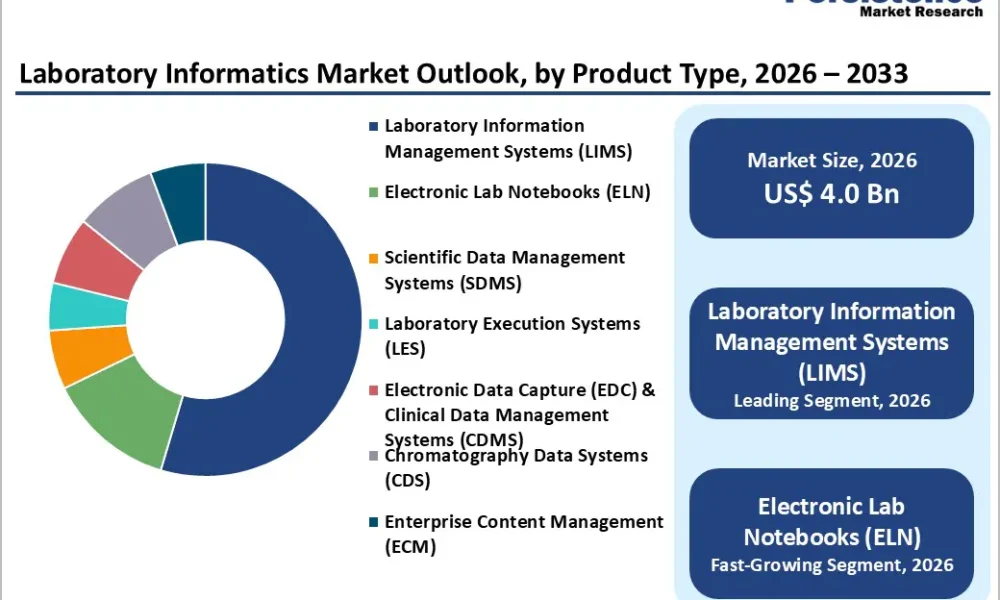
The global laboratory informatics market has seen steady growth and is poised for continued expansion, reaching an estimated value of US$ 4.0 billion in 2026 and projected to grow to US$ 5.9 billion by 2033. This growth is indicative of the broader trends in the digital healthcare space, with technological advancements being embraced across the board, especially in clinical and research laboratories. The laboratory informatics market is characterized by the integration of IT systems such as Laboratory Information Management Systems (LIMS), Electronic Lab Notebooks (ELNs), and other digital platforms that streamline workflows, improve data accuracy, and ensure regulatory compliance in laboratory settings.
The laboratory informatics market is primarily driven by digital transformation trends in healthcare, increasing demand for automation in laboratory operations, and the growing need for compliance with stringent regulatory frameworks. North America remains the leading region in the global market, thanks to its advanced healthcare infrastructure, early adoption of digital technologies, and substantial investment in biomedical research. Meanwhile, Asia-Pacific has emerged as the fastest-growing region, with governments in countries like China, India, and Japan focusing on healthcare digitization and research capabilities. This expansion is fueled by increasing investments in diagnostic software, services, and interoperable solutions, as well as rising patient awareness.
Download Your Free Sample & Explore Key Insights: https://www.persistencemarketresearch.com/samples/33204
Key Highlights from the Report
• Dominant Segment: Laboratory Information Management Systems (LIMS) hold the largest market share at 54.6% in 2025.
• Dominant Region: North America leads the market due to its strong healthcare IT infrastructure and high digital adoption.
• Growth Rate: The laboratory informatics market is projected to grow at a CAGR of 5.8% from 2026 to 2033.
• Cloud Adoption: Cloud-based solutions dominate the market due to their scalability and cost-effectiveness.
• Regulatory Compliance: Regulatory requirements, such as ISO/IEC-17025 and CLIA, continue to drive the adoption of LIMS and other informatics solutions.
• AI Integration: The integration of AI and cloud-based technologies is driving efficiency and automation in laboratory workflows.
Market Segmentation
By Product Type
The market can be segmented based on product type, where Laboratory Information Management Systems (LIMS) dominate the global market. LIMS accounts for over 54% of the market share in 2025. These systems serve as the backbone of modern laboratories, enabling sample tracking, data acquisition, and workflow automation. As laboratories face increasing volumes and complexity of data, LIMS helps ensure data accuracy, regulatory compliance, and smooth operational efficiency. Additionally, they assist in meeting international standards such as ISO/IEC-17025 and CLIA, which require strict documentation and quality control in laboratories, particularly in clinical diagnostics and research.
Other products in the laboratory informatics market include Electronic Lab Notebooks (ELNs), Laboratory Execution Systems (LES), and Scientific Data Management Systems (SDMS), though they hold a smaller market share compared to LIMS. These systems are crucial for research environments, enhancing collaboration, improving traceability, and optimizing workflows.
By Deployment Mode
The laboratory informatics market is also segmented by deployment mode, where cloud-based solutions are becoming increasingly popular. The demand for cloud-based laboratory informatics solutions has surged due to their scalability, cost-efficiency, and accessibility. Cloud platforms offer laboratories the ability to access real-time data remotely and improve collaboration across teams, particularly in multi-site operations. Cloud solutions are also easier to maintain, as they reduce the need for on-premise hardware and software updates.
On-premise deployments are still common in some industries, particularly those with high-security requirements or complex infrastructure, but the growing adoption of cloud-based solutions is reshaping the landscape. A large percentage of healthcare organizations have already embraced cloud computing, reporting increased performance and operational efficiency after transitioning to cloud-based platforms.
By End-User
The end-user segment of the laboratory informatics market is broad, covering healthcare organizations, pharmaceutical companies, academic institutions, and contract research organizations (CROs). Among these, pharmaceutical and biotechnology companies are the largest consumers of laboratory informatics solutions. The need for high-throughput testing, regulatory compliance, and the ability to handle large datasets in drug development processes drives demand for sophisticated informatics platforms.
Hospitals and clinical diagnostic laboratories also significantly contribute to market growth. These labs require real-time data management solutions to ensure diagnostic accuracy, meet regulatory standards, and manage patient data securely. Additionally, academic and research institutions use laboratory informatics for scientific experimentation and data analysis, leading to growth in this segment.
Get Custom Insights Designed for Your Business: https://www.persistencemarketresearch.com/request-customization/33204
Regional Insights
North America
North America is the largest market for laboratory informatics, accounting for approximately 47.3% of the global market share in 2025. The region’s dominance is attributed to its robust healthcare IT infrastructure, high levels of digital adoption, and a strong research and development ecosystem. The U.S., in particular, has established a leading position in the digitalization of healthcare, with widespread implementation of electronic health records (EHRs) and Laboratory Information Management Systems (LIMS). Furthermore, regulatory support and public funding for biomedical research in the U.S. further fuel the growth of the laboratory informatics market.
In North America, government and private sector investments in advanced healthcare technologies continue to drive market expansion. Moreover, the growing focus on personalized medicine and precision health has accelerated the adoption of laboratory informatics solutions, particularly in clinical diagnostics and biomedical research.
Europe
Europe holds a significant share of the laboratory informatics market due to its advanced healthcare infrastructure and stringent regulatory standards. The European Union (EU) has actively promoted digital healthcare through initiatives aimed at improving the interoperability of health information systems. As a result, many laboratories in Europe have adopted digital tools to comply with regulations such as the EU Clinical Trials Regulation and the In Vitro Diagnostic Medical Devices Regulation.
The region’s growing focus on improving research collaboration, coupled with its strong pharmaceutical and biotechnology sectors, supports the demand for laboratory informatics solutions. Public funding for research and innovation is also a key factor driving market growth in Europe, with governments in the UK, Germany, and France investing heavily in digital healthcare and laboratory automation.
Asia-Pacific
Asia-Pacific is the fastest-growing region for laboratory informatics, driven by the rapid adoption of digital healthcare technologies, expanding healthcare infrastructure, and government initiatives aimed at improving healthcare quality. Countries such as China, India, and Japan are at the forefront of this digital transformation, with increasing internet penetration and rising healthcare investments.
In the Asia-Pacific region, the growing prevalence of chronic diseases such as diabetes, cancer, and cardiovascular disorders is increasing the demand for laboratory testing and data management solutions. Governments are also prioritizing digital health initiatives, which further boost the adoption of laboratory informatics solutions.
Market Drivers
The primary drivers of growth in the laboratory informatics market include the increasing adoption of digital laboratory solutions, a shift toward automation, and rising regulatory compliance requirements. Laboratories across the globe are transitioning from paper-based to digital workflows to enhance efficiency and accuracy. This shift is particularly prominent in the healthcare sector, where compliance with regulations like ISO/IEC-17025 and CLIA is crucial.
Another major driver is the growing demand for real-time data access and remote monitoring capabilities in healthcare. With cloud-based solutions and AI-enabled analytics, laboratories can streamline operations, reduce manual errors, and improve the accuracy of results. These systems help laboratories handle large volumes of data, automate complex workflows, and support high-throughput testing, which is essential in research, clinical diagnostics, and drug development.
Market Restraints
Despite the promising growth, the laboratory informatics market faces several challenges, primarily concerning data security and privacy. Laboratories deal with highly sensitive data, including patient records and research data, which must be protected in compliance with regulations such as HIPAA and GDPR. Healthcare data breaches are a significant concern, with healthcare being one of the costliest sectors for data breaches globally.
In 2024 alone, the U.S. reported over 500 data breaches affecting millions of patient records, underscoring the vulnerability of digital healthcare systems. As more laboratories adopt cloud-based solutions, concerns over data privacy and the risk of cyberattacks may deter some organizations from fully embracing digital laboratory informatics.
Market Opportunities
There are significant opportunities in the laboratory informatics market, particularly in the development of cloud-based and SaaS (Software-as-a-Service) solutions. These platforms offer scalability, reduced IT infrastructure costs, and easier updates and compliance management. As more healthcare organizations move to the cloud, the demand for secure, cloud-hosted informatics solutions will continue to rise.
Additionally, the integration of AI in laboratory informatics presents exciting opportunities. AI-powered analytics can help laboratories automate data interpretation, predict outcomes, and enhance decision-making. Furthermore, the growing trend of personalized medicine, which relies on advanced data analytics, provides another avenue for the expansion of laboratory informatics solutions, particularly in clinical and research settings.
Checkout Now & Download Complete Market Report: https://www.persistencemarketresearch.com/checkout/33204
Company Insights
The laboratory informatics market features several key players that are leading the way in innovation, research, and development.
• LabWare
• Thermo Fisher Scientific, Inc.
• PerkinElmer, Inc.
• Abbott
• LabLynx, Inc.
• Agilent Technologies, Inc.
• Waters
• IDBS
• McKesson Corporation
Global Laboratory Informatics Market Segmentation
By Product Type
- Laboratory Information Management Systems (LIMS)
- Electronic Lab Notebooks (ELN)
- Scientific Data Management Systems (SDMS)
- Laboratory Execution Systems (LES)
- Electronic Data Capture (EDC) & Clinical Data Management Systems (CDMS)
- Chromatography Data Systems (CDS)
- Enterprise Content Management (ECM)
By Deployment Mode
- On-premise
- Web-hosted
- Cloud-based
By Component
- Software
- Services
By End User
- Life Sciences
- CROs
- Chemical Industry
- F&B and Agriculture
- Environmental Testing Labs
- Petrochemical Refineries & Oil and Gas Industry
- Others
By Region
- North America
- Europe
- East Asia
- South Asia & Oceania
- Latin America
- Middle East and Africa
Recent Developments
Thermo Fisher Scientific entered into a collaboration with NVIDIA in January 2026 to develop AI-powered laboratory instruments and automation technologies, marking a significant shift towards more intelligent workflows in research and clinical settings.
LabWare, Inc. launched the Clinical Health Solution 5.06 in September 2025, an updated version of its LIMS designed to optimize workflow and enhance capabilities in clinical diagnostics, data management, and communications.




