
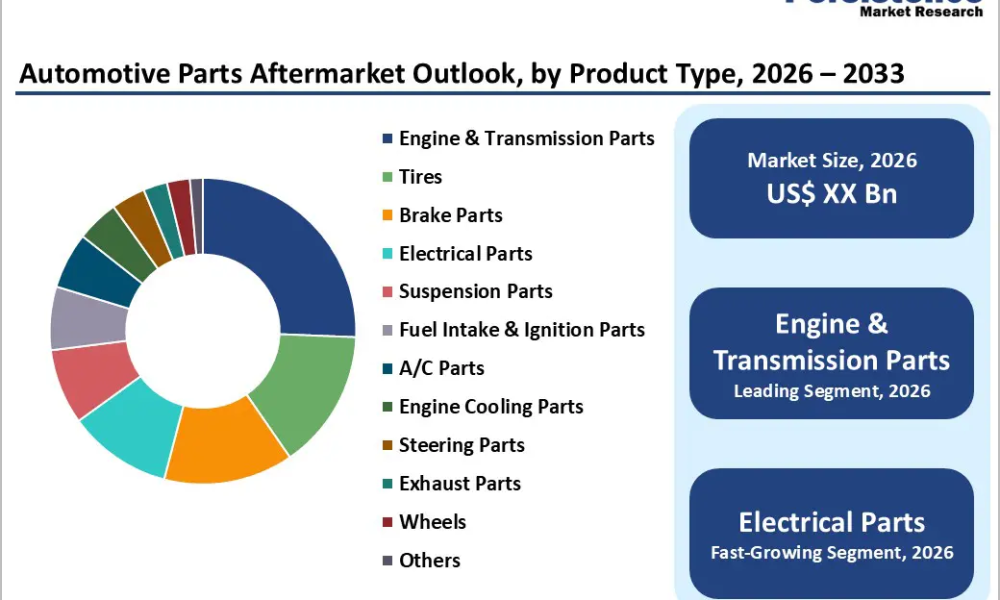
The global automotive parts aftermarket continues to demonstrate strong structural resilience and long-term growth potential, supported by rising vehicle parc, increasing average vehicle age, and accelerating technological integration across repair, replacement, and distribution ecosystems. According to consolidated insights from leading market research firms, the global Automotive Parts Aftermarket was valued at US$ 676.5 billion in 2026 and is projected to reach US$ 984.2 billion by 2033, expanding at a compound annual growth rate (CAGR) of 5.5% during the forecast period from 2026 to 2033.
This sustained expansion reflects a fundamental shift in consumer and fleet behavior toward proactive vehicle maintenance, cost-efficient repair solutions, and extended vehicle lifecycles. As global vehicle ownership continues to rise—particularly in emerging economies—demand for replacement parts, accessories, diagnostics, and maintenance services is growing steadily. Additionally, supply chain restructuring, digital aftermarket platforms, and increasing penetration of electric and hybrid vehicles are reshaping traditional aftermarket dynamics.
Key growth drivers include the rising average age of vehicles in developed markets, which directly correlates with higher replacement part consumption, and increasing vehicle complexity that necessitates advanced aftermarket solutions. The proliferation of e-commerce channels for automotive components, growing do-it-yourself (DIY) and do-it-for-me (DIFM) repair culture, and the expansion of organized service networks are further reinforcing market growth. Regulatory mandates related to vehicle safety, emissions, and right-to-repair policies are also supporting aftermarket accessibility and competition globally.
Get Your FREE Sample Report Instantly Click Now: https://www.persistencemarketresearch.com/samples/32832
Automotive Parts Aftermarket Segmentation
By Component
- Engine & Transmission Parts
- Pistons & Piston Rings
- Oil Filters & Pumps
- Air Filters
- Clutch
- Transmission Filters
- Brake Parts
- Brake Pads
- Brake Calipers
- Brake Rotors
- Brake Shoes
- Brake Drums
- Electrical Parts
- Starters
- Alternators
- Batteries
- Light Bulbs
- Sensors
- Fuel Intake & Ignition Parts
- Fuel Filters
- Fuel Injectors
- Spark Plugs
- Glow Plugs
- Fuel Pumps
- A/C Parts
- Cabin Air Filters
- Compressors
- Condensers
- Blower Motors
- Suspension Parts
- Shock Absorbers
- Leaf Springs
- Coil Springs
- Air Springs
- Exhaust Parts
- Exhaust Pipes
- Mufflers
- Engine Cooling Parts
- Radiators
- Radiator Fans
- Intercoolers
- Water Pumps
- Steering Parts
- Wheels
- Tires
By Vehicle Type
- Passenger Vehicles
- Light Commercial Vehicles
- Heavy Commercial Vehicles
- Off-Road Vehicles
- Others
By Sales Channel
- Independent Aftermarket Retailers
- Wholesalers & Distributors
- Authorized OEM Dealerships
- Online / E-commerce Platforms
- Miscellaneous
By Region
- North America
- Europe
- East Asia
- South Asia and Oceania
- Latin America
- Middle East and Africa
Regional Insights
Geographically, North America and Europe collectively account for a significant share of the global Automotive Parts Aftermarket. These regions benefit from a mature vehicle fleet, high average vehicle age, well-established aftermarket ecosystems, and strong regulatory frameworks supporting vehicle safety and emissions compliance. The presence of major OEMs, tier-one suppliers, and organized service networks further strengthens aftermarket demand in these regions.
Asia-Pacific is identified as the fastest-growing regional market during the forecast period. Rapid urbanization, rising disposable incomes, increasing vehicle ownership, and expanding middle-class populations in countries such as China, India, and Southeast Asian nations are driving aftermarket expansion. Additionally, the region’s growing manufacturing base, cost-competitive labor, and expanding e-commerce infrastructure are accelerating the development of both domestic and export-oriented aftermarket supply chains.
Latin America and the Middle East & Africa are also witnessing steady growth, supported by improving economic conditions, increasing used vehicle imports, and gradual formalization of aftermarket services. These regions offer long-term growth potential as vehicle penetration rates rise and organized service networks expand.
Customize This Report for Your Exact Requirements: https://www.persistencemarketresearch.com/request-customization/32832
Unique Features and Innovations in the Market
The modern Automotive Parts Aftermarket is increasingly differentiated by technology integration, data intelligence, and customer-centric service models. Digital diagnostics tools, AI-powered demand forecasting, and IoT-enabled vehicle monitoring systems are enabling predictive maintenance and reducing unplanned breakdowns. These capabilities are particularly valuable for fleet operators and commercial vehicle owners seeking to optimize uptime and operational efficiency.
Artificial intelligence is being deployed to improve parts identification accuracy, optimize pricing strategies, and streamline inventory management across complex distribution networks. IoT technologies enable real-time monitoring of vehicle health, allowing service providers to recommend timely part replacements before failures occur. Meanwhile, the rollout of 5G connectivity is enhancing vehicle-to-cloud communication, supporting over-the-air updates, remote diagnostics, and advanced telematics solutions that integrate seamlessly with aftermarket services.
Additive manufacturing and advanced materials are also influencing aftermarket innovation by enabling rapid prototyping, localized production of low-volume components, and improved durability of replacement parts. These innovations are collectively improving service efficiency, reducing lead times, and enhancing overall customer satisfaction.
Market Highlights
The Automotive Parts Aftermarket is increasingly being adopted as a strategic lever for cost optimization, asset longevity, and sustainability. Businesses and fleet operators are prioritizing preventive maintenance and high-quality aftermarket components to reduce lifecycle costs and improve vehicle reliability. The shift toward remanufactured and refurbished parts is also gaining traction, driven by cost advantages and growing emphasis on circular economy principles.
Regulatory frameworks play a critical role in shaping market dynamics. Safety and emissions regulations necessitate regular replacement of compliant components, while right-to-repair legislation in several regions is improving consumer access to parts and service information. Sustainability considerations, including carbon footprint reduction and resource efficiency, are further encouraging the use of durable, recyclable, and remanufactured aftermarket products.
Key Players and Competitive Landscape
The global Automotive Parts Aftermarket is moderately fragmented, with the presence of multinational suppliers, regional specialists, and emerging digital platforms. Leading companies are focusing on product innovation, strategic partnerships, digital channel expansion, and geographic diversification to strengthen their market positions.
- Robert Bosch GmbH continues to leverage its strong OEM and aftermarket portfolio, focusing on advanced diagnostics, electronic components, and connected service solutions to enhance aftermarket value propositions.
- Continental AG emphasizes smart mobility and safety systems, expanding its aftermarket offerings in electronics, sensors, and ADAS-related components.
- Denso Corporation strengthens its global aftermarket presence through high-quality thermal systems, powertrain components, and expanding service networks, particularly in Asia-Pacific.
- ZF Friedrichshafen AG focuses on driveline, chassis, and braking technologies, supported by digital service solutions and remanufacturing initiatives.
- Magna International Inc. leverages its engineering expertise to expand aftermarket components aligned with evolving vehicle architectures, including electrified platforms.
- Aisin Corporation concentrates on transmission systems, engine components, and expanding aftermarket service capabilities across global markets.
- Delphi Technologies (BorgWarner) advances its aftermarket footprint through power electronics, fuel systems, and diagnostics tailored to both ICE and hybrid vehicles.
Recent Developments
- Leading aftermarket suppliers have expanded digital B2B and B2C platforms to enhance parts availability, improve order fulfillment speed, and strengthen customer engagement across regions.
- Several major players have announced investments in remanufacturing and sustainable aftermarket solutions, aligning product portfolios with circular economy goals and regulatory sustainability targets.
Ready to Dive Deep? Buy Full Report Today: https://www.persistencemarketresearch.com/checkout/32832
Future Opportunities and Growth Prospects
The future of the Automotive Parts Aftermarket is closely tied to evolving vehicle technologies, regulatory landscapes, and mobility patterns. The gradual transition toward electrification, autonomous features, and software-defined vehicles will reshape aftermarket demand, creating opportunities in batteries, electronics, software services, and specialized diagnostics. While traditional mechanical components will remain relevant in the near term, electronic and digital aftermarket solutions are expected to account for a growing share of market value.
Emerging markets offer significant untapped potential as vehicle ownership rises and organized aftermarket ecosystems develop. Continued investment in digital infrastructure, workforce upskilling, and supply chain resilience will be critical for capturing these opportunities. Furthermore, regulatory support for right-to-repair, sustainability, and vehicle safety will continue to influence aftermarket accessibility and innovation.
Overall, the global Automotive Parts Aftermarket is positioned for sustained and diversified growth through 2033, supported by technological advancement, expanding vehicle fleets, and increasing recognition of the aftermarket as a critical component of the global automotive value chain.




