
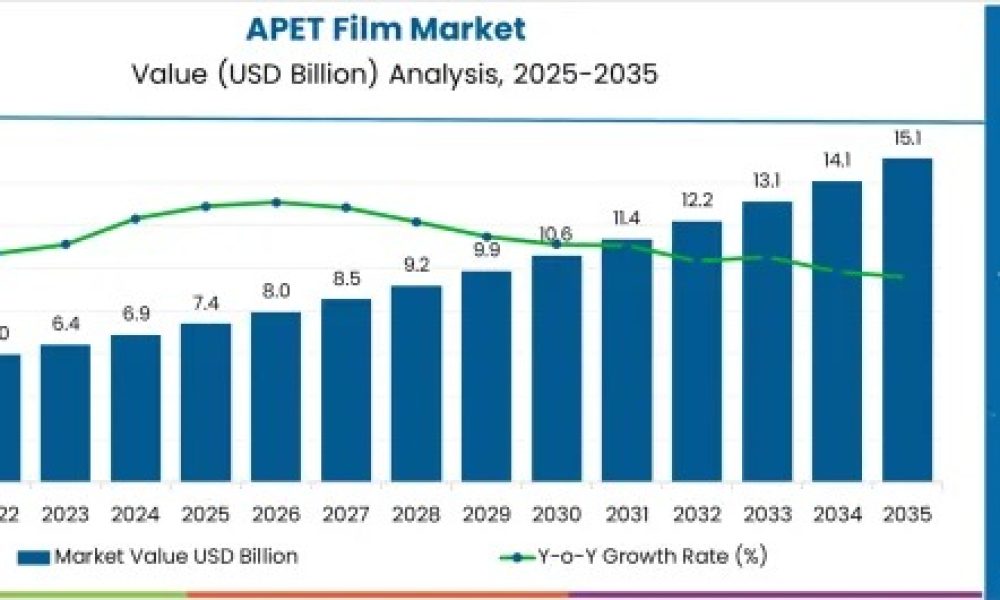
The global APET (Amorphous Polyethylene Terephthalate) film market is witnessing strong and consistent growth as industries increasingly seek sustainable, high-performance packaging materials. APET films are widely used in packaging applications where clarity, durability, and recyclability are essential. From food and beverages to pharmaceuticals and personal care, APET films have become a preferred choice for manufacturers aiming to combine product protection with visual appeal.
In 2025, the APET film market is valued at USD 7.4 billion and is forecast to reach USD 15.1 billion by 2035, growing at a healthy CAGR of 7.4%. This growth reflects rising consumer awareness, regulatory pressure on plastic waste, and technological advancements in film processing and coatings.
Meaning of APET Film
APET film is a transparent thermoplastic polyester material derived from polyethylene terephthalate. It is known for its excellent optical clarity, stiffness, chemical resistance, and thermal stability. Unlike traditional plastics, APET is fully recyclable and approved for direct food contact, making it suitable for modern packaging requirements.
APET films are primarily used in blister packs, trays, lidding films, and labels, where product visibility and safety are critical. Due to their adaptability, APET films are widely used across consumer goods, food packaging, medical supplies, and electronics.
Market Outlook
The outlook for the APET film market remains highly optimistic over the next decade. Growing urbanization, increasing packaged food consumption, and the rapid expansion of e-commerce are accelerating the demand for transparent and protective packaging films. Regulatory authorities across regions are pushing for recyclable and mono-material packaging, which directly supports APET film adoption.
Innovation in anti-fog coatings, heat-sealable layers, UV-resistant surfaces, and barrier technologies is further expanding the usability of APET films in complex applications. As sustainability becomes a core strategic objective for brands, APET films are expected to play a central role in future packaging systems.
Request For Sample Report | Customize Report | Purchase Full Report – Sample link
Market Overview
The APET film market is segmented by end-use industry, type, application, and region.
By End-Use Industry:
- Consumer Goods
- Food & Beverage
- Medical & Pharmaceutical
- Electronics Industry
- Automotive
- Others (Cosmetics, Stationery, Textile)
By Type:
- Anti-fog
- High-barrier
- Heat sealable
- UV-resistant
- Flame retardant
By Application:
- Blister packaging
- Trays
- Lidding films
- Labels & graphics
Among these, the consumer goods segment dominates with 65% market share, driven by demand for attractive, protective, and lightweight packaging.
Market Growth Drivers
Several factors are accelerating growth in the APET film market:
- Rising preference for recyclable and sustainable packaging
- Increasing demand for ready-to-eat and convenience foods
- Expansion of cold-chain logistics
- Improved thermoforming and coating technologies
- Strong growth in personal care and cosmetics packaging
APET films are lightweight, FDA-approved, and offer excellent printability, making them ideal for modern retail and online delivery systems.
Market Demand
Demand for APET films is strongest in Asia-Pacific, where growing populations and rising incomes are driving packaged food and consumer goods sales. In developed markets, demand is fueled by strict sustainability regulations and the shift toward circular packaging systems.
APET films are widely used in thermoformed trays for meat, seafood, and poultry, ensuring hygiene and product safety. They are also popular in cosmetics packaging due to their durability and moldability.
However, challenges such as limited raw material availability, high capital investment requirements, and recycling complexities may affect supply chains in certain regions.
Key Market Trends
The APET film market is shaped by multiple emerging trends:
- Anti-fog films: Prevent condensation and maintain clarity in refrigerated products.
- High-barrier films: Improve shelf life and moisture protection.
- Digital printing: Enables small-batch and customized packaging.
- Mono-material packaging: Supports recyclability goals.
- Cold-chain compatibility: Expands use in pharmaceuticals and fresh food.
These trends highlight a shift toward smart, functional, and eco-friendly packaging materials.
Segmental Insights
By End-Use Industry:
Consumer goods lead with 65% market share, driven by cosmetics, personal care, and household products.
By Type:
Anti-fog APET films dominate with 29.3% share, especially in food and pharmaceutical packaging.
By Application:
Blister packaging holds 32.7% share, supported by retail display needs and regulatory compliance.
By Form:
Rolls dominate with 35% share, due to flexibility, easy handling, and reduced processing waste.
Regional Outlook
Asia-Pacific is the fastest-growing region, followed by North America and Europe.
Country-wise CAGR (2025–2035):
- India: 8.0%
- China: 7.7%
- Japan: 7.5%
- USA: 6.9%
- South Korea: 6.9%
India’s growth is driven by regulatory support for eco-friendly packaging and booming online retail. China benefits from high production capacity and government sustainability initiatives. Japan and South Korea are fueled by advanced packaging design and strong personal care industries.
Competitive Landscape
The APET film market is moderately competitive, with global players investing heavily in sustainability, capacity expansion, and digital manufacturing.
Key players include:
- Octal
- Toray Plastics
- Klöckner Pentaplast
- Covestro
- Gascogne Flexible
- Jindal Poly Films
These companies focus on expanding production facilities, developing recyclable mono-material films, and enhancing barrier and coating technologies. Mergers and acquisitions are also common as firms seek global expansion and technological leadership.
Bullet Point Market Highlights
Market Size & Growth:
- Market value (2025): USD 7.4 billion
- Market forecast (2035): USD 15.1 billion
- CAGR: 7.4%
Leading Segments:
- End-use: Consumer goods (65%)
- Type: Anti-fog (29.3%)
- Application: Blister packaging (32.7%)
- Form: Rolls (35%)
Key Growth Regions:
- Asia-Pacific
- North America
- Europe
Major Drivers:
- Sustainable packaging regulations
- Growth in ready-to-eat food
- E-commerce expansion
- Cold-chain logistics
Key Challenges:
- High capital investment
- Recycling complexity
- Raw material price volatility
Conclusion
The APET film market is set for strong long-term growth as sustainability, performance, and visual appeal become critical packaging priorities. With increasing adoption across food, consumer goods, pharmaceuticals, and personal care, APET films are evolving into a strategic packaging solution. Continuous innovation, regulatory support, and growing consumer demand for recyclable materials will ensure that APET films remain a key component of the global packaging industry through 2035.
Why FMI: https://www.futuremarketinsights.com/why-fmi
About Future Market Insights (FMI)
Future Market Insights, Inc. (FMI) is an ESOMAR-certified, ISO 9001:2015 market research and consulting organization, trusted by Fortune 500 clients and global enterprises. With operations in the U.S., UK, India, and Dubai, FMI provides data-backed insights and strategic intelligence across 30+ industries and 1,200 markets worldwide.
Contact Us:
Future Market Insights Inc.
Christiana Corporate, 200 Continental Drive,
Suite 401, Newark, Delaware – 19713, USA
T: +1-347-918-3531
For Sales Enquiries: [email protected]



