
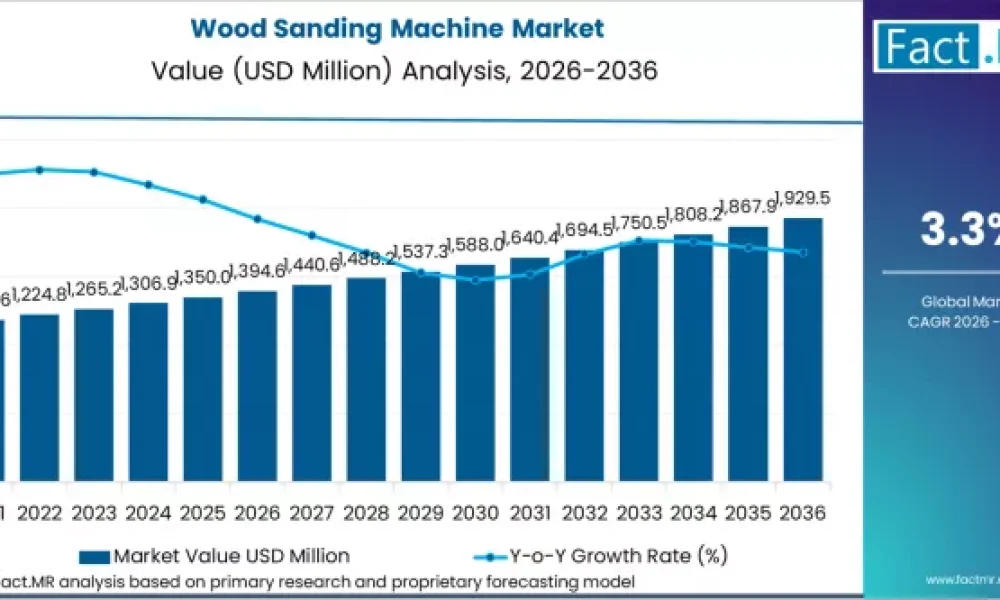
The global wood sanding machine market is entering a phase of disciplined, quality-led growth, transitioning from a secondary tooling category to a critical pillar of “process infrastructure.” Driven by the escalating costs of material rework and a surge in demand for high-end furniture finishes, the market is valued at USD 1,394.6 million in 2026 and is projected to reach USD 1,929.5 million, expanding at a steady 3.3% CAGR.
As the woodworking industry grapples with labor shortages and rising timber prices, the “Who, What, and How” of surface preparation has shifted toward automation. Industry leaders like Homag, SCM Group, Biesse, and Felder Group are currently deploying wide-belt and robotic sanding solutions that integrate AI-driven sensors to detect grain irregularities, effectively eliminating human error at the final stage of production.
Request for Sample Report | Customize Report |purchase Full Report – https://www.factmr.com/connectus/sample?flag=S&rep_id=11261
The Shift from Cosmetic Choice to Risk Management
In 2026, sanding is no longer viewed as a mere aesthetic preference but as a measurable business risk. For furniture manufacturers and architectural millworkers, a single finish defect can trigger costly rejects or warranty claims that erode increasingly thin margins.
“The commercial importance of sanding machines today is derived from surface consistency rather than raw material removal rates,” explains a senior industrial analyst. “As manufacturers move toward water-based finishes and high-gloss lacquers, the margin for error in the sanding phase has dropped to near zero. You aren’t just buying a machine; you’re buying rework avoidance.”
Key Market Drivers: Automation and Sustainability
The market’s 2026 momentum is underpinned by three transformative drivers:
- Industry 4.0 & Robotics: The adoption of robotic sanding work cells has increased by 15% year-over-year. These systems utilize force-torque feedback to apply uniform pressure, a task notoriously difficult to maintain manually over an eight-hour shift.
- Energy-Efficient Compliance: In line with EU Ecodesign Lot 5 Phase-2 enforcement, manufacturers are replacing high-power induction motors with IE5-class energy-efficient drives, reducing the carbon footprint of finishing lines by up to 22%.
- Dust Management Innovations: With stricter OSHA and international air quality standards, “smart” dust extraction systems that adjust airflow based on real-time particulate load have become a standard feature in high-volume belt sanders.
Regional Outlook and Competitive Landscape
North America remains the dominant regional market, commanding a 45.1% share valued at $0.5 billion. This is largely attributed to “reshoring” initiatives and industrial grants that encourage domestic furniture manufacturers to modernize their finishing lines.
Meanwhile, the Asia-Pacific region—specifically Vietnam and Indonesia—is emerging as the fastest-growing hub for industrial-scale wide-belt sanders. These nations are expanding their plywood and engineered wood capacities to serve a global middle class that increasingly prefers customized, ready-to-assemble (RTA) wooden furniture.
Future Outlook: The Rise of the Modular Sanding Line
As the market moves toward 2030, the trend is shifting toward modular machine designs. Instead of fixed-configuration units, manufacturers are investing in sanding platforms that can be retrofitted with different heads—such as cross-belts, planetary rollers, or brush units—allowing them to adapt to changing consumer preferences for “distressed” or “super-matte” textures without purchasing entirely new machinery.
Strategic Shifts: The Rise of Subscription-Based Surface Management
In a move toward “operational de-risking,” the 2026 market is witnessing a transition from traditional capital expenditure (CapEx) toward SaaS (Sanding-as-a-Service) and performance-based leasing. Manufacturers, particularly in Europe and Asia, are increasingly adopting subscription models that include predictive maintenance SLAs and guaranteed surface tolerances. This shift allows smaller woodworking shops to access high-end CNC sanding technology—such as the Heesemann LIGNA 2025 innovations—without the prohibitive upfront costs. By utilizing digital twin simulations to test process parameters before the first belt touches the wood, these facilities are achieving a level of “first-time-right” manufacturing that was once reserved for the aerospace and automotive sectors.
About the Woodworking Infrastructure Report: This summary provides an authoritative overview of the wood sanding machine sector, synthesizing 2026 market projections from leading industrial research firms. The data highlights the intersection of precision engineering, regulatory compliance, and digital manufacturing.
About Fact.MR
Fact.MR is a global market research and consulting firm, trusted by Fortune 500 companies and emerging businesses for reliable insights and strategic intelligence. With a presence across the U.S., UK, India, and Dubai, we deliver data-driven research and tailored consulting solutions across 30+ industries and 1,000+ markets. Backed by deep expertise and advanced analytics, Fact.MR helps organizations uncover opportunities, reduce risks, and make informed decisions for sustainable growth.



