
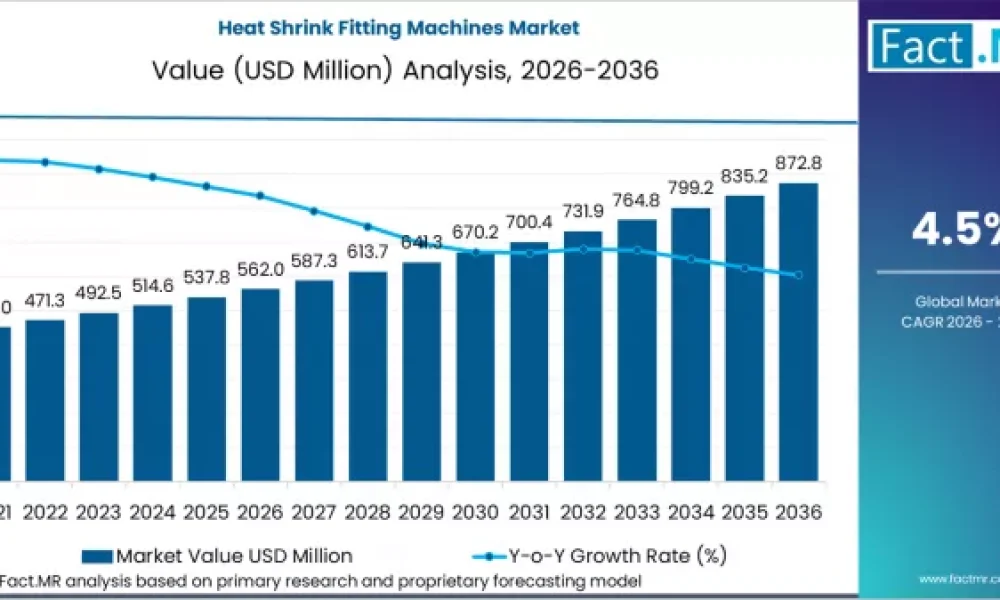
The global heat shrink fitting machines market is witnessing a period of strategic expansion, fueled by the aerospace and automotive industries’ urgent transition toward high-speed, high-precision manufacturing. Driven by the critical need for superior clamping force and minimal tool run-out, the market for shrink-fit technology—including both induction heating units and specialized toolholders—is projected to reach USD 562 million by the end of 2026, growing at a steady CAGR of 4.5% through 2036.
This growth marks a fundamental shift in the “Who, What, and How” of industrial assembly. Modern heat shrink fitting machines, which utilize electromagnetic induction to expand tool bores for interference-fit assembly, are rapidly replacing traditional collet chucks in smart factories. Leading manufacturers such as Sandvik Coromant, BIG Kaiser, Haimer, and Schunk are currently spearheading the integration of these systems into fully automated, AI-monitored production lines.
Request for Sample Report | Customize Report |purchase Full Report – https://www.factmr.com/connectus/sample?flag=S&rep_id=13900
The Engine of High-Speed Precision: Why Heat Shrink?
In an era where dimensional accuracy is non-negotiable, heat shrink fitting machines provide the only mechanical bond capable of maintaining near-zero run-out at spindle speeds exceeding 20,000 RPM. This precision is achieved through the physical principle of thermal expansion: the machine heats the toolholder, allowing for the effortless insertion of a cutting tool, which is then gripped with massive, uniform force as the holder rapidly cools and contracts.
Key operational benefits driving adoption in 2026 include:
- Extended Tool Life: Sintered toolholders created by shrink-fit machines increase cutting tool lifespan by an average of 60% by reducing vibration and uneven wear.
- Reduced Machining Time: Enhanced rigidity allows for more aggressive cutting parameters, leading to a 7.5% average reduction in cycle times for complex components.
- Sustainable Efficiency: Modern induction units utilize IGBT technology to target heat only where it is needed, reducing energy consumption and eliminating the need for hazardous gas flames or chemical lubricants.
Market Drivers: Aerospace, EVs, and the Smart Factory
The 2026 market surge is underpinned by three transformative industrial trends:
- Electrification of Transport: The production of Electric Vehicle (EV) components requires the machining of difficult-to-cut materials like aluminum alloys and composites. Shrink-fit holders provide the thermal stability and reach required for deep-cavity milling in motor housings and battery trays.
- Aerospace MRO Growth: As the global aviation fleet expands, Maintenance, Repair, and Overhaul (MRO) centers are adopting portable induction shrink-fitting units for the rapid assembly and disassembly of giant bearings, gears, and turbine shafts.
- Digital Twin Integration: New “connected” machines feature Ethernet-enabled data logging. Manufacturers can now monitor heating cycles and temperature uniformity in real-time, creating a digital audit trail that ensures every tool assembly meets aerospace-grade certification.
Regional Outlook: North America and Asia-Pacific Lead
North America remains the largest market for advanced toolholding systems, commanding a 35% share due to its mature aerospace sector and the widespread adoption of 5-axis machining centers. However, the Asia-Pacific region—specifically China, India, and Vietnam—is emerging as the fastest-growing geography. This expansion is fueled by massive investments in localized semiconductor manufacturing and the “China 2025” and “Make in India” initiatives, which prioritize high-end industrial automation.
Future Outlook: Toward Autonomous Tool Management
As the market moves toward 2030, the focus is shifting from stand-alone machines to Integrated Tool Management (ITM) ecosystems. By combining heat shrink fitting with robotic arms and laser-based presetting, the “dark factory” vision is becoming a reality. In these environments, tools are automatically shrunk, measured, and delivered to the CNC spindle without human intervention, maximizing uptime and eliminating the risk of metallurgical damage from manual overheating.
About the Heat Shrink Fitting Market Report: This summary provides an authoritative overview of the current strategic trends and growth metrics within the thermal assembly and toolholding sector. Data is synthesized from 2026 industrial forecasts, OEM production benchmarks, and global material science advancements.
About Fact.MR
Fact.MR is a global market research and consulting firm, trusted by Fortune 500 companies and emerging businesses for reliable insights and strategic intelligence. With a presence across the U.S., UK, India, and Dubai, we deliver data-driven research and tailored consulting solutions across 30+ industries and 1,000+ markets. Backed by deep expertise and advanced analytics, Fact.MR helps organizations uncover opportunities, reduce risks, and make informed decisions for sustainable growth.



