
Global Anti-Wrinkle Products Market Projected to Reach $13.8 Billion by 2026 Amid Surge in ‘Prejuvenation’ Trends
The global anti-wrinkle products market is undergoing a fundamental transformation, with its valuation projected to reach $13.8 billion by the end of 2026. Driven by a strategic shift from corrective treatments to early-intervention prejuvenation, the industry is expanding beyond its traditional senior demographic to capture a rapidly growing audience of Gen Z and Millennial consumers.
Recent data indicates that while the geriatric population remains a cornerstone of the market, approximately 43% of skincare users now initiate anti-aging regimens in their early 20s. This behavioral shift, combined with breakthroughs in biotechnology and a 7.5% projected compound annual growth rate (CAGR) through 2033, positions the anti-wrinkle sector as one of the most resilient segments within the global beauty and personal care industry.
Request for Sample Report | Customize Report |purchase Full Report – https://www.factmr.com/connectus/sample?flag=S&rep_id=13993
Market Dynamics: The Who, What, and Why
Who: Industry leaders like L’Oréal S.A., The Estée Lauder Companies, and Beiersdorf are pivoting toward high-performance, clinical-grade formulations. While women remain the primary consumer base, the male grooming segment is currently the fastest-growing demographic, expanding at a 6.7% CAGR.
What: The market is dominated by topical serums and concentrates, which held a 45.6% revenue share in 2024. These products are favored for their high concentrations of active ingredients like retinoids, peptides, and hyaluronic acid.
Where: Asia-Pacific has emerged as the largest regional market, commanding a 36.7% share. Rapid urbanization in China and India, coupled with a cultural emphasis on skin longevity, continues to outpace growth in North America and Europe.
Why: The convergence of an aging global population—expected to reach 2.1 billion people over age 60 by 2050—and heightened exposure to environmental exposome factors (UV radiation and pollution) is mandating more sophisticated skin-shielding solutions.
How: Innovation is being funneled through AI-driven diagnostics and DNA-based skincare, allowing brands to offer hyper-personalized regimens that improve efficacy and consumer trust.
Active Ingredients and Formulation Trends
The demand for clean beauty has forced a dual-track innovation path. While synthetic ingredients like stabilized retinol remain the gold standard for visible results, there is an accelerating move toward organic and plant-based alternatives.
Modern consumers are no longer satisfied with vague promises. They are demanding evidence-based results supported by clinical trials, notes a leading industry analyst. This has led to a surge in peptide-rich formulations and biotechnology-derived ingredients that offer the efficacy of traditional synthetics with a lower irritation profile.
Key Takeaways from Anti-Wrinkle Products Market
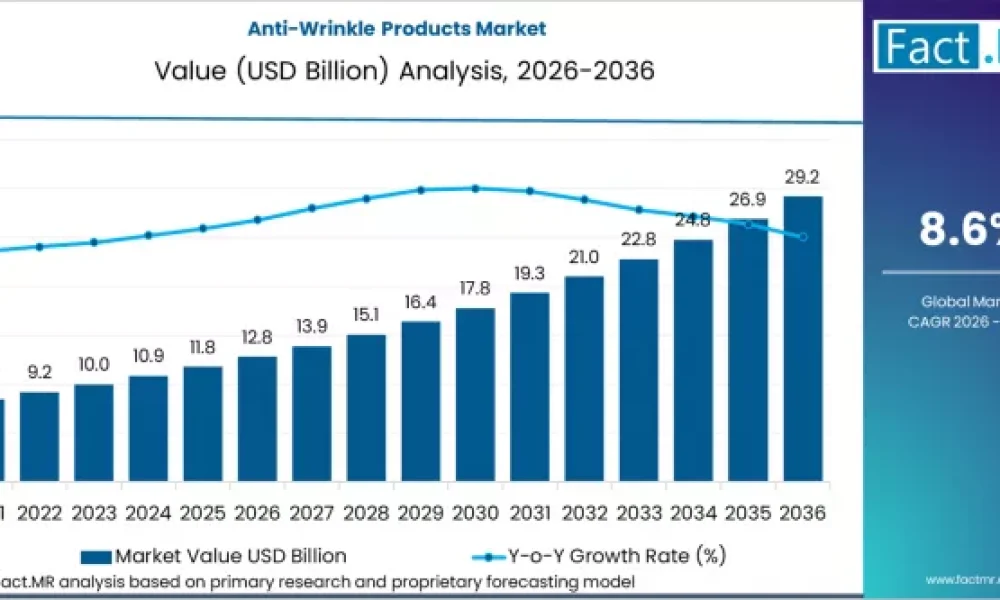
- Market Value (2026): USD 12.8 billion
- Market Forecast Value (2036): USD 29.2 billion
- Market Forecast CAGR: 8.6%
- Leading Product Type: Anti-Wrinkle Creams (46.8%)
- Leading Ingredient Type: Retinoids (34.2%)
- Growth Drivers: Rising demand for wrinkle reduction, improved skin firmness, and facial rejuvenation
- Key Growth Regions: China, India, Brazil, Germany, USA, UK, Japan
- Key Players: L’Oréal, Estée Lauder Companies, Procter and Gamble, Unilever, Beiersdorf, Shiseido Company, Johnson and Johnson, Amorepacific Corporation
Key Market Statistics and Forecasts
| Category | 2026 Projection | 2033 Forecast | Growth Driver |
| Market Value | $13.8 Billion | $26.3 Billion | Demographic Shifts |
| Dominant Segment | Serums/Concentrates | Serums/Concentrates | Targeted Efficacy |
| Leading Region | Asia-Pacific | Asia-Pacific | Middle-Class Expansion |
| Fastest Channel | E-commerce | E-commerce | AI Personalization |
Future Outlook: Personalization and Digital Integration
The next phase of market evolution will be defined by the omnichannel experience. Online sales are expected to grow at a 11.2% CAGR, bolstered by virtual consultations and subscription models that offer recurring revenue for premium brands. Furthermore, the implementation of the Modernization of Cosmetics Regulation Act (MoCRA) in the United States and stricter EU safety protocols are raising the bar for transparency, favoring established players with robust R&D capabilities.
As the industry moves toward 2036, the integration of ingestible beauty (nutricosmetics) and minimally invasive procedure extenders—products designed to maintain the effects of fillers and neurotoxins—will likely provide the next major frontier for expansion.
About the Industry Report:
This market analysis provides an exhaustive look at the anti-wrinkle products landscape, covering active ingredients, distribution channels, and regional growth vectors. It serves as a critical resource for investors, dermatologists, and beauty industry stakeholders navigating the complex $90+ billion broader anti-aging ecosystem.
Related Reports



