
Global Automotive Powertrain Market Set to Surpass $3.4 Trillion by 2033 as Electrification Reshapes Vehicle Architecture
The automotive sector enters a computational renaissance in 2026, driven by a 20% surge in EV market share and the rapid adoption of integrated e-axle technologies across North America, Europe, and Asia-Pacific.
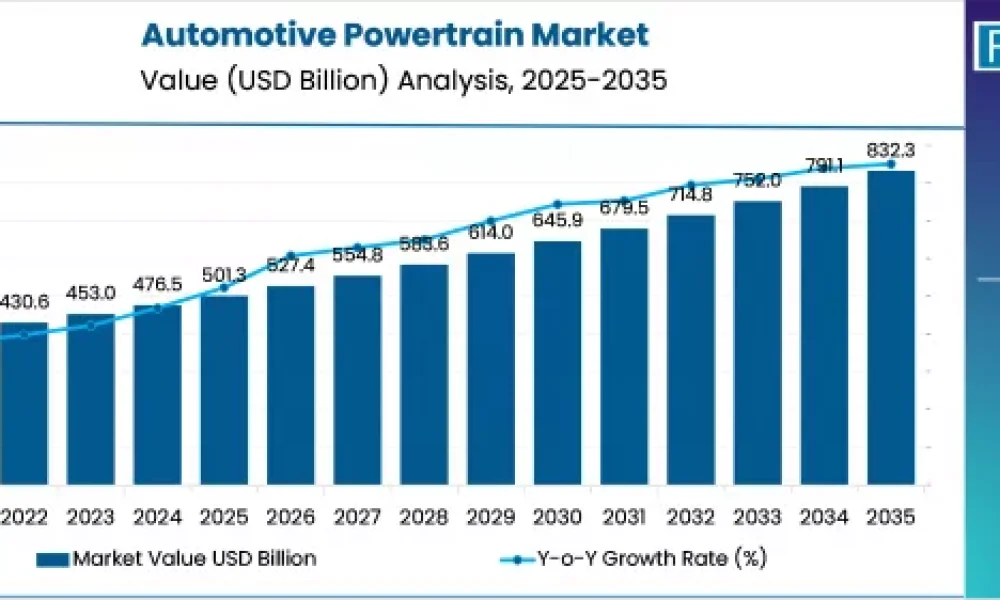
The global automotive powertrain market is undergoing its most significant transformation in a century. According to latest industry data, the market is projected to grow from $972.02 billion in 2025 to over $3.46 trillion by 2033, accelerating at a compound annual growth rate (CAGR) of 15.9%.
This growth is being fueled by a dual-track evolution: the refinement of high-efficiency Internal Combustion Engines (ICE) and a massive capital pivot toward electric vehicle (EV) platforms. As of 2026, battery-electric vehicles (BEVs) are no longer a niche segment, now accounting for nearly 20% of global vehicle sales.
The Strategic Shift: Who, What, and Why
The powertrain—traditionally the mechanical heart of a vehicle—is transitioning into a software-defined power domain. This shift is driven by:
Regulatory Mandates: Tightening CO2 targets in the EU and new EPA rules in the U.S. requiring a 55-mpg fleet average by 2026.
Technological Innovation: The rise of 800V-1200V architectures and wide-bandgap materials like Silicon Carbide (SiC), which reduce power losses by over 20%.
Market Leaders: Industry titans including BorgWarner, Robert Bosch GmbH, ZF Friedrichshafen, and Magna International are leading the transition toward integrated e-axles and modular drive units.
Request for Sample Report | Customize Report |purchase Full Report – https://www.factmr.com/connectus/sample?flag=S&rep_id=346
Market Segmentation and Key Growth Drivers
1. Electrification and Hybridization
While ICE systems still command a significant portion of the parc, the electric powertrain segment is the primary growth engine, expected to reach $715.9 billion by the end of 2026. Hybrid-electric models currently represent approximately 34.5% of the EU market, serving as a critical bridge for consumers navigating infrastructure gaps.
2. The Rise of Integrated E-Axles
The industry is moving away from fragmented sub-systems toward all-in-one e-axle designs. These power domains combine the motor, inverter, and transmission into a single unit, potentially cutting manufacturing costs by up to 30%.
3. Regional Dominance: Asia-Pacific and Europe
Asia-Pacific: Remains the largest market, contributing over 60% of global revenue, driven by China’s aggressive NEV (New Energy Vehicle) subsidies and India’s surging production.
Europe: Projected to see the highest CAGR through 2032 due to the EU’s commitment to a 55% reduction in greenhouse gas emissions by 2036.
Industry Insights: Challenges and Opportunities
Despite the bullish outlook, the market faces headwinds. High development costs—averaging $150 per kilowatt-hour for EV batteries—and supply chain volatility for rare-earth materials remain significant hurdles.
We are witnessing a radical shift from traditional linear value chains to fluid, intelligence-driven automotive ecosystems, states a leading industry analyst. The competitive advantage in 2026 no longer comes from horsepower alone, but from the ability to integrate computational insight into physical motion.
Table: Comparative Powertrain Growth Forecast (2025–2033)
| Segment | 2025 Market Share (Est.) | Projected CAGR | Primary Driver |
| ICE (Gasoline/Diesel) | 78% | 3.2% | Fleet Replacement & Emerging Markets |
| Electric (BEV/PHEV) | 22% | 15.9% | Regulatory Compliance & Battery Innovation |
| Commercial Vehicles | 12% | 11.7% | E-commerce Logistics & Urbanization |
Future Outlook: Beyond 2026
Looking ahead, the quiet revolution in chassis and materials will continue. Innovations in magnet-free motors and CO2-based heat pumps are expected to become standard, extending EV range by up to 20% in cold climates. As 5G connectivity and AI-driven diagnostics become embedded in the powertrain, the industry is moving toward a future of predictive maintenance and Vehicle-as-a-Service business models.
About the Automotive Powertrain Market Report
This press release is based on comprehensive market analysis covering global trends, technological breakthroughs, and regulatory shifts. For industry leaders and investors, the data underscores a clear mandate: adapt to the electrified, software-defined ecosystem or risk obsolescence in an increasingly competitive global landscape.
To View Related Report :
Automotive Powertrain Sensors Market https://www.factmr.com/report/automotive-powertrain-sensors-market



