
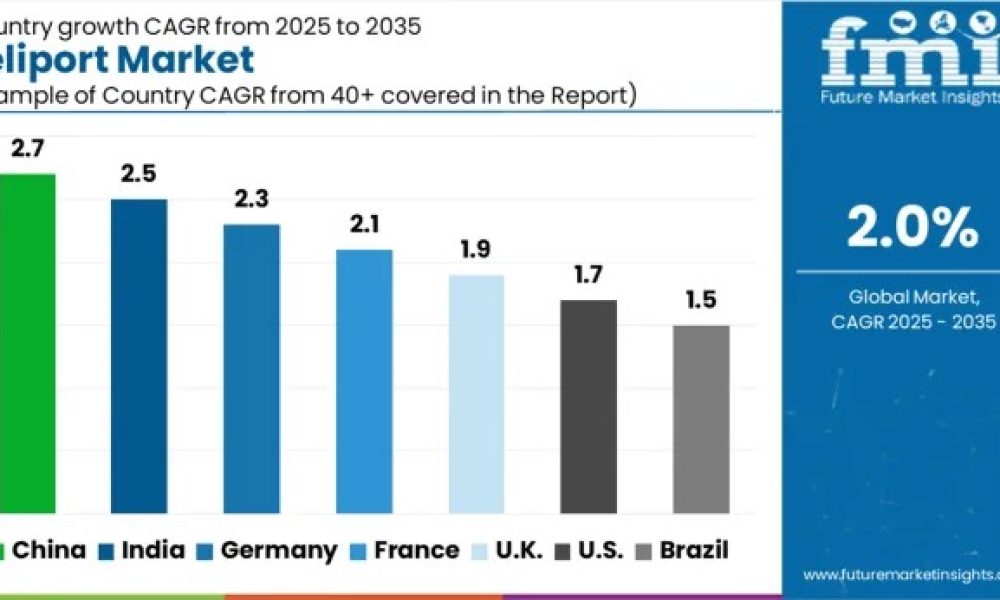
The global heliport market continues to chart a steady growth path, underpinned by rising demand for rapid-response air transport, expanding urban air mobility initiatives, and sustained investment in emergency medical and offshore aviation infrastructure. Valued at USD 73.6 million in 2025, the market is projected to reach USD 89.7 million by 2035, growing at a compound annual growth rate (CAGR) of 2.0% over the forecast period.
While growth remains modest compared with other aviation infrastructure segments, the heliport market reflects a structurally resilient demand profile driven by safety-critical operations, regulatory compliance, and long-term infrastructure planning. Heliports play a specialized yet indispensable role across commercial aviation, healthcare logistics, defense, offshore energy, and emerging urban air mobility ecosystems.
Asia-Pacific Emerges as the Fastest-Growing Region
Regionally, Asia-Pacific is positioned as the leading growth engine for the heliport market, supported by rapid urbanization, increasing helicopter fleet deployment, and proactive government initiatives to enhance air mobility infrastructure. Countries such as China and India, with forecast CAGRs of 2.7% and 2.5% respectively, are investing in heliport networks aligned with smart city programs, emergency medical services expansion, and tourism-driven aviation demand.
China’s growth is reinforced by rising commercial and corporate helicopter usage, expanding medical evacuation networks, and integration of heliports near metropolitan and industrial hubs. India’s trajectory is shaped by regional connectivity initiatives, public-private partnerships, and increasing reliance on helicopters for time-sensitive transport in densely populated urban centers and remote regions.
Europe is expected to maintain stable, regulation-driven expansion, led by Germany, France, and the United Kingdom. Growth in the region is closely tied to modernization of existing heliport facilities, compliance with stringent safety and environmental standards, and integration with multimodal urban transport systems. While regulatory rigor constrains rapid capacity additions, it also ensures consistent demand for high-quality, technologically advanced heliport infrastructure.
North America exhibits comparatively slower growth, with the United States forecast at a 1.7% CAGR. Market expansion in the region is primarily driven by private heliport installations, corporate aviation, offshore operations, and medical emergency networks. Mature infrastructure, land-use constraints, and regulatory oversight contribute to incremental rather than accelerated growth, despite high operational sophistication.
Get access to comprehensive data tables and detailed market insights — request your sample report today!
https://www.futuremarketinsights.com/reports/sample/rep-gb-25139
Market Position Within the Broader Aviation Ecosystem
Within the wider aviation infrastructure landscape, the heliport market represents approximately 3.8% of the airport and airfield infrastructure segment and 4.2% of the rotary-wing aircraft support market. Its relevance is particularly pronounced in urban air mobility and vertiport development (3.1%), emergency medical and disaster response services (3.5%), and defense and offshore oil and gas operations (3.0%).
This positioning underscores the heliport market’s strategic importance as a foundational enabler of vertical takeoff and landing (VTOL) operations, supporting both traditional helicopter traffic and future eVTOL deployment.
Surface-Level and Small Heliports Dominate Market Structure
By type, surface-level heliports account for 39.4% of global market revenue in 2025, maintaining leadership due to their cost efficiency, operational flexibility, and ease of regulatory approval. These heliports offer faster construction timelines, simplified maintenance, and adaptability across urban, rural, and remote environments—making them particularly suitable for emergency services and regional transport.
From a capacity perspective, small heliports represent the largest segment with a 46.8% revenue share. Designed for single or limited-bay operations, small heliports align with the practical requirements of medical evacuation, tourism, and corporate transport. Their lower capital expenditure, reduced spatial footprint, and faster deployment cycles support widespread adoption, particularly in hospitals, industrial sites, and underserved regions.
Medical End-Use Anchors Demand Stability
By end-use, the medical segment leads with a 33.7% market share in 2025, highlighting the heliport market’s critical role in healthcare logistics. Hospital-based heliports and dedicated medical landing sites are expanding globally to support air ambulance services, organ transport, and disaster response operations. Data from emergency services consistently demonstrate that helicopter-based evacuation significantly reduces response times and improves patient outcomes, reinforcing sustained infrastructure investment in this segment.
Technology and Digital Integration Redefine Heliport Design
Recent developments in the heliport market emphasize modular construction, digitalization, and safety enhancement. Prefabricated heliport pads, lightweight composite materials, automated lighting systems, and advanced navigation aids are reducing construction time while improving operational reliability. Integration with real-time monitoring platforms, weather systems, and helicopter traffic management software is further enhancing safety compliance and throughput efficiency.
As urban air mobility concepts evolve, heliports are increasingly designed with multi-use functionality, supporting emergency response, cargo handling, passenger services, and future eVTOL operations within a single infrastructure footprint.
Drive Your Business Growth Strategy: Checkout the Report for Key Insights
https://www.futuremarketinsights.com/checkout/25139
Competitive Landscape Driven by Engineering Expertise
The global heliport market is led by specialized infrastructure developers and system integrators focused on safety, automation, and regulatory compliance. Key players include Cavotec SA, FEC HELIPORTS, Aluminium Offshore Pte Ltd., Calzoni, Eaton Corporation Plc., Heliport Systems Inc., and Technokontrol Global Ltd. These companies differentiate through turnkey solutions, advanced mechanical and electrical systems, and integrated monitoring technologies that address the evolving operational demands of heliport operators worldwide.
Outlook: Measured Growth with Strategic Importance
Looking ahead to 2035, the heliport market is expected to remain a low-growth but high-importance infrastructure segment, anchored by essential services and long-term aviation planning. Incremental expansion in Asia-Pacific, continued modernization in Europe, and steady replacement and optimization in North America will define the market’s trajectory.
As cities, healthcare systems, and aviation operators prioritize speed, accessibility, and safety, heliports will remain a critical enabler of vertical air transport. Stakeholders seeking a deeper understanding of regional dynamics, segment-level opportunities, and competitive positioning can explore the full market report for comprehensive insights and forward-looking analysis.
Why Choose FMI: Empowering Decisions that Drive Real-World Outcomes: https://www.futuremarketinsights.com/why-fmi
About Future Market Insights (FMI)
Future Market Insights, Inc. (FMI) is an ESOMAR-certified, ISO 9001:2015 market research and consulting organization, trusted by Fortune 500 clients and global enterprises. With operations in the U.S., UK, India, and Dubai, FMI provides data-backed insights and strategic intelligence across 30+ industries and 1200 markets worldwide.



