
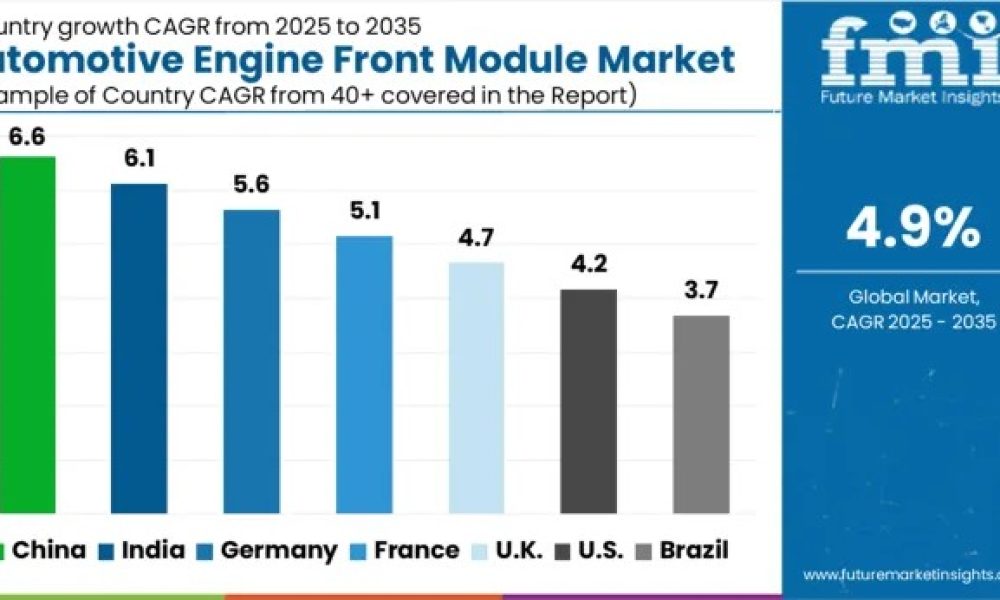
The global automotive engine front module market is entering a sustained expansion phase, projected to grow from USD 137.5 billion in 2025 to USD 221.9 billion by 2035, creating an absolute dollar opportunity of USD 84.4 billion over the forecast period. This growth reflects the increasing strategic importance of integrated front-end assemblies in modern vehicle architectures, where engine front modules (EFMs) play a critical role in structural integrity, crash performance, thermal management, and system integration.
Engine front modules have evolved from discrete component carriers into highly engineered systems that integrate radiators, air-conditioning condensers, cooling fans, lighting elements, grilles, and crash management structures. This shift toward modular front-end solutions is being driven by OEM priorities around manufacturing efficiency, weight optimization, regulatory compliance, and platform standardization. As vehicle programs scale globally, modular EFMs reduce assembly complexity, shorten production cycles, and improve quality consistency across regions.
Integrated Design Driving Long-Term Market Stability
The market’s forecast CAGR of 4.9% between 2025 and 2035 is supported by steady vehicle production growth, particularly in mid-range and premium passenger vehicles where performance, safety, and thermal efficiency requirements are more demanding. Unlike highly cyclical automotive subsystems, engine front modules benefit from their deep integration into vehicle design, making demand less sensitive to short-term production volatility.
Get access to comprehensive data tables and detailed market insights — request your sample report today!
https://www.futuremarketinsights.com/reports/sample/rep-gb-25275
From 2030 onward, growth momentum is expected to strengthen further as electric and hybrid vehicle platforms increasingly adopt advanced front-end module designs. While electric vehicles eliminate conventional engines, they intensify requirements for battery cooling, power electronics thermal management, airflow optimization, and crash protection, reinforcing the relevance of EFMs in next-generation architectures.
Radiators Anchor Component Demand Within Modular Assemblies
By component, the radiator segment is projected to account for 29.7% of total market revenue in 2025, maintaining its position as the largest contributor within engine front modules. Radiators remain central to vehicle thermal management, supporting both internal combustion and electrified powertrains. Increasing engine power density, higher operating temperatures, and tighter packaging constraints are driving OEMs to adopt advanced radiator designs with improved heat dissipation and corrosion resistance.
Radiators also act as the structural and functional anchor within modular front-end assemblies, around which condensers, cooling fans, and airflow systems are integrated. Continuous improvements in fin geometry, coolant flow optimization, and lightweight materials are sustaining the segment’s leadership despite growing electrification.
Passenger Vehicles Dominate Volume, EVs Shape Future Designs
Passenger vehicles are expected to represent 56.3% of engine front module demand in 2025, reflecting high global production volumes and rising consumer expectations for safety, comfort, and efficiency. OEMs are increasingly deploying integrated front modules to reduce vehicle weight, enhance aerodynamics, and meet stringent emissions and crash regulations.
At the same time, the rapid expansion of electric and hybrid passenger vehicles is reshaping design priorities. EFMs for EV platforms emphasize compact packaging, enhanced airflow management, and multi-zone cooling, enabling efficient thermal control for batteries and power electronics. This transition is increasing the engineering value per module, even as automakers pursue cost optimization.
Metal Remains the Dominant Material Amid Lightweight Innovation
By material, metal-based engine front modules are projected to account for 59.1% of market revenue in 2025, supported by their superior structural strength, impact resistance, and thermal conductivity. Metals continue to offer reliability in crash-critical zones and compatibility with high-volume manufacturing processes.
While composites and plastics are gaining traction for selective weight reduction, advances in lightweight metal alloys are allowing suppliers to balance mass reduction with durability and recyclability. This positions metals as the preferred choice for applications where safety performance and long service life remain paramount.
Asia Leads Growth as Modular Platforms Scale Globally
Regionally, Asia-Pacific is emerging as the primary growth engine, supported by strong vehicle production in China and India. China is projected to grow at a 6.6% CAGR, driven by domestic OEM investment in modular vehicle platforms and accelerating EV adoption. India follows closely at 6.1% CAGR, supported by rising demand for compact and mid-size vehicles, cost-efficient manufacturing, and increasing regulatory focus on safety and efficiency.
Europe and North America continue to play a critical role in premium vehicle programs and advanced module technologies, with Germany, France, the UK, and the United States emphasizing lightweight materials, emissions compliance, and crash-optimized designs.
Drive Your Business Growth Strategy: Checkout the Report for Key Insights
https://www.futuremarketinsights.com/reports/automotive-engine-front-module-market
Competitive Landscape Favors Integrated System Suppliers
The competitive environment is characterized by suppliers with strong engineering depth, materials expertise, and proximity to OEM assembly plants. Leading companies including Magna, Hyundai Mobis, Denso, Aisin Seiki, Valeo, Mahle, Bosch, Hella, Grupo Antolin, and Magneti Marelli are leveraging modular architectures, advanced materials, and scalable manufacturing to strengthen long-term OEM relationships.
Competitive differentiation increasingly depends on the ability to deliver lightweight, crash-resistant, and multifunctional front modules that integrate thermal management, aerodynamics, and safety systems within a single assembly. Strategic partnerships, platform participation, and investments in EV-specific front-end solutions are shaping supplier positioning.
Outlook: Engine Front Modules as a Core Vehicle Architecture Element
As automotive design continues to evolve toward electrification, modularization, and efficiency-driven engineering, engine front modules are becoming a core architectural element rather than a peripheral component group. Their role in balancing safety, performance, thermal control, and manufacturability positions the market for long-term structural growth.
With a strong USD 84.4 billion absolute opportunity through 2035, the automotive engine front module market is set to remain a critical focus area for OEMs and suppliers navigating the next decade of vehicle platform transformation.
Why Choose FMI: Empowering Decisions that Drive Real-World Outcomes: https://www.futuremarketinsights.com/why-fmi
About Future Market Insights (FMI)
Future Market Insights, Inc. (FMI) is an ESOMAR-certified, ISO 9001:2015 market research and consulting organization, trusted by Fortune 500 clients and global enterprises. With operations in the U.S., UK, India, and Dubai, FMI provides data-backed insights and strategic intelligence across 30+ industries and 1200 markets worldwide.



